National Income Accounting
CBSE · Class 12 · Economics
Summary of National Income Accounting for CBSE Class 12 Economics. Key concepts, important points, and chapter overview.
Interactive on Super Tutor
Studying National Income Accounting? Get the full interactive chapter.
Quizzes, flashcards, AI doubt-solver and a step-by-step study plan — built for chapter summary and more.
1,000+ Class 12 students started this chapter today
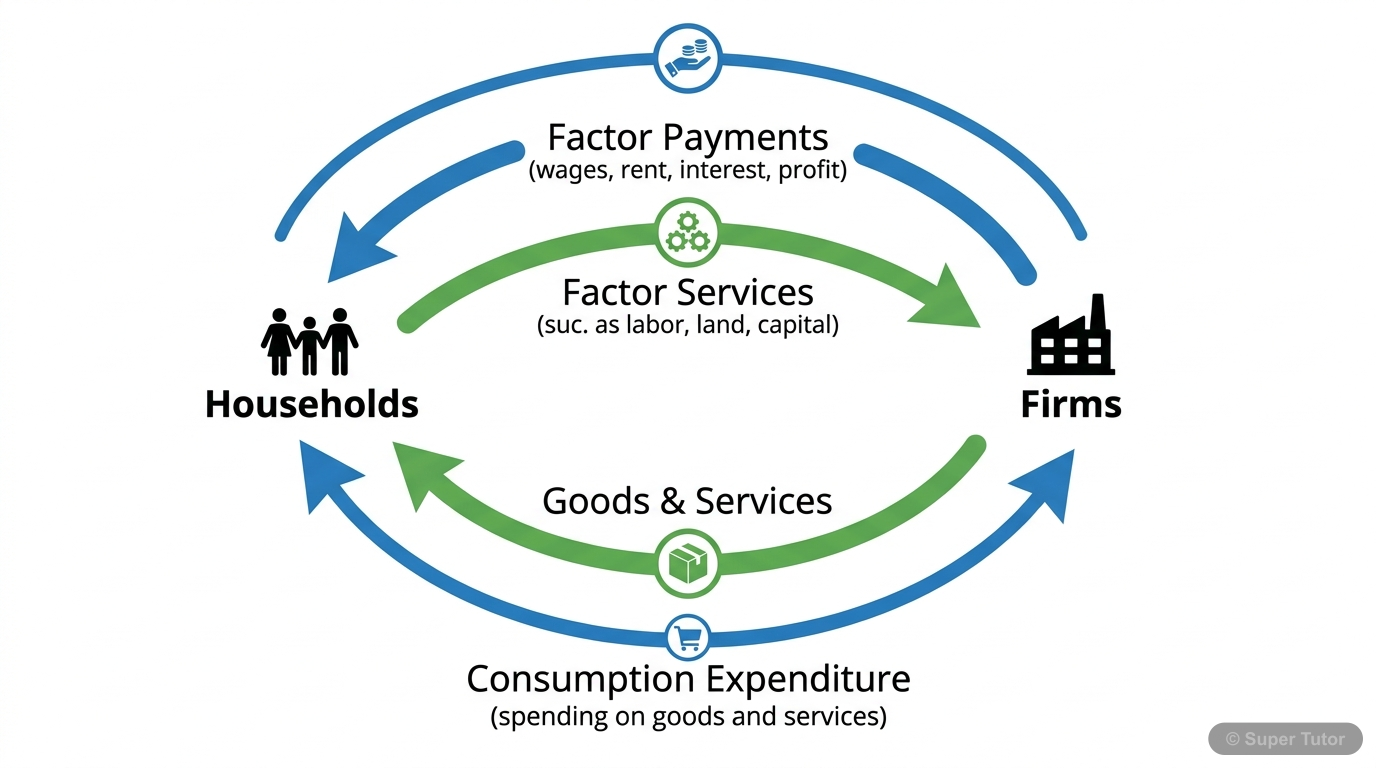
Learn better with visuals Super Tutor has hundreds of illustrations like this across every chapter — all free to try.
Get startedOverview
National income accounting studies how production, income, and expenditure are measured in an economy. The chapter builds the idea of a circular flow between firms and households, explains how GDP is calculated by three methods, and shows how national income aggregates are derived from GDP. It also
Key Concepts
A final good is meant
A final good is meant for final use and does not pass through further stages of production. Intermediate goods are raw materials or inputs used in pro
Flows are measured over a period
Flows are measured over a period of time, such as annual income or output. Stocks are measured at a particular point of time, such as capital stock or
Value added of a firm equals
Value added of a firm equals the value of production minus the value of intermediate goods used. It is the net contribution of a firm to total output
Gross Value Added includes depreciation
Gross Value Added includes depreciation, while Net Value Added excludes depreciation. Depreciation is the annual allowance for wear and tear of capita
In economics
In economics, investment means capital formation. Gross investment is total capital goods produced, and net investment equals gross investment minus d
Learning Objectives
- Understand the meaning of final goods, intermediate goods, value added, stock and flow variables, and depreciation.
- Explain the circular flow of income in a simple economy with households and firms.
- Calculate GDP using the product method, expenditure method, and income method.
- Distinguish between GDP, GNP, NNP, National Income, Personal Income, and Personal Disposable Income.
- Differentiate factor cost, basic prices, and market prices.
Frequently Asked Questions
What are the important topics in National Income Accounting for CBSE Class 12 Economics?
How to score full marks in National Income Accounting — CBSE Class 12 Economics?
Sources & Official References
- NCERT Official — ncert.nic.in
- CBSE Academic — cbseacademic.nic.in
- CBSE Official — cbse.gov.in
- National Education Policy 2020 — education.gov.in
Content is aligned to the official syllabus. Refer to the board website for the latest curriculum.
More resources for National Income Accounting
Practice Quiz
Test yourself with a quick quiz
Important Questions
Practice with board exam-style questions
Revision Notes
Key points for last-minute revision
Formula Sheet
All formulas in one place
Concept Maps
See how topics connect visually
Study Plan
Step-by-step plan to ace this chapter
Flashcards
Quick-fire cards for active recall
Syllabus
What topics to cover
NCERT Solutions
Every textbook question solved step by step
For serious students
Get the full National Income Accounting chapter — for free.
Quizzes, flashcards, AI doubt-solver and a step-by-step study plan for CBSE Class 12 Economics.