The Theory of the Firm Under Perfect Competition
CBSE · Class 12 · Economics
Summary of The Theory of the Firm Under Perfect Competition for CBSE Class 12 Economics. Key concepts, important points, and chapter overview.
Interactive on Super Tutor
Studying The Theory of the Firm Under Perfect Competition? Get the full interactive chapter.
Quizzes, flashcards, AI doubt-solver and a step-by-step study plan — built for chapter summary and more.
1,000+ Class 12 students started this chapter today
Learn better with visuals Super Tutor has hundreds of illustrations like this across every chapter — all free to try.
Get startedOverview
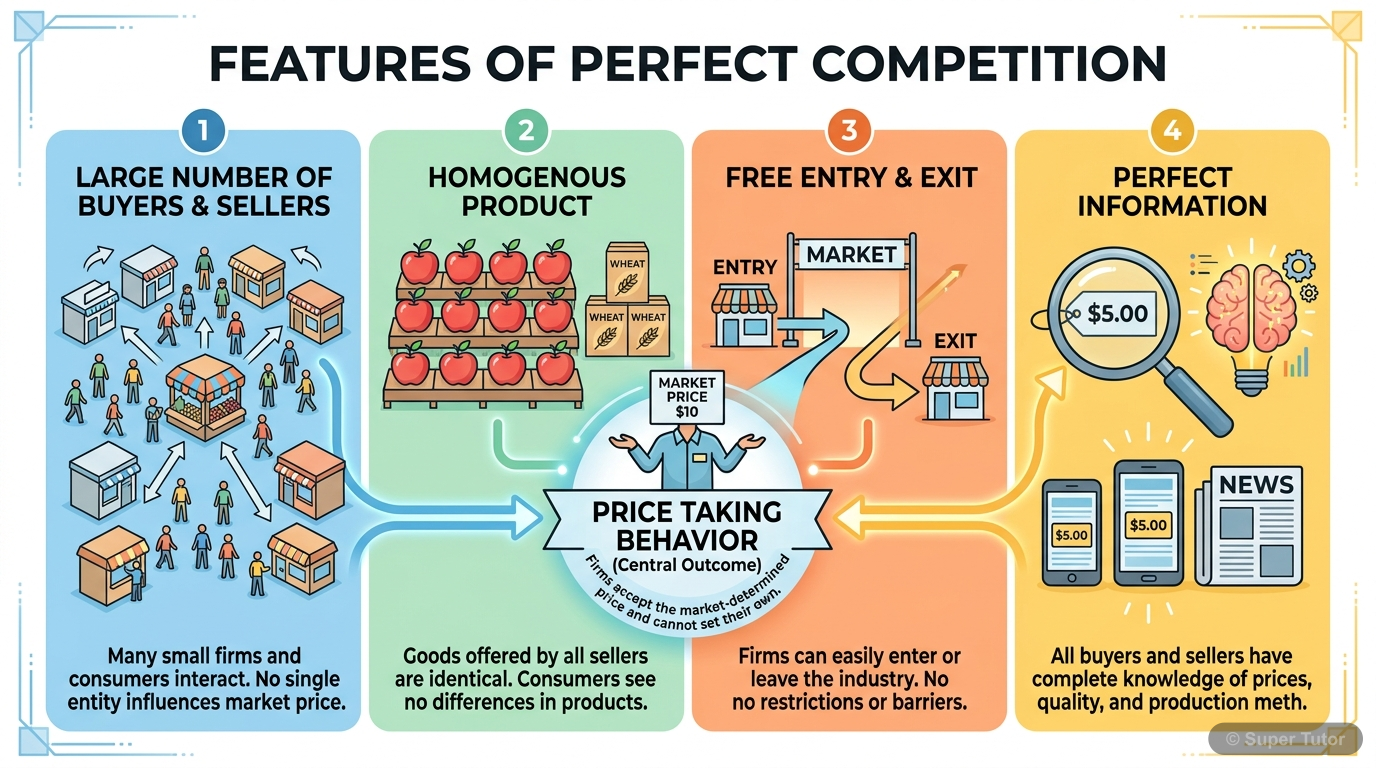
Perfect competition creates a market setting in which a firm behaves as a price taker and decides output by comparing revenue with cost. A firm is assumed to be a ruthless profit maximiser, so output is chosen where profit is highest. The chapter connects profit maximisation, revenue concepts, suppl
Key Concepts
A perfectly competitive market has
A perfectly competitive market has a large number of buyers and sellers, homogenous products, free entry and exit, and perfect information. These feat
A price
A price-taking firm accepts the market price as given. If it charges above market price, it cannot sell anything. If it charges at or below market pri
Total revenue is the money earned
Total revenue is the money earned from sales and is given by TR = p × q, where p is market price and q is quantity sold.
Average revenue is TR per unit
Average revenue is TR per unit of output. For a price-taking firm, AR = TR/q = p.
Marginal revenue is the increase
Marginal revenue is the increase in total revenue from selling one more unit. For a perfectly competitive firm, MR = p.
Learning Objectives
- Understand the defining features of perfect competition
- Explain why a perfectly competitive firm is a price taker
- Define and use total revenue, average revenue, and marginal revenue
- Apply the rule profit is maximised where MR equals MC
- Identify the short run shut down point and the long run shut down point
Frequently Asked Questions
What are the important topics in The Theory of the Firm Under Perfect Competition for CBSE Class 12 Economics?
How to score full marks in The Theory of the Firm Under Perfect Competition — CBSE Class 12 Economics?
Sources & Official References
- NCERT Official — ncert.nic.in
- CBSE Academic — cbseacademic.nic.in
- CBSE Official — cbse.gov.in
- National Education Policy 2020 — education.gov.in
Content is aligned to the official syllabus. Refer to the board website for the latest curriculum.
More resources for The Theory of the Firm Under Perfect Competition
Practice Quiz
Test yourself with a quick quiz
Important Questions
Practice with board exam-style questions
Revision Notes
Key points for last-minute revision
Formula Sheet
All formulas in one place
Concept Maps
See how topics connect visually
Study Plan
Step-by-step plan to ace this chapter
Flashcards
Quick-fire cards for active recall
Syllabus
What topics to cover
NCERT Solutions
Every textbook question solved step by step
For serious students
Get the full The Theory of the Firm Under Perfect Competition chapter — for free.
Quizzes, flashcards, AI doubt-solver and a step-by-step study plan for CBSE Class 12 Economics.