Government Budget and the Economy
CBSE · Class 12 · Economics
NCERT Solutions for Government Budget and the Economy — CBSE Class 12 Economics.
Interactive on Super Tutor
Studying Government Budget and the Economy? Get the full interactive chapter.
Quizzes, flashcards, AI doubt-solver and a step-by-step study plan — built for ncert solutions and more.
1,000+ Class 12 students started this chapter today
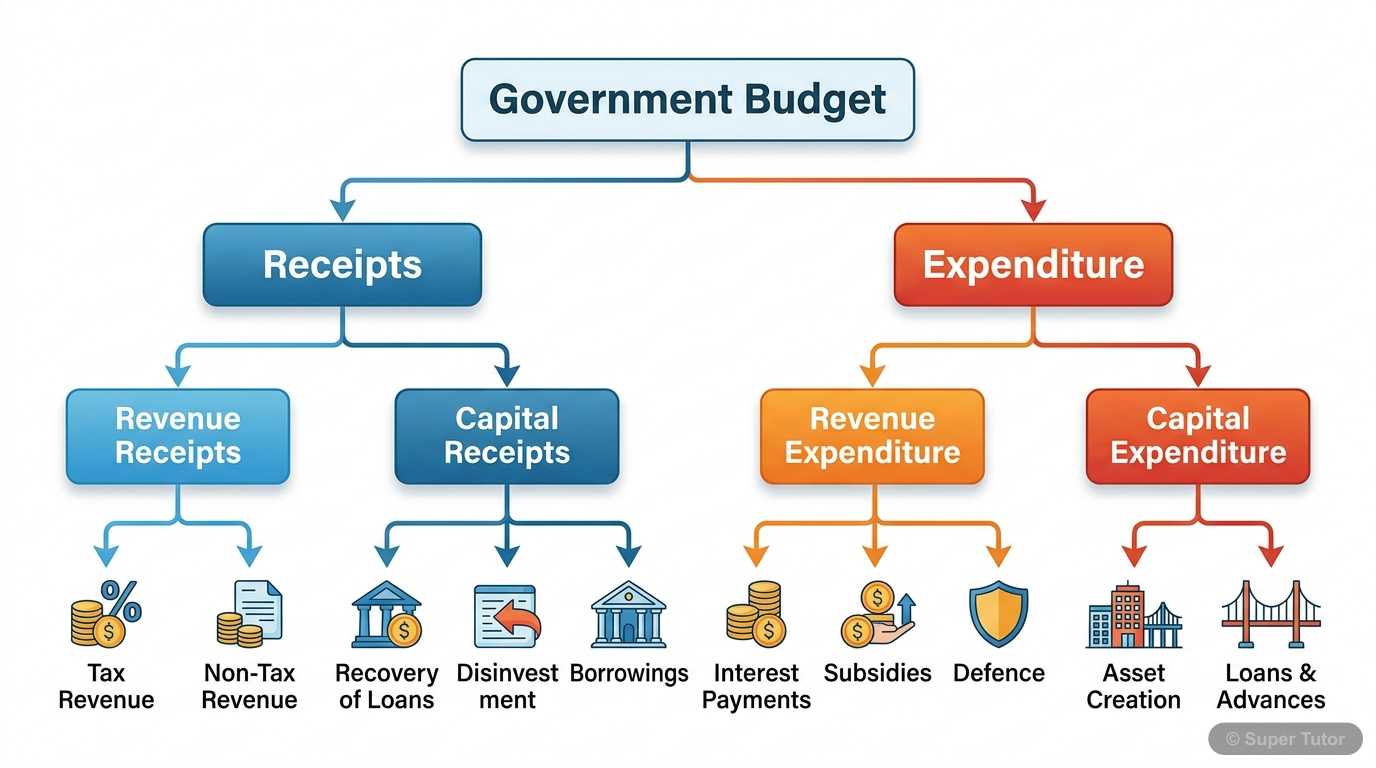
Super Tutor has 11+ illustrations like this for Government Budget and the Economy alone — flashcards, concept maps, and step-by-step visuals.
See them allGovernment Budget and the Economy — Exercises
1Explain why public goods must be provided by the government.Show solution
Explanation:
1. Non-rivalry: One person's consumption of a public good does not reduce the amount available for others. For example, one person enjoying street lighting does not reduce the light available to others.
2. Non-excludability: It is not feasible to exclude anyone from enjoying the benefits of a public good once it is provided. For example, once a dam is built for flood control, it protects everyone in the area regardless of whether they paid for it.
Why private enterprise will not provide them:
- Because of non-excludability, it is impossible to charge a fee (price) for the use of public goods. Anyone can enjoy the good without paying — this is called the free-rider problem.
- Since private firms cannot recover their costs through user charges, they have no profit incentive to produce public goods.
- As a result, the market fails to provide public goods, or provides them in insufficient quantities.
Conclusion: Since private markets fail to provide public goods due to the free-rider problem arising from non-excludability and non-rivalry, the government must step in and provide these goods, financing them through tax revenues. Examples include national defence, street lighting, and public parks.
2Distinguish between revenue expenditure and capital expenditure.Show solution
| Basis | Revenue Expenditure | Capital Expenditure |
|---|---|---|
| Meaning | Expenditure that does not result in the creation of assets or reduction of liabilities | Expenditure that results in creation of assets or reduction of liabilities |
| Nature | Recurring/regular in nature | Non-recurring/one-time in nature |
| Effect on assets | Does not create any physical or financial asset for the government | Creates physical or financial assets for the government |
| Examples | Salaries of government employees, interest payments on past debt, subsidies, pensions | Construction of roads, bridges, schools; purchase of machinery; loans given to states |
| Budget head | Shown in the Revenue Budget | Shown in the Capital Budget |
| Impact | Meets current/day-to-day operational needs | Adds to the productive capacity of the economy |
Key Point: When revenue expenditure exceeds revenue receipts, it results in a revenue deficit, which is considered undesirable because it means the government is borrowing even to meet its day-to-day expenses, leaving nothing for capital formation.
3'The fiscal deficit gives the borrowing requirement of the government'. Elucidate.Show solution
Or equivalently:
Explanation:
The fiscal deficit measures the gap between the government's total expenditure and its total non-borrowed receipts (i.e., revenue receipts + non-debt capital receipts like disinvestment proceeds).
- Total receipts of the government consist of: (i) Revenue receipts (taxes + non-tax revenue), (ii) Capital receipts (borrowings + non-debt capital receipts).
- When total expenditure exceeds total receipts excluding borrowings, the government must borrow to finance this gap.
- Therefore, the fiscal deficit equals exactly the amount the government needs to borrow from all sources — the public (through bonds/securities), the Reserve Bank of India, and external sources.
Conclusion: Since fiscal deficit = total expenditure − total non-borrowed receipts, it directly indicates how much the government must borrow to finance its expenditure. Hence, fiscal deficit is equivalent to the net borrowing requirement of the government. A higher fiscal deficit implies higher government borrowing, which can crowd out private investment and increase public debt.
4Give the relationship between the revenue deficit and the fiscal deficit.Show solution
Relationship:
Fiscal deficit can be decomposed as:
This shows that:
- Revenue deficit is a component of fiscal deficit. Every rupee of revenue deficit contributes to the fiscal deficit.
- If the revenue deficit is zero (i.e., revenue receipts fully cover revenue expenditure), the fiscal deficit arises only due to capital expenditure not covered by non-debt capital receipts.
- A rising ratio of revenue deficit to fiscal deficit indicates that a larger share of borrowings is being used to meet current consumption expenditure rather than capital investment — this is a sign of deteriorating quality of government expenditure.
Key Insight: A fiscal deficit accompanied by a high revenue deficit is more harmful because it means borrowed funds are being used for consumption rather than asset creation, reducing future growth potential.
5Suppose that for a particular economy, investment is equal to 200, government purchases are 150, net taxes (lump-sum taxes minus transfers) is 100 and consumption is given by . (a) What is the level of equilibrium income? (b) Calculate the value of the government expenditure multiplier and the tax multiplier. (c) If government expenditure increases by 200, find the change in equilibrium income.Show solution
-
-
- (net lump-sum taxes, i.e., taxes minus transfers)
- , where
- Marginal Propensity to Consume,
Part (a): Equilibrium Income
Disposable income:
Consumption:
Equilibrium condition:
Part (b): Multipliers
Government Expenditure Multiplier:
Tax Multiplier:
Part (c): Change in Equilibrium Income when
The equilibrium income increases by 800, from 1500 to 2300.
6Consider an economy described by the following functions: , , , . (a) Find the equilibrium level of income and the autonomous expenditure multiplier in the model. (b) If government expenditure increases by 30, what is the impact on equilibrium income? (c) If a lump-sum tax of 30 is added to pay for the increase in government purchases, how will equilibrium income change?Show solution
- (Note: Here consumption depends on directly, implying no taxes initially; = transfers)
- , ,
- (MPC)
Note: Since (transfers) are given and the consumption function is , we interpret this as: (no lump-sum taxes initially), so .
Thus:
Part (a): Equilibrium Income
Autonomous Expenditure Multiplier:
Part (b): Impact of
Equilibrium income increases by 150 (from 900 to 1050).
Part (c): Balanced Budget — and (new lump-sum tax)
When a lump-sum tax is introduced:
- Effect of :
- Effect of :
Net change in income:
This illustrates the Balanced Budget Multiplier = 1: when government expenditure and taxes both increase by the same amount, equilibrium income increases by exactly that amount ().
7In the above question (Q.6), calculate the effect on output of a 10 per cent increase in transfers, and a 10 per cent increase in lump-sum taxes. Compare the effects of the two.Show solution
- , , (lump-sum tax introduced in Q.6c)
- Multiplier
Effect of 10% increase in Transfers ():
The transfer multiplier is:
Equilibrium income increases by 40.
Effect of 10% increase in Lump-sum Taxes ():
The tax multiplier is:
Equilibrium income decreases by 12.
Comparison:
| | Change in TR (+10) | Change in T (+3) |
|---|---|---|
| Multiplier | | |
| | | |
| Direction | Expansionary | Contractionary |
- Both the transfer multiplier and the tax multiplier have the same absolute value (), but they work in opposite directions.
- An increase in transfers raises income (as it increases disposable income and hence consumption), while an increase in taxes reduces income.
- The magnitudes differ here only because the base values of and are different (, ), so a 10% change in each gives different absolute changes.
8We suppose that , , , . (a) Find the equilibrium income. (b) What are tax revenues at equilibrium income? Does the government have a balanced budget?Show solution
-
- ,
- (proportional income tax, )
- No transfers mentioned, so
-
Part (a): Equilibrium Income
Equilibrium condition:
Part (b): Tax Revenues and Balanced Budget
Government Expenditure
Tax Revenue
Since G = 100 > T \approx 70.27, the government has a budget deficit of approximately .
The government does NOT have a balanced budget. Government expenditure exceeds tax revenues, resulting in a fiscal deficit of approximately 29.73.
9Suppose marginal propensity to consume is 0.75 and there is a 20 per cent proportional income tax. Find the change in equilibrium income for the following: (a) Government purchases increase by 20. (b) Transfers decrease by 20.Show solution
- (MPC)
- (proportional income tax rate)
- With proportional tax:
Multiplier with proportional tax:
Part (a): Government purchases increase by 20 ()
Equilibrium income increases by 50.
Part (b): Transfers decrease by 20 ()
The transfer multiplier with proportional tax:
Equilibrium income decreases by 37.5.
Summary:
- Increase in by 20 →
- Decrease in by 20 →
10Explain why the tax multiplier is smaller in absolute value than the government expenditure multiplier.Show solution
Tax Multiplier:
Comparison:
Since 0 < c < 1, we have c < 1, therefore:
\frac{c}{1-c} < \frac{1}{1-c}
\Rightarrow |\alpha_T| < |\alpha_G|
Economic Reasoning:
1. Government expenditure is a direct injection into the income stream. When the government spends ₹1, it directly adds ₹1 to aggregate demand, which then gets multiplied through successive rounds of consumption spending.
2. A tax cut (or tax increase) affects income indirectly — it first changes disposable income, and only a fraction of that change is spent on consumption. The remaining fraction is saved and does not contribute to aggregate demand.
3. Therefore, a ₹1 increase in government spending has a larger initial impact on aggregate demand than a ₹1 reduction in taxes (which only increases spending by c \times 1 = c < 1).
Conclusion: The tax multiplier is smaller in absolute value than the government expenditure multiplier by a factor of , because tax changes affect aggregate demand only through the consumption channel, whereas government expenditure directly adds to aggregate demand.
11Explain the relation between government deficit and government debt.Show solution
The government deficit (fiscal deficit) is the excess of government expenditure over its non-borrowed receipts in a given year.
Government Debt:
Government debt (public debt) is the accumulated stock of all past borrowings of the government that remain outstanding.
Relationship:
1. Flow vs. Stock: Deficit is a flow concept (measured over a period, e.g., one year), while debt is a stock concept (measured at a point in time).
2. Deficit adds to Debt: Every year's fiscal deficit must be financed by borrowing. These borrowings add to the existing stock of government debt:
3. Debt creates future deficits: The accumulated debt requires interest payments. These interest payments are part of revenue expenditure, which can themselves contribute to future deficits — creating a vicious cycle.
4. Debt-to-GDP ratio: If the economy grows faster than the rate at which debt accumulates, the debt-to-GDP ratio may fall even if there are deficits. But persistent large deficits lead to a rising debt-to-GDP ratio, which is fiscally unsustainable.
Conclusion: Government deficit and government debt are closely linked — deficits are the annual additions to the stock of debt. Persistent deficits lead to an ever-growing debt burden, increasing interest obligations and potentially crowding out productive expenditure.
12Does public debt impose a burden? Explain.Show solution
View 1: Public Debt is NOT a Burden (Traditional/Internal Debt View)
- If the debt is internal (borrowed from citizens of the same country), it is argued that 'we owe it to ourselves.' The government pays interest to domestic bondholders, which is merely a transfer within the economy.
- No net burden is imposed on the economy as a whole since the payment of interest is a redistribution from taxpayers to bondholders.
View 2: Public Debt IS a Burden
1. Distributional burden: Taxes are collected from all citizens (including the poor) to pay interest to bondholders (who tend to be wealthier), worsening income distribution.
2. Burden on future generations: If debt-financed government expenditure is used for current consumption (revenue expenditure) rather than capital formation, future generations inherit the debt without the benefit of higher productive capacity. They must pay higher taxes to service the debt.
3. Crowding out: Government borrowing raises interest rates, which may crowd out private investment. Lower private investment reduces the future capital stock and hence future output — this is the real burden.
4. External debt: If debt is owed to foreigners, interest payments represent a real transfer of resources abroad, imposing a genuine burden on the domestic economy.
Ricardian Equivalence: Some economists argue that rational consumers, anticipating future taxes to repay debt, will save more today — so debt-financed spending has no real effect. However, this view is contested.
Conclusion: Public debt imposes a burden if it reduces future growth in output — either by crowding out private investment, by being used for consumption rather than capital formation, or when it is external debt requiring resource transfers abroad.
13Are fiscal deficits inflationary?Show solution
Whether fiscal deficits are inflationary depends on how they are financed:
Case 1: Deficit financed by borrowing from the public (bonds)
- The government borrows from the public by selling bonds/securities.
- This does not directly increase the money supply.
- However, it may raise interest rates, which could crowd out private investment.
- The inflationary impact is limited in this case.
Case 2: Deficit financed by borrowing from the Central Bank (Monetisation)
- If the government borrows from the Reserve Bank of India (RBI), the RBI prints new money to lend to the government.
- This increases the money supply in the economy.
- According to the quantity theory of money, an increase in money supply (without a corresponding increase in output) leads to inflation.
- This is the most inflationary method of deficit financing.
Other Considerations:
- If the economy is operating below full employment, a fiscal deficit can stimulate output and employment without necessarily causing inflation (as the increased demand is met by increased supply).
- If the economy is at or near full employment, increased government spending financed by deficits will bid up prices, causing inflation.
- The FRBMA, 2003 prohibits the government from borrowing directly from the RBI (except for temporary advances) to prevent monetisation of deficits.
Conclusion: Fiscal deficits are potentially inflationary, especially when financed by money creation. However, the inflationary impact depends on the method of financing and the state of the economy (whether it is at full employment or not).
14Discuss the issue of deficit reduction.Show solution
Why reduce deficits?
1. Debt sustainability: Persistent deficits lead to growing public debt. Rising debt-to-GDP ratios can become unsustainable, leading to fiscal crises.
2. Crowding out: Government borrowing raises interest rates, crowding out private investment and reducing long-run growth.
3. Inflation: Monetised deficits increase money supply and cause inflation.
4. Intergenerational equity: Current deficits impose debt burdens on future generations.
How to reduce deficits?
A. Increase Revenue:
- Broaden the tax base and improve tax compliance.
- Introduce tax reforms (e.g., GST) to reduce evasion.
- Increase non-tax revenues through disinvestment of public sector enterprises.
B. Reduce Expenditure:
- Cut unproductive subsidies.
- Reduce revenue expenditure (especially non-merit subsidies).
- Improve efficiency of government spending.
Challenges and Trade-offs:
- Expenditure cuts may reduce welfare spending, harming the poor and vulnerable sections.
- Tax increases may reduce incentives for investment and work.
- Reducing deficits during a recession (contractionary fiscal policy) can worsen the downturn — the timing of deficit reduction matters.
- The FRBMA, 2003 mandates reducing fiscal deficit to 3% of GDP and eliminating revenue deficit, providing an institutional framework for deficit reduction.
Quality of Deficit Reduction:
- It is important that deficit reduction does not come at the cost of capital expenditure (which promotes growth). Ideally, revenue deficits should be eliminated first, while capital expenditure is maintained or increased.
Conclusion: Deficit reduction is necessary for long-run fiscal sustainability, but it must be done carefully — balancing the need for fiscal consolidation with the need to maintain growth-promoting expenditure and social welfare spending.
15What do you understand by G.S.T? How good is the system of G.S.T as compared to the old tax system? State its categories.Show solution
Goods and Services Tax (GST) is a single, comprehensive indirect tax on the supply of goods and services, operational from 1 July 2017 in India. It is:
- A destination-based consumption tax (tax is levied at the point of consumption, not production).
- Applicable throughout the country with one rate for one type of goods/service.
- It has a facility of Input Tax Credit (ITC) — tax paid at the previous stage can be set off against tax liability at the next stage, making it effectively a tax on value addition at each stage.
GST vs. Old Tax System:
| Feature | Old System | GST |
|---|---|---|
| Structure | Multiple taxes (Excise, VAT, Service Tax, CST, etc.) | Single unified tax |
| Cascading effect | Tax on tax (cascading) due to limited ITC | Eliminated through full ITC chain |
| Uniformity | Different rates across states | Uniform rates across the country |
| Compliance | Complex, multiple registrations | Simplified, single online portal |
| Market | Fragmented due to entry taxes, octroi | Common national market |
| Transparency | Low | High |
| Cost of production | Higher due to cascading taxes | Lower, making Indian goods competitive |
Advantages of GST over old system:
1. Eliminates the cascading effect of taxes (tax on tax).
2. Creates a common national market, facilitating free movement of goods.
3. Reduces cost of production and business operations.
4. Expands tax base and improves compliance through technology.
5. Expected to raise GDP by about 2%.
6. Reduces human interface between taxpayer and government.
Categories/Rates under GST:
GST has six standard rates:
1. 0% — Essential goods (food grains, etc.)
2. 3% — Gold and precious metals
3. 5% — Essential commodities
4. 12% — Standard goods
5. 18% — Most services and goods
6. 28% — Luxury and demerit goods (with additional cess on some items)
Special provisions:
- Five petroleum products are kept outside GST temporarily.
- Alcoholic liquor for human consumption: States continue to levy VAT.
- Tobacco products: Subject to both GST and Central Excise Duty.
Constitutional basis: The 101st Constitutional Amendment Act (2016) introduced Article 246A, empowering both Parliament and State Legislatures to make laws on GST. Separate Acts — CGST, SGST, UTGST, and IGST — were enacted for implementation.
Stuck on a step?
Ask Super Tutor AI to explain any solution on this page in a simpler way — free, 24x7.
Ask a Doubt FreeFrequently Asked Questions
What are the important topics in Government Budget and the Economy for CBSE Class 12 Economics?
How to score full marks in Government Budget and the Economy — CBSE Class 12 Economics?
Where can I get free NCERT Solutions for Government Budget and the Economy Class 12 Economics?
Sources & Official References
- NCERT Official — ncert.nic.in
- CBSE Academic — cbseacademic.nic.in
- CBSE Official — cbse.gov.in
- National Education Policy 2020 — education.gov.in
Content is aligned to the official syllabus. Refer to the board website for the latest curriculum.
More resources for Government Budget and the Economy
Important Questions
Practice with board exam-style questions
Syllabus
What topics to cover
Revision Notes
Key points for last-minute revision
Study Plan
Step-by-step plan to ace this chapter
Flashcards
Quick-fire cards for active recall
Formula Sheet
All formulas in one place
Chapter Summary
Understand the chapter at a glance
Practice Quiz
Test yourself with a quick quiz
Concept Maps
See how topics connect visually
For serious students
Get the full Government Budget and the Economy chapter — for free.
Quizzes, flashcards, AI doubt-solver and a step-by-step study plan for CBSE Class 12 Economics.