National Income Accounting
CBSE · Class 12 · Economics
NCERT Solutions for National Income Accounting — CBSE Class 12 Economics.
Interactive on Super Tutor
Studying National Income Accounting? Get the full interactive chapter.
Quizzes, flashcards, AI doubt-solver and a step-by-step study plan — built for ncert solutions and more.
1,000+ Class 12 students started this chapter today
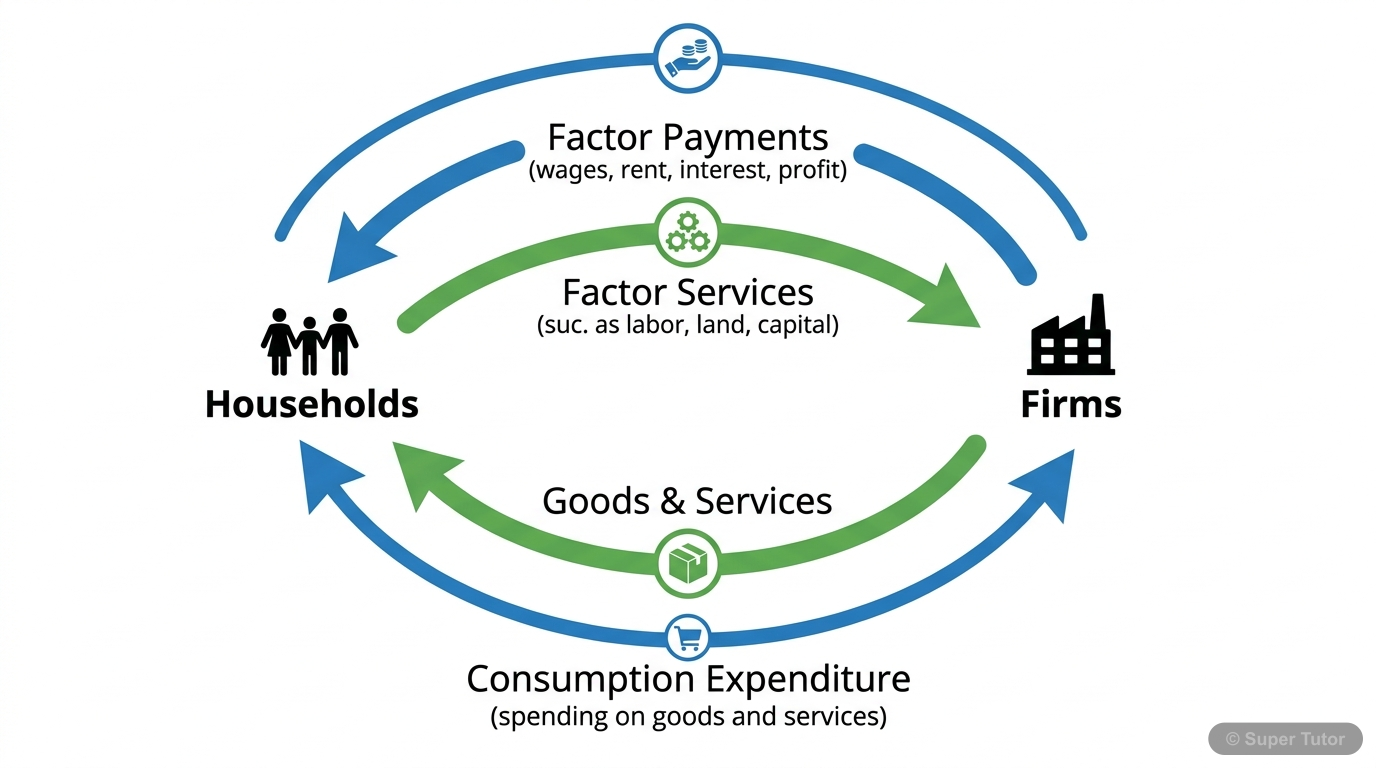
Learn better with visuals Super Tutor has hundreds of illustrations like this across every chapter — all free to try.
Get started6 worked solutions below. Unlock all 12 free in Super Tutor
Exercises
1What are the four factors of production and what are the remunerations to each of these called?Show solution
Not sure why a step works? check your working in Super Tutor
2Why should the aggregate final expenditure of an economy be equal to the aggregate factor payments? Explain.Show solution
Hence, in the circular flow of income, aggregate final expenditure = aggregate factor payments. Since the same flow of money is viewed from two sides, the value of final expenditure and the value of factor incomes must be equal. Therefore, aggregate income, aggregate expenditure and aggregate value of output are the same in equilibrium.
Not sure why a step works? check your working in Super Tutor
3Distinguish between stock and flow. Between net investment and capital which is a stock and which is a flow? Compare net investment and capital with flow of water into a tank.Show solution
- Capital is a stock because the amount of capital a firm or economy has is measured at a point in time.
- Net investment is a flow because it is measured over a period, such as a year.
Comparison with water in a tank:
- The amount of water in the tank at a particular moment is a stock.
- The flow of water into the tank per minute is a flow.
Similarly, capital is like the water in the tank, while net investment is like the rate at which water enters the tank. Net investment adds to the stock of capital over time.
Not sure why a step works? check your working in Super Tutor
4What is the difference between planned and unplanned inventory accumulation? Write down the relation between change in inventories and value added of a firm.Show solution
- Planned inventory accumulation occurs when a firm deliberately decides to increase its inventories.
- Unplanned inventory accumulation occurs when sales turn out to be lower than expected, so unsold goods remain with the firm unexpectedly.
- Unplanned decumulation happens when sales are higher than expected and inventories fall unexpectedly.
The relation between change in inventories and value added is:
and since
we get
Not sure why a step works? check your working in Super Tutor
5Write down the three identities of calculating the GDP of a country by the three methods. Also briefly explain why each of these should give us the same value of GDP.Show solution
1. Product method
2. Expenditure method
3. Income method
These give the same GDP because they are just three ways of looking at the same circular flow of income in the economy:
- In the product method, we add the value added by all firms.
- In the expenditure method, we add all final expenditures on domestic output.
- In the income method, we add all factor incomes paid for producing that output.
Since the value of output produced, the spending on it, and the income generated from it are the same flow seen from different sides, all three methods must give the same GDP.
Not sure why a step works? check your working in Super Tutor
6Define budget deficit and trade deficit. The excess of private investment over saving of a country in a particular year was Rs 2,000 crores. The amount of budget deficit was (–) Rs 1,500 crores. What was the volume of trade deficit of that country?Show solution
Trade deficit means the excess of imports over exports, i.e. .
From the national income identity:
where is the excess of private saving over private investment. The question gives excess of private investment over saving = Rs 2,000 crores, so
Budget deficit is given as Rs 1,500 crores, so
Now,
Substitute:
So,
Thus the trade deficit is Rs 500 crores.
Not sure why a step works? check your working in Super Tutor
6 more solved questions in National Income Accounting
Every remaining exercise is solved step by step in Super Tutor, plus practice quizzes and flashcards for this chapter. Free to start.
Stuck on a step?
Ask Super Tutor AI to explain any solution on this page in a simpler way — free, 24x7.
Ask a Doubt FreeFrequently Asked Questions
What are the important topics in National Income Accounting for CBSE Class 12 Economics?
How to score full marks in National Income Accounting — CBSE Class 12 Economics?
Where can I get free NCERT Solutions for National Income Accounting Class 12 Economics?
Sources & Official References
- NCERT Official — ncert.nic.in
- CBSE Academic — cbseacademic.nic.in
- CBSE Official — cbse.gov.in
- National Education Policy 2020 — education.gov.in
Content is aligned to the official syllabus. Refer to the board website for the latest curriculum.
More resources for National Income Accounting
Practice Quiz
Test yourself with a quick quiz
Important Questions
Practice with board exam-style questions
Revision Notes
Key points for last-minute revision
Formula Sheet
All formulas in one place
Chapter Summary
Understand the chapter at a glance
Concept Maps
See how topics connect visually
Study Plan
Step-by-step plan to ace this chapter
Flashcards
Quick-fire cards for active recall
Syllabus
What topics to cover
For serious students
Get the full National Income Accounting chapter — for free.
Quizzes, flashcards, AI doubt-solver and a step-by-step study plan for CBSE Class 12 Economics.