Chapter 3 of 7
NCERT Solutions

Bearings

CBSE · Class 12 · Engineering Graphics

NCERT Solutions for Bearings — CBSE Class 12 Engineering Graphics.

5 concepts

Interactive on Super Tutor

Studying Bearings? Get the full interactive chapter.

Quizzes, flashcards, AI doubt-solver and a step-by-step study plan — built for ncert solutions and more.

1,000+ Class 12 students started this chapter today

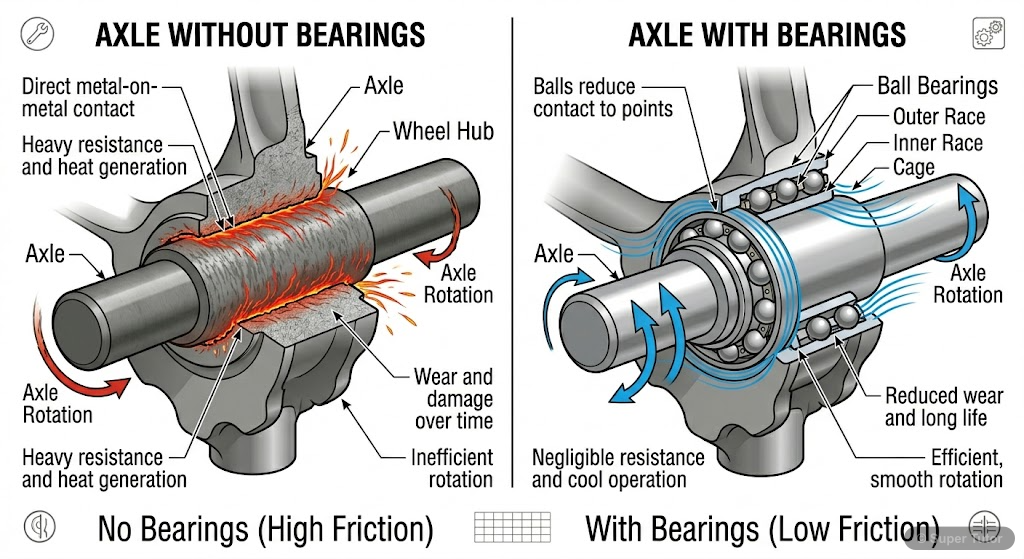
An illustration showing a bicycle wheel axle with and without bearings. The 'without bearings' side shows high friction (red, rough contact) and difficulty in rotation. The 'with bearings' side shows
Super Tutor

Learn better with visuals Super Tutor has hundreds of illustrations like this across every chapter — all free to try.

Get started
4 Questions Solved · 4 Sections

Exercise 1 – Open Bearing (Assembly Drawing)

1The given figure shows the details of the parts of an OPEN BEARING. Assemble these parts correctly, and then draw the following views to scale 1:1
(a) Front view, left half in section
(b) Left Side view
Print the titles and scale used. Draw the symbol of projection. Give six important dimensions.
Show solution
Given Information:
- Assembly: Open Bearing
- Parts: Body (Cast Iron) – 1 off, Bush (Gun Metal) – 1 off
- All fillets and rounds = R5
- Scale: 1:1
- Projection: First Angle

---

Step 1 – Understand the Parts

Body (C.I.):
- A rectangular base/pedestal with a semi-circular (open-top) seating at the top centre to receive the bush.
- The base has bolt holes for fixing to a surface.
- Typical overall dimensions (read from detail drawing): Base length ≈ 100 mm, Base width ≈ 60 mm, Height ≈ 60 mm, Bore (semi-circular seat) diameter ≈ 50 mm.

Bush (G.M.):
- A half-cylindrical (semi-circular) bush that sits in the open seat of the body.
- Outer diameter matches the seat in the body (≈ 50 mm), Inner diameter (bore) ≈ 25 mm.
- The bush is a plain half-bush (open bearing type — no cap).

---

Step 2 – Assembly Principle

The Gun Metal bush is placed into the semi-circular recess of the Cast Iron body. The shaft rests on the inner bore of the bush. Since it is an OPEN bearing (no top cap), the bush simply sits in the body's open seat.

---

Step 3 – Drawing Procedure

(a) Front View – Left Half in Section:

1. Draw the outer profile of the assembled bearing in the front view (full external view on the right half).
2. On the LEFT half, draw a sectional view by cutting along the vertical centre plane (plane of symmetry).
3. In section, show:
- The C.I. body: hatch with Cast Iron hatching (evenly spaced 45° lines).
- The G.M. bush seated in the body: hatch with Gun Metal hatching (closer spaced 45° lines, or cross-hatching as per convention).
- The semi-circular bore of the bush (inner hole) is visible.
4. Show fillets R5 at all internal corners.
5. The base of the body shows the bolt holes (shown as hidden lines on the right half, or in section on the left half).

(b) Left Side View:

1. Project the Left Side View from the Front View.
2. Show the full external profile of the body from the left side.
3. The semi-circular open top of the body is visible.
4. The bush (half-cylinder) is visible sitting in the seat.
5. Show the base plate outline, bolt holes as circles (or hidden lines).
6. All visible edges are drawn as continuous thick lines; hidden edges as dashed lines.

---

Step 4 – Six Important Dimensions to be Marked

1. Overall length of base=100 mm\text{1. Overall length of base} = 100 \text{ mm}
2. Overall width of base=60 mm\text{2. Overall width of base} = 60 \text{ mm}
3. Overall height of body=60 mm\text{3. Overall height of body} = 60 \text{ mm}
4. Bore diameter of bush (shaft hole)=ϕ25 mm\text{4. Bore diameter of bush (shaft hole)} = \phi\,25 \text{ mm}
5. Outer diameter of bush / seat diameter=ϕ50 mm\text{5. Outer diameter of bush / seat diameter} = \phi\,50 \text{ mm}
6. Bolt hole diameter and pitch=ϕ10 mm, PCD or spacing as given\text{6. Bolt hole diameter and pitch} = \phi\,10 \text{ mm, PCD or spacing as given}

---

Step 5 – Title Block and Projection Symbol

- Title: OPEN BEARING – ASSEMBLY
- Scale: 1:1
- Projection Symbol: First Angle Projection symbol (truncated cone symbol) drawn in the title block.
- Material Notes: Body – C.I., Bush – G.M.

---

Key Drawing Conventions:
- Section lines (hatching) at 45°, spaced 3–4 mm apart.
- C.I. hatching: thin lines at 45°.
- G.M. hatching: cross-hatching or closer lines at 45° (differentiated from C.I.).
- Centre lines: thin chain (dash-dot) lines through the bore axis.
- Dimension lines: thin continuous lines with arrowheads.
- All fillets and rounds = R5 (shown as small arcs at corners in section).

Exercise 2 – Open Bearing (Disassembly / Detail Drawing)

2The figure given below shows the assembly of an OPEN BEARING. Disassemble the parts and then draw the following views of the following parts to scale 1:1, keeping the same position of both the Base and the Bush, with respect to H.P. and V.P.
(a) BASE: (i) Front view, showing left half in section (ii) Top view
(b) BUSH: (i) Front view, showing right half in section (ii) Top view
Print titles and the scale used. Draw the projection symbol. Give six important dimensions.
Show solution
Given Information:
- Assembly given: Open Bearing (Fig. 3.7)
- Task: Disassemble and draw detail (part) drawings of Base and Bush separately.
- Scale: 1:1
- Projection: First Angle

---

Step 1 – Identify Parts from Assembly

From the Open Bearing assembly:
- Base (Body) – C.I.: Rectangular pedestal with a semi-circular open recess at the top to seat the bush. Has a flat base with bolt holes.
- Bush – G.M.: Half-cylindrical bush (semi-circular cross-section) that fits into the recess of the base.

---

Step 2 – Part (a): BASE

(i) Front View of Base – Left Half in Section:

1. Draw the full front view outline of the Base (body) — a rectangular block with a semi-circular recess at the top centre.
2. On the LEFT half: draw the sectional view along the vertical centre plane.
- In section, show the internal profile: the semi-circular seat, the solid walls of the body, the base thickness.
- Apply C.I. hatching (45° lines, 3–4 mm spacing) to all cut surfaces.
3. On the RIGHT half: show the external view — visible edges of the body, bolt holes (as hidden or visible depending on position), outer profile.
4. Show fillets R5 at all internal corners in section.
5. Draw centre lines through the axis of the semi-circular seat.

(ii) Top View of Base:

1. Project the top view directly below the front view.
2. Show the rectangular base outline.
3. Show the semi-circular recess (open at top) as a visible semi-circle at the centre.
4. Show bolt holes as circles at the four corners (or as per given drawing).
5. Show centre lines.
6. Hidden edges (e.g., underside features) shown as dashed lines.

Six Important Dimensions for Base:
1. Overall length=100 mm\text{1. Overall length} = 100 \text{ mm}
2. Overall width=60 mm\text{2. Overall width} = 60 \text{ mm}
3. Height of body=60 mm\text{3. Height of body} = 60 \text{ mm}
4. Diameter of semi-circular seat=ϕ50 mm\text{4. Diameter of semi-circular seat} = \phi\,50 \text{ mm}
5. Bolt hole diameter=ϕ10 mm\text{5. Bolt hole diameter} = \phi\,10 \text{ mm}
6. Base plate thickness=15 mm (or as given)\text{6. Base plate thickness} = 15 \text{ mm (or as given)}

---

Step 3 – Part (b): BUSH

(i) Front View of Bush – Right Half in Section:

1. Draw the full front view outline of the Bush — a half-cylinder (flat face at bottom, curved face at top).
2. On the RIGHT half: draw the sectional view along the vertical centre plane.
- In section, show the inner bore (hollow semi-circle) and the wall thickness of the bush.
- Apply G.M. hatching (cross-hatching or differentiated 45° lines) to cut surfaces.
3. On the LEFT half: show the external view — the curved outer surface and flat bottom face.
4. Draw centre lines through the bore axis.

(ii) Top View of Bush:

1. Project the top view below the front view of the bush.
2. Show the rectangular outline of the bush (length × width of the half-cylinder).
3. Show the inner bore as a rectangle (or semi-circle depending on orientation) with hidden/visible lines.
4. Show centre lines.

Six Important Dimensions for Bush:
1. Outer diameter of bush=ϕ50 mm\text{1. Outer diameter of bush} = \phi\,50 \text{ mm}
2. Inner bore diameter=ϕ25 mm\text{2. Inner bore diameter} = \phi\,25 \text{ mm}
3. Length of bush=60 mm (or as given)\text{3. Length of bush} = 60 \text{ mm (or as given)}
4. Wall thickness=50252=12.5 mm\text{4. Wall thickness} = \frac{50-25}{2} = 12.5 \text{ mm}
5. Overall height of bush (semi-circle)=25 mm (radius)\text{5. Overall height of bush (semi-circle)} = 25 \text{ mm (radius)}
6. Width of flat face=50 mm\text{6. Width of flat face} = 50 \text{ mm}

---

Step 4 – Title Block and Projection Symbol

- Title (a): BASE – OPEN BEARING, Scale 1:1, Material: C.I.
- Title (b): BUSH – OPEN BEARING, Scale 1:1, Material: G.M.
- Projection Symbol: First Angle Projection symbol in title block of each sheet.

---

Key Conventions:
- Sectioned surfaces hatched at 45°; C.I. and G.M. hatching differentiated.
- Centre lines as thin chain lines.
- All fillets R5 shown in section views.
- Dimension lines thin with arrowheads; all dimensions in mm.

Exercise 3 – Bush Bearing (Assembly Drawing)

3The given figure shows the details of the parts of a BUSH BEARING. Assemble these parts correctly, and then draw to scale 1:1, the following views.
(a) Front view, left half in section
(b) Right side view
Print titles and the scale used. Draw the projection symbol. Give six important dimensions.
Show solution
Given Information:
- Assembly: Bush Bearing
- Parts: Body (C.I.) – 1 off, Bush (G.M.) – 1 off (cylindrical bush pressed into the body)
- Scale: 1:1
- Projection: First Angle

---

Step 1 – Understand the Parts

Body (C.I.) – Bush Bearing:
- A pedestal/block with a CIRCULAR (full cylindrical) hole bored through it horizontally to receive the bush.
- Has a flat base with bolt holes.
- Typical dimensions: Base length ≈ 100 mm, Width ≈ 60 mm, Height ≈ 75 mm, Bore ≈ 50 mm diameter.
- Unlike the Open Bearing, the Bush Bearing has a COMPLETE circular bore (not open at top).

Bush (G.M.):
- A full cylindrical bush (hollow cylinder) pressed into the bore of the body.
- Outer diameter = bore of body ≈ 50 mm; Inner diameter (shaft hole) ≈ 30 mm.
- Length of bush = width of body bore.

---

Step 2 – Assembly Principle

The G.M. cylindrical bush is pressed (interference fit) into the circular bore of the C.I. body. The shaft runs through the inner bore of the bush. The body is bolted to the machine bed through the base holes.

---

Step 3 – Drawing Procedure

(a) Front View – Left Half in Section:

1. Draw the full front view outline of the assembled Bush Bearing.
2. On the LEFT half: cut along the vertical centre plane (plane containing the bore axis).
- Show in section:
* C.I. body walls — hatch with C.I. convention (45° lines).
* G.M. bush (cylindrical ring) — hatch with G.M. convention (cross-hatch or differentiated lines).
* Inner bore of bush (shaft hole) — left open (no hatching, it is a void).
- Show the base, pedestal walls, and the circular bore all in section.
3. On the RIGHT half: show the external view — outer profile of body, visible edges of base, bolt holes.
4. Show centre lines: horizontal axis of bore, vertical axis of symmetry.
5. Show fillets and rounds at corners.

(b) Right Side View:

1. Project the Right Side View from the Front View (First Angle Projection — placed to the LEFT of the front view in First Angle, but labelled as Right Side View).

*Note: In First Angle Projection, the Right Side View is placed to the LEFT of the Front View.*

2. Show the circular bore as a circle (visible) at the centre of the side view.
3. Show the outer profile of the body from the right side.
4. Show the base plate outline and bolt holes (as circles or hidden lines).
5. Show the bush ends as a circle (outer diameter of bush) concentric with the bore circle.
6. All visible edges: thick continuous lines; hidden edges: dashed lines.

---

Step 4 – Six Important Dimensions

1. Overall length of body=100 mm\text{1. Overall length of body} = 100 \text{ mm}
2. Overall height of body=75 mm\text{2. Overall height of body} = 75 \text{ mm}
3. Overall width of body=60 mm\text{3. Overall width of body} = 60 \text{ mm}
4. Inner bore diameter of bush (shaft hole)=ϕ30 mm\text{4. Inner bore diameter of bush (shaft hole)} = \phi\,30 \text{ mm}
5. Outer diameter of bush / bore of body=ϕ50 mm\text{5. Outer diameter of bush / bore of body} = \phi\,50 \text{ mm}
6. Bolt hole diameter and spacing=ϕ10 mm\text{6. Bolt hole diameter and spacing} = \phi\,10 \text{ mm}

---

Step 5 – Title Block and Projection Symbol

- Title: BUSH BEARING – ASSEMBLY
- Scale: 1:1
- Projection Symbol: First Angle Projection symbol in title block.
- Material: Body – C.I., Bush – G.M.

---

Key Drawing Conventions:
- C.I. hatching: 45° lines, 3–4 mm apart.
- G.M. hatching: cross-hatching (two sets of 45° lines) or closer spacing — must be visually different from C.I.
- Centre lines: thin chain (dash-dot) lines.
- The bore axis is a horizontal centre line in the front view and appears as a point (with centre mark) in the side view.
- Dimension lines: thin with arrowheads, all in mm.

Exercise 4 – Bush Bearing (Disassembly / Detail Drawing)

4The figure given below shows the front view and side view of the assembly of Bush Bearing. Disassemble the parts and draw the views of the following parts to scale 1:1. Keep the same position of the parts with respect to H.P. and V.P.
(a) BODY: (i) Front view, left half in section (ii) Side view
(b) BUSH: (i) Front view, right half in section (ii) Top view
Print titles and the scale used. Draw the projection symbol. Give six important dimensions.
Show solution
Given Information:
- Assembly given: Bush Bearing (Fig. 3.14)
- Task: Disassemble and draw detail (part) drawings of Body and Bush separately.
- Scale: 1:1
- Projection: First Angle
- Position of parts with respect to H.P. and V.P. to remain the same as in assembly.

---

Step 1 – Identify Parts from Assembly

- Body – C.I.: Pedestal block with a full circular bore running horizontally through it. Flat base with bolt holes.
- Bush – G.M.: Full cylindrical (hollow) bush that was pressed into the body bore.

---

Step 2 – Part (a): BODY

(i) Front View of Body – Left Half in Section:

1. Draw the full front view outline of the Body.
2. On the LEFT half: section along the vertical centre plane.
- Show in section:
* The solid C.I. walls of the pedestal and base.
* The circular bore (now empty — bush removed) shown as a void (no hatching inside the bore).
* The bore appears as a rectangle in section (two horizontal lines representing top and bottom of the bore).
- Apply C.I. hatching (45° lines, 3–4 mm spacing) to all cut solid material.
3. On the RIGHT half: show the external view — outer profile, base, bolt holes as hidden or visible lines.
4. Show centre lines: horizontal bore axis, vertical axis of symmetry.
5. Show fillets and rounds at corners.

(ii) Side View of Body:

1. Project the Side View from the Front View.
2. Show the circular bore as a full circle (visible) at the centre — this is the most prominent feature.
3. Show the outer rectangular profile of the body from the side.
4. Show the base plate and bolt holes.
5. All visible edges: thick continuous lines; hidden edges: dashed lines.

Six Important Dimensions for Body:
1. Overall length=100 mm\text{1. Overall length} = 100 \text{ mm}
2. Overall height=75 mm\text{2. Overall height} = 75 \text{ mm}
3. Overall width=60 mm\text{3. Overall width} = 60 \text{ mm}
4. Bore diameter=ϕ50 mm\text{4. Bore diameter} = \phi\,50 \text{ mm}
5. Base plate thickness=15 mm\text{5. Base plate thickness} = 15 \text{ mm}
6. Bolt hole diameter=ϕ10 mm\text{6. Bolt hole diameter} = \phi\,10 \text{ mm}

---

Step 3 – Part (b): BUSH

(i) Front View of Bush – Right Half in Section:

1. Draw the full front view outline of the Bush — a hollow cylinder (appears as a rectangle in front view with two concentric circles visible in side/end view).
2. In front view: the bush appears as a rectangle (length × outer diameter).
3. On the RIGHT half: section along the vertical centre plane.
- Show in section:
* The G.M. wall of the bush (annular cross-section cut).
* Apply G.M. hatching (cross-hatching or differentiated 45° lines) to the cut wall.
* The inner bore (hollow) left open — no hatching.
4. On the LEFT half: show the external view — outer cylindrical surface (appears as rectangle), and the inner bore shown as hidden lines (dashed).
5. Show centre lines: horizontal axis of the cylinder, vertical axis of symmetry.

(ii) Top View of Bush:

1. Project the Top View from the Front View.
2. The bush is a cylinder; its top view (looking from above) shows:
- Outer circle: ϕ50\phi\,50 mm (outer diameter).
- Inner circle: ϕ30\phi\,30 mm (inner bore diameter).
- Both circles are concentric.
3. Show centre lines (two perpendicular centre lines through the centre).
4. The top view clearly shows the annular (ring) cross-section of the bush.

Six Important Dimensions for Bush:
1. Outer diameter=ϕ50 mm\text{1. Outer diameter} = \phi\,50 \text{ mm}
2. Inner bore diameter=ϕ30 mm\text{2. Inner bore diameter} = \phi\,30 \text{ mm}
3. Length of bush=60 mm (or as given)\text{3. Length of bush} = 60 \text{ mm (or as given)}
4. Wall thickness=50302=10 mm\text{4. Wall thickness} = \frac{50-30}{2} = 10 \text{ mm}
5. Chamfer at ends (if any)=2×45\text{5. Chamfer at ends (if any)} = 2 \times 45^\circ
6. Overall length to outer diameter ratio (for fit specification)\text{6. Overall length to outer diameter ratio (for fit specification)}

---

Step 4 – Title Block and Projection Symbol

- Title (a): BODY – BUSH BEARING, Scale 1:1, Material: C.I.
- Title (b): BUSH – BUSH BEARING, Scale 1:1, Material: G.M.
- Projection Symbol: First Angle Projection symbol drawn in the title block of each drawing.

---

Key Drawing Conventions:
- C.I. hatching: 45° lines, evenly spaced 3–4 mm.
- G.M. hatching: cross-hatching (two sets of parallel lines at 45° to each other) — clearly differentiated from C.I.
- Centre lines: thin chain (dash-dot) lines extending slightly beyond the outline.
- Hidden lines: thin dashed lines.
- Outlines: thick continuous lines.
- All dimensions in mm; dimension lines thin with arrowheads.
- The bore axis of the bush must be kept in the same orientation (horizontal) as in the assembly, as instructed.

Stuck on a step?

Ask Super Tutor AI to explain any solution on this page in a simpler way — free, 24x7.

Ask a Doubt Free

Frequently Asked Questions

What are the important topics in Bearings for CBSE Class 12 Engineering Graphics?
Key topics in Bearings include Bearing Classification and Types, Bearings Classification Overview, Bearings Classification and Types. These are the concepts CBSE Class 12 examiners draw on most — study them first, then practise related questions.
How to score full marks in Bearings — CBSE Class 12 Engineering Graphics?
Start by understanding all key concepts. Practise previous year questions from this chapter. Revise formulas and definitions regularly. Use flashcards for quick revision before the exam.
Where can I get free NCERT Solutions for Bearings Class 12 Engineering Graphics?
This page has free step-by-step NCERT Solutions for every exercise question in Bearings (CBSE Class 12 Engineering Graphics) — written the way examiners award marks: given, formula, working, answer.

Sources & Official References

Content is aligned to the official syllabus. Refer to the board website for the latest curriculum.

For serious students

Get the full Bearings chapter — for free.

Quizzes, flashcards, AI doubt-solver and a step-by-step study plan for CBSE Class 12 Engineering Graphics.