Isometric Projection — NCERT Solutions
CBSE · Class 12 · Engineering Graphics
NCERT Solutions for Isometric Projection, CBSE Class 12 Engineering Graphics: 22 textbook questions solved step by step.
Interactive on Super Tutor
Studying Isometric Projection? Get the full interactive chapter.
Quizzes, flashcards, AI doubt-solver and a step-by-step study plan — built for NCERT solutions and more.
Free trial, no card needed.
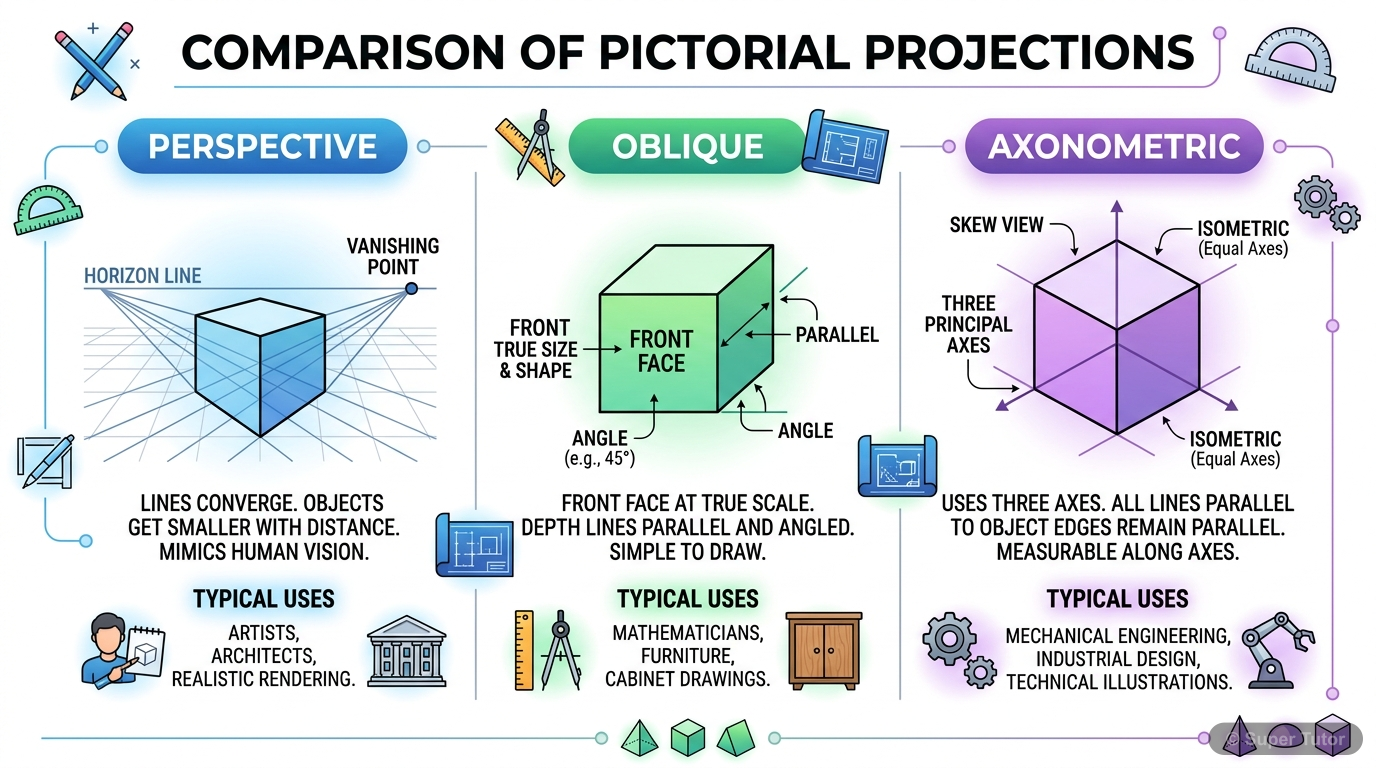
Learn better with visuals Super Tutor pairs illustrations like this with notes and quizzes for Isometric Projection.
Get startedThe first 11 solutions are open to read. The other 11 are free with a Super Tutor account. Unlock all 22 free in Super Tutor
Single Solids)
1Draw an isometric projection of a triangular prism having base edge of 65 mm and axial height of 85 mm, resting on one of its rectangular faces on H.P. keeping its base perpendicular to V.P.Show solution
Given:
- Base edge of triangular prism = 65 mm
- Axial height (length) = 85 mm
- Resting on one of its rectangular faces on H.P.
- Base (triangular face) perpendicular to V.P.
Concept: When a triangular prism rests on one of its rectangular faces, its axis lies horizontal (parallel to H.P.) and perpendicular to V.P. We use the box method to draw the isometric projection.
Steps:
Step 1 – Draw the isometric box:
Draw an isometric rectangular box of dimensions:
- Length (along axis) = 85 mm (along the receding isometric axis toward V.P.)
- Width = 65 mm (along the left isometric axis)
- Height = height of equilateral triangle with side 65 mm
Step 2 – Locate the triangular base:
On the left vertical face of the box (which represents the plane perpendicular to V.P.), mark the equilateral triangle:
- Let the bottom-left and bottom-right corners of the rectangular face be and (65 mm apart along the base).
- Find the apex at the midpoint of , raised by mm vertically.
Step 3 – Draw the prism:
- Project all three vertices , , of the triangular base along the axial direction (85 mm) to get the other triangular face , , .
- Join , , as the lateral edges.
- Draw the two triangular faces and the three rectangular faces (only visible faces with thick lines; hidden edges as dashed or omitted per convention).
Step 4 – Complete the drawing:
- Mark the axis of the prism as a chain-dash line along the 85 mm direction.
- Add dimensions: base edge = 65 mm, axial height = 85 mm.
- Show the direction of viewing arrow.
- Use thick lines for visible edges and conventional lines for axis and centre lines.
Result: The isometric projection of the triangular prism resting on its rectangular face is complete.
Not sure why a step works? check your working in Super Tutor
2Draw an isometric projection of a pentagonal prism of base side of 35 mm and axial length of 60 mm kept on one of its face edges on H.P. with one rectangular face parallel to H.P. on top and axis is perpendicular to V.P.Show solution
Given:
- Base side of pentagonal prism = 35 mm
- Axial length = 60 mm
- Resting on one of its face edges on H.P.
- One rectangular face parallel to H.P. (on top)
- Axis perpendicular to V.P.
Concept: The prism rests on a bottom edge of one rectangular face; the axis is horizontal and perpendicular to V.P. (going into the picture). The top rectangular face is horizontal (parallel to H.P.).
Steps:
Step 1 – Draw the helping figure (true shape of pentagonal base):
Draw a regular pentagon of side 35 mm with one side at the bottom (resting edge) and one side at the top (parallel to H.P.).
- Label the bottom edge vertices as (left) and (right).
- The remaining three vertices going upward: (bottom-right), (top), (bottom-left) — following the pentagon.
- The top side is (parallel to H.P.).
Step 2 – Set up isometric axes:
Since the axis is perpendicular to V.P., the pentagonal faces appear on the left and right isometric planes. The 60 mm length goes along the receding (depth) isometric axis.
Step 3 – Draw the front pentagonal face:
On the left isometric plane (vertical plane perpendicular to V.P.), draw the pentagon:
- Draw base edge mm horizontally.
- Construct the remaining vertices using true measurements transferred along isometric vertical and horizontal directions.
- Mark all five vertices of the pentagon.
Step 4 – Project to get the rear face:
Project each vertex of the front pentagon 60 mm along the receding isometric axis to obtain the rear pentagonal face .
Step 5 – Draw visible rectangular faces:
- Top rectangular face (): parallel to H.P. — draw with thick lines.
- Two side rectangular faces visible from the viewing direction.
- Bottom resting edge and on H.P.
Step 6 – Complete the drawing:
- Draw the axis as a chain-dash line along the 60 mm direction.
- Add dimensions: base side = 35 mm, axial length = 60 mm.
- Show direction of viewing arrow.
- Use thick lines for all visible edges.
Result: The isometric projection of the pentagonal prism resting on one face edge with top face parallel to H.P. is complete.
Not sure why a step works? check your working in Super Tutor
3A square pyramid is resting on its base, having base edge 60 mm and axial height of 70 mm with its base edge parallel to V.P. Draw its isometric projection.Show solution
Given:
- Base edge of square pyramid = 60 mm
- Axial height = 70 mm
- Resting on its base on H.P.
- Base edges parallel to V.P.
Concept: The pyramid stands upright on its square base. In isometric projection, the square base appears as a rhombus (isometric square). The apex is directly above the centre of the base.
Steps:
Step 1 – Draw the isometric square base:
- Draw two isometric axes at 30° to the horizontal (left and right).
- Mark base edge = 60 mm along each isometric axis direction.
- Complete the rhombus representing the square base (60 mm side).
- Since base edges are parallel to V.P., the front two edges ( and ) are parallel to V.P. (drawn along the left and right isometric axes).
Step 2 – Locate the centre of the base:
- Draw diagonals and of the rhombus; their intersection gives the centre of the base.
Step 3 – Draw the axis and locate the apex:
- From centre , draw a vertical line (true height) of 70 mm upward.
- Mark the apex at the top of this vertical line.
Step 4 – Draw the lateral edges:
- Join apex to all four base corners , , , .
- Visible edges (front two slant edges and , and front base edges) are drawn with thick lines.
- Hidden edges ( and , rear base edges) are either shown as dashed lines or omitted.
Step 5 – Complete the drawing:
- Draw the axis of the pyramid as a chain-dash line from to (70 mm vertical).
- Add dimensions: base edge = 60 mm, axial height = 70 mm.
- Show direction of viewing arrow.
Result: The isometric projection of the square pyramid resting on its base with base edges parallel to V.P. is complete.
Not sure why a step works? check your working in Super Tutor
4Draw an isometric projection of a hexagonal pyramid having base edge 35 mm and axis of 65 mm resting on its base on H.P. Keep two of its base sides perpendicular to V.P.Show solution
Given:
- Base edge of hexagonal pyramid = 35 mm
- Axial height = 65 mm
- Resting on its base on H.P.
- Two base sides perpendicular to V.P.
Concept: The pyramid stands upright. The hexagonal base is drawn as an isometric hexagon. Two sides of the hexagon are perpendicular to V.P. (i.e., they appear along the receding isometric axes).
Steps:
Step 1 – Draw the isometric hexagonal base:
- Draw the isometric axes.
- For a regular hexagon of side 35 mm with two sides perpendicular to V.P.:
- The two sides perpendicular to V.P. are drawn along the receding (left and right) isometric axes.
- Mark the six vertices of the hexagon: , , , , , in order.
- Sides and are perpendicular to V.P. (along receding axes); sides , , , are at 30° to horizontal.
- Use the box method: enclose the hexagon in an isometric rectangle of dimensions mm (width) mm (depth) and locate all six vertices.
Step 2 – Locate the centre of the base:
- Draw the main diagonals of the hexagon to find centre .
Step 3 – Draw the axis and apex:
- From , draw a vertical line of 65 mm upward.
- Mark apex at the top.
Step 4 – Draw lateral edges:
- Join to all six base vertices.
- Visible lateral edges (front three: , , or as applicable from viewing direction) — thick lines.
- Hidden lateral edges — dashed or omitted.
- Draw visible base edges with thick lines; hidden base edges as dashed or omitted.
Step 5 – Complete the drawing:
- Draw the axis as a chain-dash line from to .
- Add dimensions: base edge = 35 mm, axial height = 65 mm.
- Show direction of viewing arrow.
Result: The isometric projection of the hexagonal pyramid with two base sides perpendicular to V.P. is complete.
Not sure why a step works? check your working in Super Tutor
5Draw an isometric projection of a frustum of hexagonal pyramid of shorter base side 25 mm and longer base side 45 mm and height 75 mm. It is resting on its larger base on H.P. with two of its base sides parallel to V.P.Show solution
Given:
- Longer base side (bottom) = 45 mm
- Shorter base side (top) = 25 mm
- Height of frustum = 75 mm
- Resting on larger base on H.P.
- Two base sides parallel to V.P.
Concept: A frustum is obtained by cutting a pyramid with a plane parallel to the base. We draw the isometric hexagon for the larger base, then the smaller isometric hexagon for the top, centred on the same vertical axis, and join corresponding vertices.
Steps:
Step 1 – Draw the larger isometric hexagonal base (bottom):
- Draw isometric axes.
- With two sides parallel to V.P. (these sides are horizontal in the isometric view, i.e., parallel to the left-right isometric axis):
- Draw the isometric hexagon of side 45 mm.
- Label vertices , , , , , .
- Sides and are parallel to V.P. (horizontal in isometric).
Step 2 – Locate the centre of the bottom base:
- Intersection of main diagonals of the bottom hexagon.
Step 3 – Draw the axis:
- From , draw a vertical line of 75 mm upward. Mark top centre as .
Step 4 – Draw the smaller isometric hexagonal top:
- Centred at , draw the isometric hexagon of side 25 mm.
- Ensure the orientation is the same (two sides parallel to V.P.).
- Label vertices , , , , , corresponding to the bottom vertices.
Step 5 – Join corresponding vertices (lateral edges):
- Join –, –, –, –, –, –.
- Draw visible lateral edges and faces with thick lines.
- Hidden edges as dashed or omitted.
Step 6 – Complete the drawing:
- Draw the axis as a chain-dash line from to .
- Add dimensions: bottom side = 45 mm, top side = 25 mm, height = 75 mm.
- Show direction of viewing arrow.
Result: The isometric projection of the hexagonal frustum resting on its larger base with two sides parallel to V.P. is complete.
Not sure why a step works? check your working in Super Tutor
6Draw an isometric projection of a hemisphere of 50 mm diameter kept with circular face on H.P.Show solution
Given:
- Diameter of hemisphere = 50 mm, so radius mm
- Hemisphere resting with its flat circular face on H.P.
Concept: When the flat face of the hemisphere is on H.P., the flat circular face appears as an ellipse (isometric circle) in the H.P. The curved surface rises above it. The radius of the hemisphere in isometric = isometric scale factor mm (for true isometric projection). However, for the construction, we use the four-centre ellipse method.
Steps:
Step 1 – Draw the isometric ellipse for the flat circular base:
- Draw an isometric square (rhombus) of side = 50 mm in the H.P. (horizontal isometric plane).
- Using the four-centre method, draw the ellipse inscribed in this rhombus.
- Find the four centres by drawing perpendiculars from each vertex of the rhombus to the opposite sides.
- Draw four arcs with appropriate radii to complete the ellipse.
- This ellipse represents the flat circular face of the hemisphere on H.P.
Step 2 – Determine the isometric radius for the curved surface:
- The major axis of the ellipse = ; in practice, the major axis of the four-centre ellipse mm (approximately), so half major axis mm.
- For the hemispherical arc, use half the major axis of the ellipse as the radius for the arc.
Step 3 – Draw the hemispherical arc:
- Mark the centre of the ellipse.
- Draw a semicircular arc above the ellipse with centre and radius = half the major axis of the ellipse (i.e., mm), curving upward from one end of the major axis to the other.
- This arc represents the curved profile of the hemisphere.
Step 4 – Complete the drawing:
- The visible portion of the ellipse (front half) is shown with a thick line.
- The arc (curved surface outline) is shown with a thick line.
- Draw the centre lines through along the isometric axes.
- Mark the axis (vertical) as a chain-dash line.
- Add dimensions: diameter = 50 mm.
- Show direction of viewing arrow.
Result: The isometric projection of the hemisphere with its flat circular face on H.P. is complete.
Not sure why a step works? check your working in Super Tutor
MORE TO DO (Combination of Two Solids)
1Draw the isometric projection of combination of solids: BELOW: HEMISPHERE, ABOVE: CYLINDER, COMMON AXIS: VERTICAL.Show solution
Given:
- Lower solid: Hemisphere (flat face down on H.P.)
- Upper solid: Cylinder placed centrally on top of the hemisphere's flat face
- Common axis: Vertical
(Dimensions are to be assumed or taken from the reference figure. Typical assumed values: Hemisphere diameter = 60 mm; Cylinder diameter = 40 mm, height = 50 mm.)
Steps:
Step 1 – Draw the isometric ellipse for the flat base of the hemisphere:
- Draw an isometric square (rhombus) of side equal to the hemisphere diameter in the H.P.
- Inscribe the ellipse using the four-centre method.
- This represents the flat circular face of the hemisphere resting on H.P.
Step 2 – Draw the curved surface of the hemisphere:
- From the centre of the ellipse, draw an upward arc with radius = half the major axis of the ellipse.
- This arc forms the visible outline of the hemispherical surface.
Step 3 – Locate the top of the hemisphere:
- The topmost point of the hemisphere is at height = isometric radius above along the vertical axis.
- Mark centre at the top of the hemisphere (on the vertical axis).
Step 4 – Draw the cylinder on top:
- At , draw the bottom ellipse of the cylinder (isometric circle of cylinder diameter) using the four-centre method in the H.P. plane at height of hemisphere.
- Project the cylinder upward by its height.
- Draw the top ellipse of the cylinder similarly.
- Draw two vertical tangent lines connecting the left and right extremities of the top and bottom ellipses (these are the visible lateral edges/outline of the cylinder).
Step 5 – Complete the drawing:
- Draw the common vertical axis as a chain-dash line through both solids.
- Show only visible outlines with thick lines.
- Add dimensions and direction of viewing arrow.
Result: The isometric projection of the combination (hemisphere below, cylinder above) with vertical common axis is complete.
Not sure why a step works? check your working in Super Tutor
2Draw the isometric projection of combination of solids: BELOW: HEXAGONAL SLAB, ABOVE: PENTAGONAL PRISM, COMMON AXIS: VERTICAL.Show solution
Given:
- Lower solid: Hexagonal slab (short hexagonal prism) on H.P.
- Upper solid: Pentagonal prism placed centrally on top of the hexagonal slab
- Common axis: Vertical
(Assume suitable dimensions, e.g., Hexagonal slab: side = 50 mm, thickness = 20 mm; Pentagonal prism: side = 30 mm, height = 60 mm.)
Steps:
Step 1 – Draw the isometric hexagonal base (bottom of slab):
- Draw the isometric hexagon of the slab's base in the H.P.
- Project it upward by the slab thickness to get the top face of the slab.
- Draw visible lateral edges of the slab.
Step 2 – Locate the centre of the top face of the slab:
- Mark centre on the top hexagonal face.
Step 3 – Draw the pentagonal prism on top:
- Centred at , draw the isometric pentagon (bottom face of pentagonal prism) on the top face of the slab.
- For a regular pentagon, use the box method: enclose in an isometric rectangle and locate the five vertices.
- Project each vertex of the bottom pentagon upward by the prism height to get the top pentagonal face.
- Join corresponding vertices to draw the lateral edges.
Step 4 – Draw visible faces:
- Draw all visible faces of both solids with thick lines.
- Hidden edges are omitted or shown as dashed lines.
Step 5 – Complete the drawing:
- Draw the common vertical axis as a chain-dash line.
- Add dimensions and direction of viewing arrow.
Result: The isometric projection of the combination (hexagonal slab below, pentagonal prism above) with vertical common axis is complete.
Not sure why a step works? check your working in Super Tutor
3Draw the isometric projection of combination of solids: BELOW: CIRCULAR SLAB, ABOVE: HEXAGONAL PRISM, COMMON AXIS: VERTICAL.Show solution
Given:
- Lower solid: Circular slab (short cylinder) on H.P.
- Upper solid: Hexagonal prism placed centrally on top
- Common axis: Vertical
(Assume: Circular slab diameter = 80 mm, thickness = 20 mm; Hexagonal prism side = 30 mm, height = 60 mm.)
Steps:
Step 1 – Draw the circular slab (short cylinder):
- Draw the bottom ellipse of the circular slab using the four-centre method (isometric circle of diameter 80 mm) in H.P.
- Project upward by 20 mm (thickness) and draw the top ellipse.
- Draw two vertical tangent lines for the visible lateral outline.
Step 2 – Locate the centre of the top ellipse:
- is the centre of the top face of the circular slab.
Step 3 – Draw the hexagonal prism on top:
- Centred at , draw the isometric hexagon (bottom face of hexagonal prism) on the top face of the slab.
- Project each vertex upward by 60 mm to get the top hexagonal face.
- Draw the lateral edges and visible rectangular faces.
Step 4 – Visible edges:
- Draw all visible outlines with thick lines.
- The portion of the top ellipse of the slab hidden by the hexagonal prism base is not shown.
Step 5 – Complete the drawing:
- Draw the common vertical axis as a chain-dash line.
- Add dimensions and direction of viewing arrow.
Result: The isometric projection of the combination (circular slab below, hexagonal prism above) with vertical common axis is complete.
Not sure why a step works? check your working in Super Tutor
4Draw the isometric projection of combination of solids: BELOW: CIRCULAR SLAB, ABOVE: PENTAGONAL PRISM, AXIS: VERTICAL AND HORIZONTAL.Show solution
Given:
- Lower solid: Circular slab with vertical axis (standing upright on H.P.)
- Upper solid: Pentagonal prism with horizontal axis (lying on its side on top of the slab)
- Axes: Vertical (slab) and Horizontal (prism)
(Assume: Circular slab diameter = 70 mm, thickness = 20 mm; Pentagonal prism side = 25 mm, length = 70 mm.)
Steps:
Step 1 – Draw the circular slab (vertical axis):
- Draw the bottom ellipse of the slab in H.P. using four-centre method.
- Project upward by slab thickness and draw the top ellipse.
- Draw visible lateral outline (two vertical tangent lines).
Step 2 – Locate the centre of the top face of the slab:
Step 3 – Draw the pentagonal prism with horizontal axis on top:
- The pentagonal prism lies horizontally on the top face of the slab.
- The pentagonal cross-section is drawn on the vertical isometric plane (perpendicular to V.P. or parallel to V.P. as per orientation).
- Draw the pentagon of side 25 mm centred at on the vertical plane.
- Project the pentagon along the horizontal axis direction by 70 mm (length of prism) to get the other pentagonal face.
- Draw all lateral edges and visible rectangular faces.
Step 4 – Complete the drawing:
- Draw the vertical axis of the slab and horizontal axis of the prism as chain-dash lines.
- Show all visible edges with thick lines.
- Add dimensions and direction of viewing arrow.
Result: The isometric projection of the combination (circular slab with vertical axis, pentagonal prism with horizontal axis) is complete.
Not sure why a step works? check your working in Super Tutor
5Draw the isometric projection of combination of solids: BELOW: CIRCULAR SLAB, ABOVE: EQUILATERAL TRIANGULAR PRISM, AXIS: VERTICAL AND HORIZONTAL.Show solution
Given:
- Lower solid: Circular slab with vertical axis
- Upper solid: Equilateral triangular prism with horizontal axis (lying on its rectangular face on top of the slab)
- Axes: Vertical (slab) and Horizontal (prism)
(Assume: Circular slab diameter = 70 mm, thickness = 20 mm; Triangular prism base edge = 40 mm, length = 70 mm.)
Steps:
Step 1 – Draw the circular slab:
- Draw bottom ellipse in H.P. using four-centre method (diameter 70 mm).
- Project upward by 20 mm; draw top ellipse.
- Draw visible lateral outline.
Step 2 – Locate centre of the top face.
Step 3 – Draw the equilateral triangular prism horizontally on top:
- The prism rests on one of its rectangular faces on the top of the slab.
- On the vertical isometric plane through , draw the equilateral triangle of side 40 mm:
- Base edge horizontal (40 mm).
- Apex at height mm above the base.
- Project the triangle along the horizontal axis by 70 mm to get the other triangular face.
- Draw all three rectangular lateral faces (only visible ones with thick lines).
Step 4 – Complete the drawing:
- Draw the vertical axis of the slab and horizontal axis of the prism as chain-dash lines.
- Add dimensions and direction of viewing arrow.
Result: The isometric projection of the combination (circular slab below with vertical axis, equilateral triangular prism above with horizontal axis) is complete.
Not sure why a step works? check your working in Super Tutor
Free with a Super Tutor account
Free with a Super Tutor account
Free with a Super Tutor account
Free with a Super Tutor account
Free with a Super Tutor account
Free with a Super Tutor account
Free with a Super Tutor account
Free with a Super Tutor account
Free with a Super Tutor account
Free with a Super Tutor account
Free with a Super Tutor account
11 more solved questions in Isometric Projection
They are free with a Super Tutor account, along with practice quizzes and flashcards for this chapter. Free to start, no card needed.
Frequently Asked Questions
What are the important topics in Isometric Projection for CBSE Class 12 Engineering Graphics?
Are these NCERT Solutions for Isometric Projection free?
Sources & Official References
- NCERT Official — ncert.nic.in
- CBSE Academic — cbseacademic.nic.in
- CBSE Official — cbse.gov.in
- National Education Policy 2020 — education.gov.in
Content is aligned to the official syllabus. Refer to the board website for the latest curriculum.
More resources for Isometric Projection
For serious students
Get the full Isometric Projection chapter — start free.
Quizzes, flashcards, an AI doubt solver and a study plan for CBSE Class 12 Engineering Graphics. Free to start, no card needed.