Shaft Couplings — NCERT Solutions
CBSE · Class 12 · Engineering Graphics
NCERT Solutions for Shaft Couplings, CBSE Class 12 Engineering Graphics: 7 textbook questions solved step by step.
Interactive on Super Tutor
Studying Shaft Couplings? Get the full interactive chapter.
Quizzes, flashcards, AI doubt-solver and a step-by-step study plan — built for NCERT solutions and more.
Free trial, no card needed.
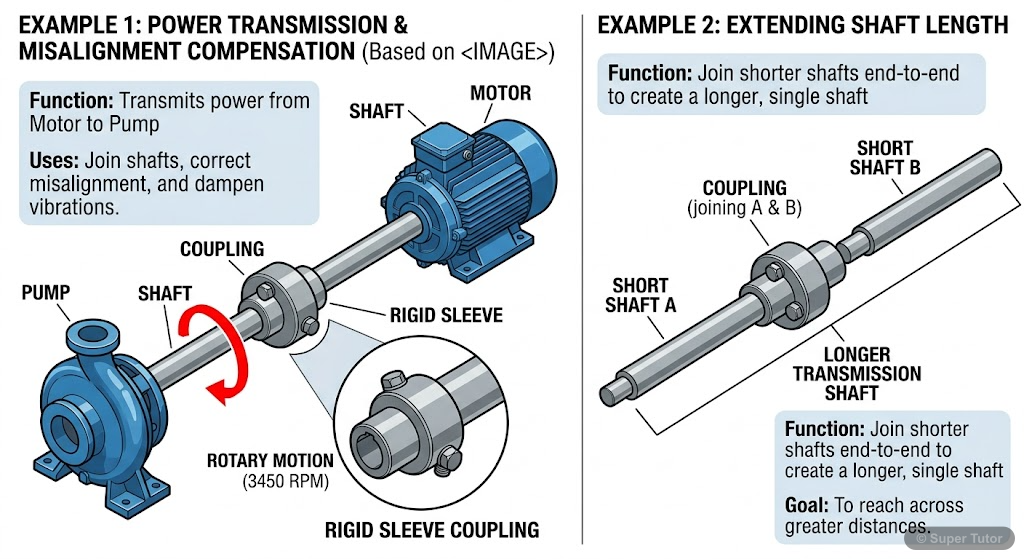
Learn better with visuals Super Tutor pairs illustrations like this with notes and quizzes for Shaft Couplings.
Get startedThe first 4 solutions are open to read. The other 3 are free with a Super Tutor account. Unlock all 7 free in Super Tutor
Exercise 1 — Unprotected Flange Coupling (Fig. 6.8): Assembly Drawing
1Fig 6.8 shows details of an unprotected Flange Coupling. Assemble these parts and draw the following orthographic views to scale 1:1.
a. Front view, upper half in section
b. Right hand side view, without section.
Show the dimensions properly. Print title and scale used and draw the projection symbol.Show solution
Given: Detail (part) drawings of an Unprotected Flange Coupling as shown in Fig. 6.8.
Scale: 1:1 (Full Size)
Parts Identified in an Unprotected Flange Coupling:
- Flange A (with hub, flange disc, bolt holes, keyway)
- Flange B (with hub, flange disc, bolt holes, spigot/socket recess, keyway)
- Shaft A
- Shaft B
- Key A (Rectangular Sunk Key)
- Key B (Rectangular Sunk Key)
- Bolts, Nuts and Washers (typically 3 or 4 sets)
Assembly Procedure (Step-by-Step):
Step 1 – Understand the assembly:
- The two shafts (Shaft A and Shaft B) are to be coupled end-to-end.
- Flange A is fitted on Shaft A using Key A; Flange B is fitted on Shaft B using Key B.
- The two flanges are brought face-to-face; the spigot of one flange fits into the socket (recess) of the other for alignment.
- Bolts pass through the bolt holes in both flanges and are secured with nuts and washers.
Step 2 – Draw the Front View (Upper Half in Section):
- Draw the horizontal axis (shaft centre line) as a chain-dot line.
- Draw the two shafts as rectangles (diameter as given, e.g., mm) extending from both sides.
- Draw the hubs of Flange A and Flange B around the respective shafts.
- Show the keyways on the shafts and in the hubs in the sectional half.
- Draw the flange discs of both flanges meeting at the centre.
- Show the spigot (projection) of one flange fitting into the socket (recess) of the other.
- In the upper half (above the centre line): draw the section — apply hatching (thin lines at ) to all cut solid parts (hub, flange disc, shaft cross-section). Bolts passing through bolt holes are not hatched (bolts are not sectioned by convention).
- In the lower half (below the centre line): draw the external (outside) view — show the bolt heads/nuts, the outer profile of flanges and hubs.
- Show all important dimensions: shaft diameter, hub diameter, hub length, flange diameter, flange thickness, bolt circle diameter (PCD), bolt diameter, number of bolts, overall length, keyway dimensions.
Step 3 – Draw the Right Hand Side View (Without Section):
- Project from the front view to the right.
- This view shows the right-side face of Flange B (or Flange A depending on orientation).
- Draw the outer circle of the flange disc.
- Draw the bolt holes (as circles) equally spaced on the pitch circle diameter (PCD).
- Draw the hub circle (concentric).
- Draw the shaft circle (innermost concentric circle).
- Show the nuts (hexagonal or square) on the bolt ends if visible.
- Show centre lines for all circles.
- No hatching (no section in this view).
Step 4 – Dimensioning:
- Dimension all diameters with the symbol: shaft , hub outer , flange outer , bolt circle , bolt hole .
- Dimension lengths: hub length, flange thickness, overall coupling length.
- Dimension keyway: width depth.
- Use leader lines and dimension lines as per SP:46 conventions.
Step 5 – Title Block and Projection Symbol:
- Write Title: ASSEMBLY OF UNPROTECTED FLANGE COUPLING
- Write Scale: 1:1
- Draw the First Angle Projection Symbol (frustum of cone — as used in CBSE/Indian standard) in the title block.
Key Conventions to Follow:
- Centre lines: thin chain-dot lines.
- Cutting plane line shown on the front view.
- Section lines (hatching) at , equally spaced ( mm apart).
- Bolts, keys, shafts — not sectioned even if the cutting plane passes through them.
- Hidden lines may be omitted in the sectional view for clarity.
Result: The assembled orthographic views of the Unprotected Flange Coupling are drawn to scale 1:1 with the front view (upper half in section) and the right-hand side view (without section), fully dimensioned with title and projection symbol.
Not sure why a step works? check your working in Super Tutor
Exercise 2 — Unprotected Flange Coupling (Fig. 6.9): Assembly Drawing
1The given figure (Fig. 6.9) shows the details of the parts of Unprotected Flange Coupling. Assemble these parts and draw to scale 1:1, the following views of the assembly.
(a) Front view, lower half in section
(b) Right side viewShow solution
Given: Detail drawings of an Unprotected Flange Coupling — Fig. 6.9.
Scale: 1:1
Parts of Unprotected Flange Coupling:
- Flange A (with hub and keyway)
- Flange B (with hub, spigot/socket, and keyway)
- Shaft A and Shaft B
- Key A and Key B (Rectangular Sunk Keys)
- Bolts, Nuts, Washers
Assembly Steps:
Step 1 – Fit keys and flanges on shafts:
- Insert Key A into the keyway of Shaft A; slide Flange A onto Shaft A so that the keyway of the hub aligns with Key A.
- Similarly, fit Key B and Flange B onto Shaft B.
- The flanges are positioned so that the flange faces are flush with the shaft ends.
Step 2 – Couple the flanges:
- Bring Shaft A and Shaft B coaxially together.
- The spigot (male projection) on Flange B enters the socket (female recess) on Flange A for accurate alignment.
- Align the bolt holes of both flanges.
- Insert bolts through the holes; place washers and tighten nuts.
Step 3 – Draw Front View (Lower Half in Section):
- Draw the horizontal axis as a centre line.
- Draw both shafts, hubs, and flange discs symmetrically about the axis.
- Lower half (below centre line): Show the section — hatch all solid cut parts (shaft, hub, flange disc) at . Do NOT hatch bolts, keys, or nuts.
- Upper half (above centre line): Show the external view — outer profiles of flanges, bolt heads/nuts visible.
- Show spigot-socket fit at the mating face.
- Dimension: shaft , hub , hub length, flange , flange thickness, PCD of bolts, bolt , keyway size, overall length.
Step 4 – Draw Right Side View:
- Project from the right end of the front view.
- Draw concentric circles: shaft circle (innermost), hub circle, bolt hole circles on PCD, flange outer circle.
- Show bolt holes (usually 3 or 4) equally spaced on the PCD.
- Show nuts (hexagonal) if visible.
- Mark all centre lines.
- No section in this view.
Step 5 – Title and Symbol:
- Title: ASSEMBLY OF UNPROTECTED FLANGE COUPLING
- Scale: 1:1
- Draw First Angle Projection Symbol.
Result: Assembly drawing of Unprotected Flange Coupling drawn to scale 1:1 with front view (lower half in section) and right side view, with all dimensions, title, and projection symbol.
Not sure why a step works? check your working in Super Tutor
Example — Unprotected Flange Coupling: Disassembly (Detail Drawing from Assembly)
1Figure shows the assembled views of an UNPROTECTED FLANGE COUPLING. Dis-assemble the parts and then draw the following views of the following parts to full size scale, keeping them in the same position with respect to H.P. and V.P.
(a) FLANGE-A
(i) Upper half sectional front view
(ii) Right-hand side view
(b) KEY-A
(i) Front view
(ii) Top view
(iii) LH side viewShow solution
Given: Assembly drawing of an Unprotected Flange Coupling.
Task: Extract (disassemble) individual parts and draw their detail views.
Scale: 1:1 (Full Size)
(a) FLANGE-A
Description of Flange-A:
Flange-A consists of a cylindrical hub (with a central bore equal to shaft diameter and a keyway), and a circular flange disc with bolt holes. It may have a socket (recess) for the spigot of Flange-B.
(i) Upper Half Sectional Front View of Flange-A:
Step 1: Draw the horizontal centre line (axis of the bore).
Step 2 – Lower half (external view):
- Draw the outer profile: hub cylinder and flange disc as rectangles.
- Show the outer diameter of the hub and flange disc.
- Show the length of the hub.
- Show the socket recess (if present) on the face of the flange.
Step 3 – Upper half (sectional view):
- The cutting plane passes through the axis.
- Show the bore (shaft hole) through the hub — draw as a rectangle equal to shaft diameter.
- Show the keyway: a small rectangular notch at the top of the bore.
- Show the bolt holes in the flange disc (as rectangles in section).
- Show the socket recess depth and diameter.
- Apply hatching at to all solid cut material.
- Do NOT hatch the bore (empty space) or keyway.
Step 4 – Dimensions to show:
- Bore diameter (= shaft diameter)
- Hub outer diameter
- Hub length
- Flange outer diameter
- Flange thickness
- Bolt hole diameter and PCD
- Keyway: width depth
- Socket recess: diameter and depth
(ii) Right-Hand Side View of Flange-A:
Step 1: Project from the right side of the front view.
Step 2: Draw concentric circles:
- Innermost: bore circle ( = shaft diameter)
- Next: hub outer circle
- Bolt holes: small circles equally spaced on PCD circle
- Outermost: flange outer circle
Step 3: Show the keyway as a small rectangle (chord) inside the bore circle.
Step 4: Draw all centre lines (horizontal, vertical, and radial to bolt holes).
Step 5: Dimension: all diameters, PCD, number and diameter of bolt holes.
(b) KEY-A (Rectangular Sunk Key)
Description: A rectangular sunk key is a simple rectangular prism with uniform cross-section. It fits half in the shaft keyway and half in the hub keyway.
Let: Length , Width , Height (thickness)
(i) Front View of Key-A:
- The front view shows the key as a rectangle.
- Width of rectangle (length of key), Height of rectangle (thickness of key).
- Draw with thin lines; show dimensions and .
(ii) Top View of Key-A:
- The top view shows the key as a rectangle.
- Width (length), Depth (width of key).
- Draw directly below the front view with projection lines.
(iii) Left-Hand Side View of Key-A:
- The LH side view shows the cross-section of the key.
- It appears as a rectangle of size (width thickness).
- Draw to the left of the front view with projection lines.
Dimensions to mark:
- On Front View: (length) and (height/thickness)
- On Top View: (width)
- On Side View: and (for confirmation)
Title Block:
- Title: DETAIL DRAWING — UNPROTECTED FLANGE COUPLING
- Parts: FLANGE-A, KEY-A
- Scale: 1:1
- Draw First Angle Projection Symbol.
Not sure why a step works? check your working in Super Tutor
Exercise 3 — Unprotected Flange Coupling (Fig. 6.12): Disassembly
1The figure given below (Fig. 6.12) shows the assembly of Unprotected Flange Coupling. Disassemble the parts correctly and then draw to scale 1:1, the following views of the components, keeping the same position of both Flange A and hexagonal nut with respect to V.P. and H.P.
(a) FLANGE-A
(i) Front view lower half in section
(ii) Side view, looking from left
(b) HEXAGONAL NUT
(i) Front view
(ii) Side viewShow solution
Given: Assembly drawing of Unprotected Flange Coupling — Fig. 6.12.
Task: Disassemble and draw detail views of Flange-A and Hexagonal Nut.
Scale: 1:1
(a) FLANGE-A
(i) Front View — Lower Half in Section:
Step 1: Draw the horizontal axis (centre line of bore).
Step 2 – Upper half (external view, above centre line):
- Draw the outer profile of the hub (cylinder) and flange disc.
- Show the face of the flange with the socket recess (if present).
- Show the outer contour lines of hub and flange.
Step 3 – Lower half (sectional view, below centre line):
- The cutting plane passes through the axis.
- Show the bore (shaft hole) as a rectangle.
- Show the keyway as a small rectangular notch at the bottom of the bore.
- Show the bolt holes in the flange disc as rectangles.
- Show the socket recess (depth and diameter) if present.
- Apply hatching (, equally spaced) to all solid cut material in the lower half.
- Do not hatch the bore or keyway (these are empty spaces).
Step 4 – Dimensions:
- Bore , Hub outer , Hub length
- Flange outer , Flange thickness
- Bolt hole , PCD of bolt holes
- Keyway: width depth
- Socket recess: and depth
(ii) Side View — Looking from Left:
Step 1: Project from the left side of the front view.
Step 2: Draw concentric circles:
- Bore circle (innermost)
- Hub outer circle
- Bolt hole circles on PCD
- Flange outer circle (outermost)
Step 3: Show the keyway as a small rectangular notch inside the bore circle (at the appropriate position — bottom, since lower half was sectioned, keyway is at bottom).
Step 4: Show all centre lines.
Step 5: Dimension all diameters and PCD.
(b) HEXAGONAL NUT
Description: A standard hexagonal nut has a hexagonal prism body with a threaded central hole. The top and bottom faces are flat; the top corners are chamfered (giving a curved profile on the front view).
Let: Nominal diameter of bolt
- Across flats (width across flats): mm (approx.) or as given
- Thickness of nut: (approx.) or as given
- Chamfer circle diameter (across flats)
(i) Front View of Hexagonal Nut:
Step 1: Draw the rectangle of width (across flats) and height (thickness).
Step 2: Show two vertical lines inside the rectangle at positions corresponding to the two visible corners of the hexagon (at distance across corners from centre).
Step 3: Draw the chamfer arcs:
- The chamfer on the top corners produces hyperbolic curves; for drawing purposes, these are approximated as arcs of circles.
- Draw arcs from the top corners curving inward to meet the vertical edge lines.
- The arc radius (across flats) approximately.
Step 4: Show the threaded hole:
- Draw two vertical lines (representing the thread) inside, at diameter (minor diameter shown as thin lines, major diameter as thick lines).
- Alternatively, show as two thin lines for the thread representation.
Step 5: Dimension: (across flats), (thickness), (nominal diameter).
(ii) Side View of Hexagonal Nut:
Step 1: Project from the right (or left) of the front view.
Step 2: In the side view, the hexagon appears with two corners pointing left and right (if the front view shows flats).
- Draw the hexagon: it will show as a rectangle of width across corners and height , with two angled lines on left and right sides.
Step 3: Show the chamfer arc on top.
Step 4: Show the threaded hole as a circle of diameter (with a gap/break in the circle to indicate thread — thin circle for minor diameter, thick circle for major diameter).
Step 5: Dimension: across corners dimension, thickness .
Title Block:
- Title: DETAIL DRAWING — UNPROTECTED FLANGE COUPLING
- Parts: FLANGE-A, HEXAGONAL NUT
- Scale: 1:1
- Draw First Angle Projection Symbol.
Not sure why a step works? check your working in Super Tutor
Exercise 4 — Protected Flange Coupling (Fig. 6.18): Assembly Drawing
a. Lower half - sectional front view
b. Left hand side view
Print the title and scale used. Draw the projection symbol. Give important dimensions.
Free with a Super Tutor account
Exercise 5 — Protected Flange Coupling (Fig. 6.21): Disassembly
(a) FLANGE-B
(i) Front view, showing upper half in section
(ii) Side view, viewed from the right
(b) SHAFT-B
(i) Front view
(ii) Side view, viewed from the left
Print titles, scale used. Draw the projection symbol. Give main dimensions.
Free with a Super Tutor account
Exercise 6 — Protected Flange Coupling (Fig. 6.22): Disassembly
(a) FLANGE-A
(i) Front view, lower half in section
(ii) Side view looking from left
(b) RECTANGULAR SUNK TAPER KEY-A
(i) Front view
(ii) Top view
Print titles, scale used. Draw the projection symbol. Give main dimensions.
Free with a Super Tutor account
3 more solved questions in Shaft Couplings
They are free with a Super Tutor account, along with practice quizzes and flashcards for this chapter. Free to start, no card needed.
Frequently Asked Questions
What are the important topics in Shaft Couplings for CBSE Class 12 Engineering Graphics?
Are these NCERT Solutions for Shaft Couplings free?
Sources & Official References
- NCERT Official — ncert.nic.in
- CBSE Academic — cbseacademic.nic.in
- CBSE Official — cbse.gov.in
- National Education Policy 2020 — education.gov.in
Content is aligned to the official syllabus. Refer to the board website for the latest curriculum.
More resources for Shaft Couplings
For serious students
Get the full Shaft Couplings chapter — start free.
Quizzes, flashcards, an AI doubt solver and a study plan for CBSE Class 12 Engineering Graphics. Free to start, no card needed.