Tie-Rod and Pipe Joints — NCERT Solutions
CBSE · Class 12 · Engineering Graphics
NCERT Solutions for Tie-Rod and Pipe Joints, CBSE Class 12 Engineering Graphics: 6 textbook questions solved step by step. Covers Exercises.
Interactive on Super Tutor
Studying Tie-Rod and Pipe Joints? Get the full interactive chapter.
Quizzes, flashcards, AI doubt-solver and a step-by-step study plan — built for NCERT solutions and more.
Free trial, no card needed.
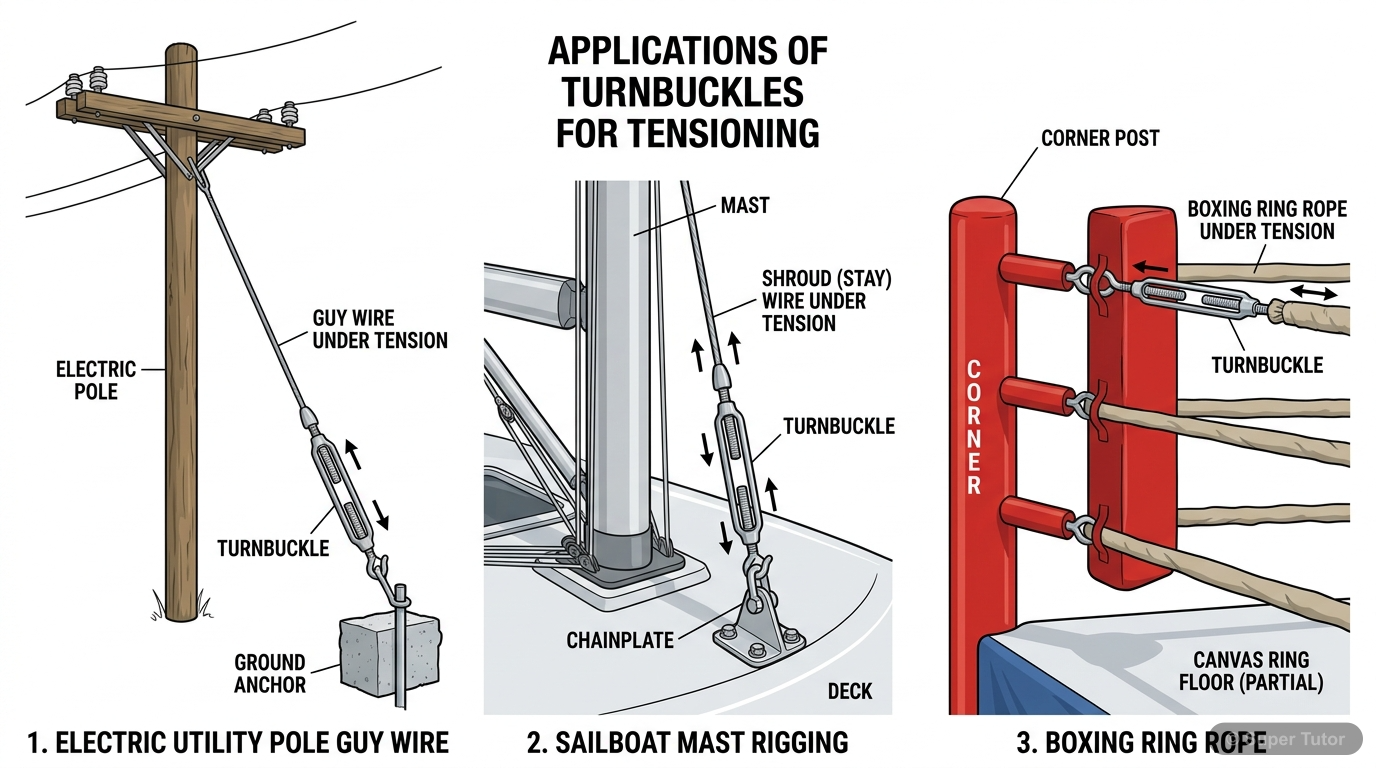
Learn better with visuals Super Tutor pairs illustrations like this with notes and quizzes for Tie-Rod and Pipe Joints.
Get startedThe first 3 solutions are open to read. The other 3 are free with a Super Tutor account. Unlock all 6 free in Super Tutor
Exercises
1The given figure shows the details of the parts of a Turnbuckle. Assemble these parts correctly and then draw the following views using scale 1:1, inserting 55 mm threaded position of each rod inside the body of the turnbuckle.
(a) Front view, upper half in section
(b) Left hand side view.Show solution
Given:
- A Turnbuckle consisting of: Body (M.S.) – 1 off, Rod A (M.S.) – 1 off, Rod B (M.S.) – 1 off.
- Scale: 1:1
- 55 mm threaded portion of each rod is inserted inside the body.
Concept / Assembly Principle:
A Turnbuckle is a tie-rod joint used to connect two rods under tension. The body is a hexagonal or cylindrical barrel with internal right-hand (RH) thread at one end and left-hand (LH) thread at the other end. Rod A has RH external thread and Rod B has LH external thread. When the body is rotated, both rods are drawn in or pushed out simultaneously.
Steps for Drawing:
Step 1 – Understand the parts:
- Body: Hexagonal barrel with a central hole threaded RH on one side and LH on the other. Note the overall length and outer hexagonal size from the given detail drawing.
- Rod A: Cylindrical rod with RH threaded end (thread length sufficient to insert 55 mm inside body).
- Rod B: Cylindrical rod with LH threaded end (thread length sufficient to insert 55 mm inside body).
Step 2 – Assembly:
- Screw Rod A into the RH threaded end of the body so that 55 mm of its threaded portion lies inside the body.
- Screw Rod B into the LH threaded end of the body so that 55 mm of its threaded portion lies inside the body.
- The two rods project outward from either end of the body.
Step 3 – Draw Front View (Upper Half in Section):
- Draw the overall outline of the assembled turnbuckle as a front view.
- The upper half is shown in section (cutting plane passes through the axis).
- In the sectioned upper half:
- Show the internal threads of the body (represented by thin lines for thread roots and thick lines for thread crests, or by conventional thread representation as per SP:46).
- Show 55 mm of Rod A's threaded shank inside the body on the RH side.
- Show 55 mm of Rod B's threaded shank inside the body on the LH side.
- Apply hatching (section lines at 45°) to the cut surfaces of the body.
- The lower half shows the external hexagonal profile of the body and the external view of the rods.
- Mark the 55 mm insertion depth with a dimension line on each side.
Step 4 – Draw Left Hand Side View:
- Project the left-hand side view from the front view.
- The body appears as a regular hexagon (across flats dimension as given).
- The rod appears as a circle (diameter of rod shank) concentric with the hexagon.
- Show hidden lines if required for the internal bore.
Step 5 – Dimensioning and Labelling:
- Provide overall length of assembly.
- Diameter of rods.
- Across-flats dimension of body.
- Length of body.
- 55 mm threaded insertion length.
- Thread designation (e.g., M20 or as per given detail).
- Write title: TURNBUCKLE — ASSEMBLY, Scale 1:1.
Important Note on dimensions (read from detail drawing Fig. 5.8):
- Overall length of body ≈ as given in detail.
- Rod diameter and thread size as given.
- The total assembled length = Length of body + protruding length of Rod A + protruding length of Rod B (after 55 mm insertion each side).
Result: The assembled front view (upper half in section) clearly shows the internal threaded engagement of 55 mm on each side, and the left-hand side view shows the hexagonal cross-section of the body with the rod circle inside.
Not sure why a step works? check your working in Super Tutor
2Figure 5.9 shows the disassembled views of the parts of a Turn Buckle. Assemble the parts correctly, and then draw the following views to scale 1:1, inserting 50 mm threaded portion of each rod inside the body of the Turn Buckle.
(a) Lower half sectional elevation.
(b) Plan.
Print the title and scale used. Give six important dimensions.Show solution
Given:
- Parts: (a) Body, (b) Rod-A (LH thread, 20), (c) Rod-B.
- Scale: 1:1
- 50 mm threaded portion of each rod inserted inside the body.
Concept:
Same as Exercise 1. The body has LH thread on one end (for Rod-A, 20 LH) and RH thread on the other end (for Rod-B). Rotating the body tightens or loosens the joint.
Assembly Steps:
- Insert Rod-A (LH thread, 20) into the LH threaded end of the body — 50 mm inside.
- Insert Rod-B (RH thread) into the RH threaded end of the body — 50 mm inside.
Step 1 – Lower Half Sectional Elevation (Front View, lower half in section):
- Draw the complete outline of the assembled turnbuckle in elevation (front view).
- The lower half is cut by a horizontal cutting plane through the axis.
- In the lower half section:
- Show the internal bore of the body with conventional thread representation.
- Show 50 mm of Rod-A threaded shank inside the body (LH side).
- Show 50 mm of Rod-B threaded shank inside the body (RH side).
- Apply 45° hatching to sectioned material (body cross-section).
- The upper half shows the external view: hexagonal flats of body, external profile of rods.
Step 2 – Plan (Top View):
- Project the top view below (or above, as per convention) the elevation.
- Body appears as a hexagon (regular, across-flats as given).
- Rods appear as rectangles (width = rod diameter) projecting from each end of the hexagon.
- Show centre lines.
- Hidden lines for internal bore shown as dashed lines.
Step 3 – Six Important Dimensions to be given:
Step 4 – Title Block:
- Title: TURNBUCKLE — ASSEMBLY
- Scale: 1:1
- Draw the first-angle or third-angle projection symbol as applicable.
Result: The lower half sectional elevation shows internal thread engagement of 50 mm on each side; the plan shows the hexagonal body with rod projections.
Not sure why a step works? check your working in Super Tutor
3The given figure shows the assembly of a Turn Buckle. Disassemble the parts and then draw the following views, to scale 1:1, keeping the same position of the parts with respect to H.P. and V.P.
(a) BODY
(i) Front view upper half in section
(ii) Top view
(b) ROD B
(i) Front view
(ii) Left side viewShow solution
Given:
- Assembled Turnbuckle (Fig. 5.12) is given.
- Disassemble and draw individual parts separately.
- Scale: 1:1
- Maintain the same orientation w.r.t. H.P. and V.P. as in the assembly.
Concept:
Disassembly means drawing each part separately (detail drawing) in the same position/orientation as it appears in the assembly view.
(a) BODY:
Part description: The body is a hexagonal barrel with a central through-hole. One half has RH internal thread, the other half has LH internal thread. There is a central collar or the hex section runs the full length.
(i) Front View — Upper Half in Section:
- Draw the front view of the body alone (without rods).
- The upper half is sectioned by a horizontal plane through the axis.
- In the upper half (section):
- Show the internal bore diameter.
- Show RH thread on one side and LH thread on the other side (conventional thread representation: thin lines for roots, thick lines for crests, or simplified representation).
- Apply 45° hatching to the cut material.
- The lower half shows the external hexagonal profile.
- Mark: overall length of body, bore diameter, across-flats dimension, thread designation.
(ii) Top View:
- Project the top view from the front view.
- The body appears as a rectangle (length = body length, width = across-flats dimension).
- Show the hexagonal flats as visible lines.
- Show the central bore as hidden (dashed) lines.
- Mark centre lines.
(b) ROD B:
Part description: Rod B is a cylindrical rod with one end having external thread (RH or LH as applicable) and the other end plain or with a hole/eye for connection.
(i) Front View:
- Draw Rod B in the same orientation as in the assembly (axis horizontal).
- Show the threaded end with conventional thread representation (length of thread as readable from assembly).
- Show the plain shank portion.
- Show the other end (eye/plain end) as applicable.
- Dimension: overall length, shank diameter, thread length, thread designation.
(ii) Left Side View:
- Project the left side view from the front view.
- The rod appears as a circle (diameter = shank diameter ).
- If the end has a flat or hole, show accordingly.
- Show centre lines.
Result: Four separate views are drawn — Body (front view upper half in section + top view) and Rod B (front view + left side view) — each to scale 1:1 in the same orientation as the assembly.
Not sure why a step works? check your working in Super Tutor
(a) Front view lower half in section
(b) Left side view
Free with a Super Tutor account
(a) Upper half sectional front view
(b) Left-hand side view.
Print title and the scale used. Draw the projection symbol. Give six important dimensions.
Free with a Super Tutor account
(a) FLANGE A
(i) Front view top half in section
(ii) Left side view
(b) HEXAGONAL NUT
(i) Front view
(ii) Right side view
Free with a Super Tutor account
3 more solved questions in Tie-Rod and Pipe Joints
They are free with a Super Tutor account, along with practice quizzes and flashcards for this chapter. Free to start, no card needed.
Frequently Asked Questions
Are these NCERT Solutions for Tie-Rod and Pipe Joints free?
Sources & Official References
- NCERT Official — ncert.nic.in
- CBSE Academic — cbseacademic.nic.in
- CBSE Official — cbse.gov.in
- National Education Policy 2020 — education.gov.in
Content is aligned to the official syllabus. Refer to the board website for the latest curriculum.
For serious students
Get the full Tie-Rod and Pipe Joints chapter — start free.
Quizzes, flashcards, an AI doubt solver and a study plan for CBSE Class 12 Engineering Graphics. Free to start, no card needed.