Legal Services — NCERT Solutions
CBSE · Class 12 · Legal Studies
NCERT Solutions for Legal Services, CBSE Class 12 Legal Studies: 4 textbook questions solved step by step. Covers Exercise — Legal Services.
Interactive on Super Tutor
Studying Legal Services? Get the full interactive chapter.
Quizzes, flashcards, AI doubt-solver and a step-by-step study plan — built for NCERT solutions and more.
Free trial, no card needed.
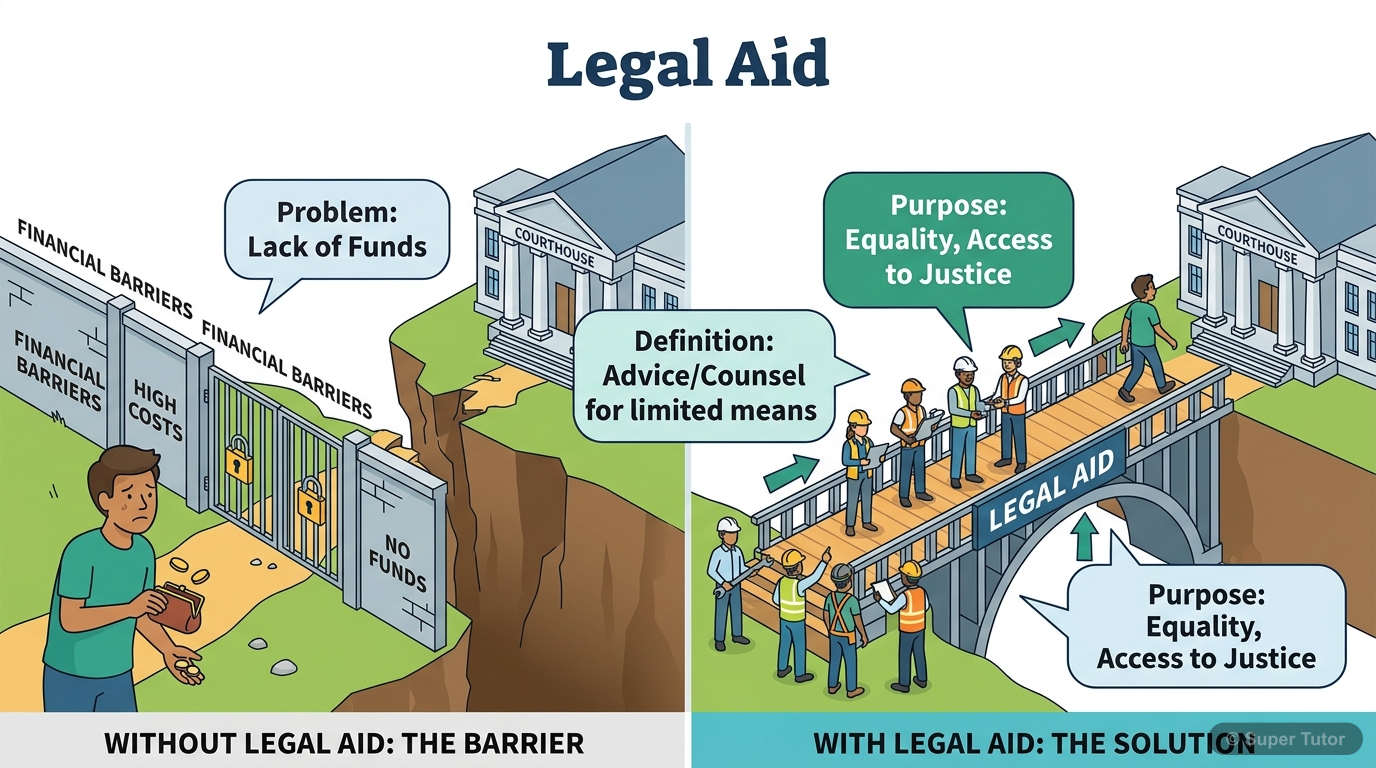
One of 16 illustrations for Legal Services in Super Tutor — alongside flashcards, concept maps and practice questions.
The first 2 solutions are open to read. The other 2 are free with a Super Tutor account.
Exercise — Legal Services (Legal Studies, Class 12)
1Discuss the main provisions for free legal aid under the Indian Constitution.Show solution
Given / Context: The Indian Constitution contains several provisions that guarantee free legal aid as a fundamental and directive right.
Key Constitutional Provisions:
1. Article 14 – Right to Equality
Article 14 guarantees equality before law and equal protection of laws to every person. This implicitly requires that every person, regardless of economic status, must have equal access to the legal system. Without free legal aid, the poor cannot enjoy this equality in practice.
2. Article 21 – Right to Life and Personal Liberty
Article 21 states that no person shall be deprived of his life or personal liberty except according to procedure established by law. The Supreme Court has interpreted this article broadly to include the right to free legal aid. In Hussainara Khatoon v. State of Bihar (1979), the Supreme Court held that free legal aid is an essential ingredient of 'reasonable, fair and just' procedure under Article 21. A trial without legal assistance to an accused who cannot afford a lawyer is not a fair trial.
3. Article 22(1) – Protection Against Arbitrary Arrest
Article 22(1) provides that every arrested person has the right to consult and be defended by a legal practitioner of his choice. This is a Fundamental Right available to every arrested person.
4. Article 39-A – Directive Principle of State Policy (DPSP)
Article 39-A was inserted by the 42nd Constitutional Amendment Act, 1976. It specifically directs the State to ensure that the operation of the legal system promotes justice on the basis of equal opportunity, and shall, in particular, provide free legal aid by suitable legislation or schemes or in any other way, to ensure that opportunities for securing justice are not denied to any citizen by reason of economic or other disabilities.
This is the most direct constitutional provision for free legal aid.
5. Article 38 – DPSP
Article 38 directs the State to secure a social order for the promotion of welfare of the people and to minimise inequalities in status, facilities and opportunities. Free legal aid is a step towards achieving this goal.
Conclusion: Together, Articles 14, 21, 22(1), 38, and 39-A form the constitutional backbone for free legal aid in India, ensuring that poverty is not a barrier to justice.
2Mention any four categories of persons entitled to free legal aid under the Legal Services Authority Act by the Central Authority.Show solution
Given / Context: The Legal Services Authorities Act, 1987 specifies certain categories of persons who are entitled to receive free legal services from the Central Authority (National Legal Services Authority – NALSA).
Four Categories of Persons Entitled to Free Legal Aid:
- Members of Scheduled Castes and Scheduled Tribes (SC/ST): Persons belonging to SC or ST communities are entitled to free legal services irrespective of their income, as they are considered socially and economically vulnerable sections of society.
- Women and Children: All women and children are entitled to free legal aid. This recognises the special vulnerability of women and children in legal proceedings and the need to protect their rights.
- Victims of Trafficking or Begar: Persons who are victims of trafficking in human beings or begar (forced labour) as referred to in Article 23 of the Constitution are entitled to free legal services.
- Persons with Disabilities (Mental or Physical): Persons who are differently abled — whether suffering from mental illness or physical disability — are entitled to free legal aid, as they face special difficulties in accessing the legal system.
Other categories (for reference) include: persons in custody (in a protective home, juvenile home, psychiatric hospital, etc.), persons whose annual income does not exceed the prescribed limit (currently ₹1 lakh for Central Authority), and victims of mass disasters, ethnic violence, caste atrocities, floods, drought, earthquake, or industrial disasters.
Conclusion: The Act ensures that the most marginalised and vulnerable sections of society receive free legal assistance so that justice is accessible to all.
Free with a Super Tutor account
Free with a Super Tutor account
2 more solved questions in Legal Services
They are free with a Super Tutor account, along with practice quizzes and flashcards for this chapter. Free to start, no card needed.
Frequently Asked Questions
What are the important topics in Legal Services for CBSE Class 12 Legal Studies?
Are these NCERT Solutions for Legal Services free?
Sources & Official References
- NCERT Official — ncert.nic.in
- CBSE Academic — cbseacademic.nic.in
- CBSE Official — cbse.gov.in
- National Education Policy 2020 — education.gov.in
Content is aligned to the official syllabus. Refer to the board website for the latest curriculum.
More resources for Legal Services
For serious students
Get the full Legal Services chapter — start free.
Quizzes, flashcards, an AI doubt solver and a study plan for CBSE Class 12 Legal Studies. Free to start, no card needed.