Chapter 12 of 14
NCERT Solutions

International Law

CBSE · Class 12 · Legal Studies

NCERT Solutions for International Law — CBSE Class 12 Legal Studies.

5 concepts

Interactive on Super Tutor

Studying International Law? Get the full interactive chapter.

Quizzes, flashcards, AI doubt-solver and a step-by-step study plan — built for ncert solutions and more.

1,000+ Class 12 students started this chapter today

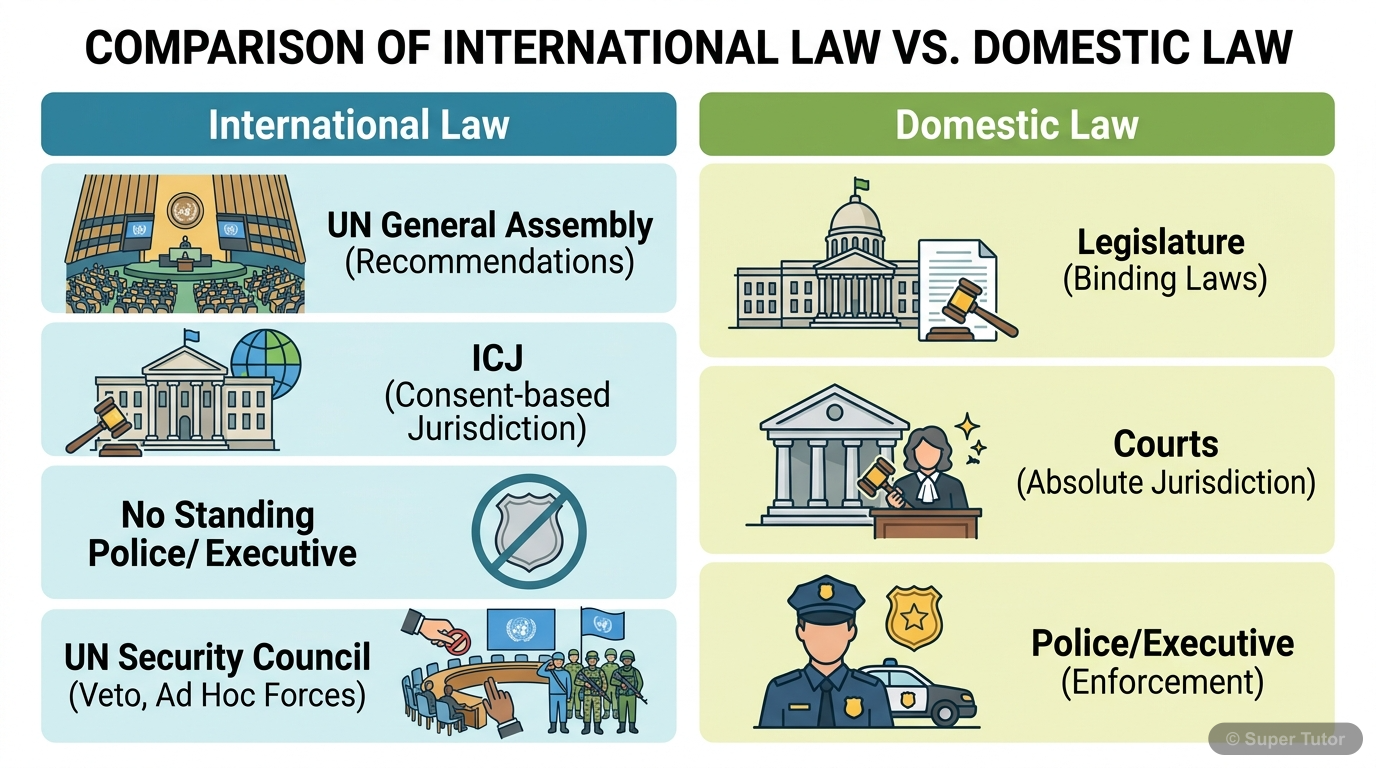
A comparison chart highlighting the key differences between international law and domestic (municipal) law, focusing on legislative power, jurisdiction, enforcement, and executive authority.
Super Tutor

This is just one of 11+ visuals inside Super Tutor's International Law chapter

Explore the full set
6 Questions Solved · 1 Section

Exercise — International Law (Legal Studies, Class 12)

1Distinguish between Public International Law and Private International Law.Show solution
Given / Concept: International Law is broadly divided into two branches — Public International Law and Private International Law. The distinction is as follows:

| Basis | Public International Law | Private International Law |
|---|---|---|
| Definition | It governs the legal relations between sovereign States and international organisations. | It governs legal relations between private individuals or entities belonging to different countries. |
| Parties involved | States, international organisations, and sometimes individuals (e.g., in human rights law). | Private individuals, corporations, or entities from different nations. |
| Subject matter | War and peace, treaties, diplomatic relations, human rights, law of the sea, etc. | Contracts, marriage, property, torts, and other civil matters having a cross-border element. |
| Sources | Treaties, customary international law, general principles, judicial decisions (Art. 38, ICJ Statute). | Domestic conflict-of-laws rules, bilateral treaties, and private agreements. |
| Enforcement | Through the ICJ, ICC, UN Security Council, and other international bodies. | Through domestic courts applying conflict-of-laws (choice of law) rules. |
| Example | A boundary dispute between India and Pakistan referred to the ICJ. | A contract dispute between an Indian company and a French company — which country's law applies? |

Conclusion: While Public International Law regulates the conduct of States on the world stage, Private International Law (also called Conflict of Laws) determines which domestic legal system governs a dispute involving private parties from different countries.
2What is the role of UN High Commissioner for Human Rights?Show solution
Given / Concept: The Office of the United Nations High Commissioner for Human Rights (OHCHR) was established by General Assembly Resolution 48/141 on 20 December 1993. The High Commissioner is the principal human rights official of the United Nations.

Role of the UN High Commissioner for Human Rights:

1. Promotion and Protection of Human Rights: The High Commissioner promotes and protects the enjoyment and full realisation of all human rights — civil, cultural, economic, political, and social — by all people.

2. Advisory Services: The office provides technical assistance and advisory services to governments, national human rights institutions, and civil society organisations to strengthen their capacity to protect human rights.

3. Coordination within the UN System: The High Commissioner coordinates human rights activities throughout the entire UN system and ensures that human rights are mainstreamed into all UN programmes and policies.

4. Monitoring and Reporting: The office monitors human rights situations across the world and prepares reports for the UN General Assembly and the Human Rights Council, drawing attention to violations.

5. Responding to Violations: The High Commissioner responds to serious violations of human rights and takes preventive action by engaging with governments and other stakeholders.

6. Dialogue with Governments: The Commissioner engages in dialogue with governments to encourage them to ratify international human rights treaties and implement their obligations.

7. Public Awareness: The office works to raise global awareness about human rights issues and the importance of international human rights standards.

Conclusion: The UN High Commissioner for Human Rights acts as the global conscience for human rights, working to ensure that the rights enshrined in international instruments are respected, protected, and fulfilled worldwide.
3Explain the various sources of International Law.Show solution
Given / Concept: The sources of International Law are authoritatively listed in Article 38(1) of the Statute of the International Court of Justice (ICJ). These are the materials and processes from which international legal rules are derived.

Sources of International Law:

1. International Conventions / Treaties (Article 38(1)(a))
- Treaties are formal written agreements between two or more States.
- They are the most important and clearest source of international law.
- Bilateral treaties bind only the two parties; multilateral treaties (e.g., the UN Charter, Geneva Conventions) may bind many States.
- A treaty is binding only on States that have ratified or acceded to it (*pacta sunt servanda* — agreements must be kept).

2. International Custom (Article 38(1)(b))
- Customary international law arises from the consistent and general practice of States followed out of a sense of legal obligation (*opinio juris*).
- Two elements are required: (i) State practice — widespread and consistent conduct of States, and (ii) Opinio juris — the belief that such practice is legally obligatory.
- Example: The principle of diplomatic immunity developed as customary law before being codified in the Vienna Convention.

3. General Principles of Law (Article 38(1)(c))
- These are principles recognised by civilised nations in their domestic legal systems that are applied at the international level.
- Examples include principles of good faith, equity, res judicata, and the principle that no one can be a judge in their own cause.

4. Judicial Decisions (Article 38(1)(d)) — Subsidiary Source
- Decisions of international courts (especially the ICJ) and tribunals are used as subsidiary means for determining rules of law.
- Under Article 59 of the ICJ Statute, decisions bind only the parties to the case, but they carry great persuasive authority.

5. Writings of Publicists (Article 38(1)(d)) — Subsidiary Source
- The teachings and writings of the most highly qualified publicists (scholars) of international law are also a subsidiary source.
- Works of scholars like Hugo Grotius, Vattel, and Malcolm Shaw have shaped international legal thinking.

Other Modern Sources (not in Art. 38 but recognised):
- Resolutions of the UN General Assembly — though not legally binding, they reflect international opinion and can contribute to the formation of customary law.
- Acts of International Organisations — decisions of bodies like the UN Security Council (under Chapter VII) can be binding.

Conclusion: The sources of international law work together to form a comprehensive legal framework. Treaties and custom are the primary sources, while judicial decisions and scholarly writings assist in interpreting and developing the law.
4What happens in case of conflict between a treaty provision and a domestic law?Show solution
Given / Concept: A conflict between an international treaty obligation and a domestic (municipal) law is a common issue in international law. The resolution of such a conflict depends on the approach adopted by the State — Monism or Dualism — and the specific constitutional provisions of the country.

Two Theoretical Approaches:

1. Monist Approach:
- International law and domestic law form a single, unified legal system.
- International law is automatically part of domestic law without the need for separate legislation.
- In case of conflict, international law generally prevails over domestic law.
- Countries like the Netherlands follow this approach.

2. Dualist Approach:
- International law and domestic law are two separate and distinct legal systems.
- A treaty does not automatically become part of domestic law; it must be incorporated through legislation.
- In case of conflict, domestic law prevails within the territory of that State, even if this puts the State in breach of its international obligations.
- India broadly follows the dualist approach.

Position in India:
- Under Article 253 of the Indian Constitution, Parliament has the power to make laws to implement international treaties, agreements, and conventions.
- A treaty ratified by India does not automatically become enforceable in Indian courts unless Parliament enacts a law to give effect to it.
- If there is a conflict between a treaty provision and an existing Indian law, the domestic law will prevail in Indian courts.
- However, Indian courts try to interpret domestic law in a manner consistent with India's international obligations wherever possible.
- Example: The *Vishaka v. State of Rajasthan* (1997) case, where the Supreme Court used CEDAW (an international convention) to fill gaps in domestic law on sexual harassment.

At the International Level:
- A State cannot use its domestic law as a justification for non-performance of its international treaty obligations (Article 27, Vienna Convention on the Law of Treaties).
- If a State violates a treaty because of a conflicting domestic law, it may face international responsibility — sanctions, referral to the ICJ, or diplomatic consequences.

Conclusion: In case of conflict, the outcome depends on the constitutional framework of the State. Domestically, domestic law usually prevails (especially in dualist States like India), but internationally, the State remains bound by its treaty obligations and may be held responsible for the breach.
5Explain the existing dispute resolution mechanism in International Law.Show solution
Given / Concept: International disputes between States are resolved through various mechanisms. Unlike domestic law, there is no single compulsory court system; instead, multiple forums and methods exist, largely based on the consent of the parties.

Dispute Resolution Mechanisms in International Law:

1. Negotiation and Diplomacy
- The simplest and most common method.
- States resolve disputes directly through diplomatic channels — bilateral talks, exchange of notes, or summit meetings.
- No third party is involved.

2. Mediation and Good Offices
- A neutral third party (a State, an international organisation, or an individual) assists the disputing parties in reaching a settlement.
- The mediator actively proposes solutions; in good offices, the third party merely facilitates communication.
- Example: UN Secretary-General often provides good offices.

3. Conciliation
- A commission of conciliation examines the dispute and proposes a non-binding solution.
- The parties are free to accept or reject the proposal.

4. Arbitration
- Parties agree to submit their dispute to an arbitral tribunal, whose decision (award) is binding.
- The Permanent Court of Arbitration (PCA) at The Hague is a major arbitration forum.
- Many treaties include arbitration clauses.

5. The International Court of Justice (ICJ)
- The principal judicial organ of the United Nations (Article 92, UN Charter).
- Settles legal disputes between States (contentious jurisdiction) and gives advisory opinions to UN organs.
- Jurisdiction is based on consent — States must accept the court's jurisdiction (Article 36, ICJ Statute).
- Its decisions are binding on the parties to the case.

6. The International Criminal Court (ICC)
- Established under the Rome Statute (2002).
- Deals with criminal matters — genocide, war crimes, crimes against humanity, and the crime of aggression.
- Prosecutes individuals (not States) for the most serious international crimes.
- Has jurisdiction only if the accused is a national of a State party or the crime was committed on the territory of a State party, or the matter is referred by the UN Security Council.
- Its jurisdiction is more restricted than ordinary criminal courts.

7. Treaty-Based Dispute Resolution Mechanisms
- Many treaties create their own dispute resolution panels.
- Example: The General Agreement on Tariffs and Trade (GATT) / World Trade Organization (WTO) has a Dispute Settlement Body (DSB) with panels and an Appellate Body.
- The United Nations, in association with the World Bank, has created forums to deal with investment disputes (e.g., ICSID — International Centre for Settlement of Investment Disputes).

8. UN Security Council
- Under Chapter VI (Pacific Settlement of Disputes) and Chapter VII (Action with respect to threats to peace), the Security Council can recommend or impose measures to resolve disputes.
- Chapter VII resolutions are binding on all UN member States.

Conclusion: International law offers a wide range of dispute resolution mechanisms — from diplomatic negotiation to binding judicial decisions. The choice of mechanism depends on the nature of the dispute, the parties involved, and the treaties applicable. The ICJ's enabling provisions are wide enough to deal with most disputes between member States.
6In an international conference, aimed at formulating a resolution on an environment issue between the member countries, Indian representative headed for a consent, subject to approval by Indian Parliament. The Parliament, on considering the matter, refused to give assent and thus the terms of resolution were not implemented in India.

a. Identify the mode of entering into the treaty opted in the given condition.
b. Analyze the situation when it would be binding on the Indian representative to give assent to the resolution.
Show solution
Given Facts:
- An international conference was held on an environmental issue.
- The Indian representative gave consent to the resolution subject to approval by the Indian Parliament.
- The Indian Parliament refused to give its assent.
- As a result, the terms of the resolution were not implemented in India.

---

Part (a): Identify the mode of entering into the treaty opted in the given condition.

Answer: The mode of entering into the treaty opted in the given condition is Ratification.

Explanation:
- Ratification is the formal process by which a State confirms and gives its final consent to be bound by a treaty that its representative has already signed or agreed to at an international conference.
- In this case, the Indian representative gave a conditional consent — i.e., consent subject to the approval of the Indian Parliament. This is the classic feature of ratification, where the signature or initial agreement at the conference level is not final; it must be subsequently approved by the competent domestic authority (here, the Parliament).
- Under Article 253 of the Indian Constitution, Parliament has the power to legislate for implementing international treaties. The executive (government) negotiates and signs treaties, but for them to have domestic legal force, parliamentary approval or legislation may be required.
- Since Parliament refused to give assent, the treaty was not ratified and therefore not binding on India.

---

Part (b): Analyze the situation when it would be binding on the Indian representative to give assent to the resolution.

Answer: The resolution would be binding on the Indian representative (and consequently on India) in the following situations:

1. If Parliament gives its assent: Had the Indian Parliament approved the resolution, the Indian representative would have been bound to implement its terms. Parliamentary approval would have completed the process of ratification, making the treaty binding on India under international law.

2. If the treaty is entered into by way of Executive Action (without requiring Parliamentary approval): Certain treaties or executive agreements that do not require changes in domestic law or financial commitments may be entered into by the executive alone. In such cases, the consent of the Indian representative at the conference itself would be binding, without needing Parliamentary approval.

3. If India is a party to a treaty that mandates acceptance of such resolutions: If India had previously ratified a parent treaty or convention that obligates member States to accept resolutions passed by the conference of parties (e.g., certain environmental conventions), then the resolution could be binding on India regardless of Parliamentary approval.

4. If the resolution reflects a rule of Customary International Law: If the environmental norm in the resolution has attained the status of customary international law (i.e., it is followed by States out of a sense of legal obligation — *opinio juris*), India would be bound by it even without ratification, since customary law binds all States.

Conclusion: In the given scenario, since the mode chosen was ratification and Parliament withheld its assent, India is not bound by the resolution domestically. However, India must be careful — if the resolution reflects binding international obligations, India could still face international responsibility for non-compliance.

Stuck on a step?

Ask Super Tutor AI to explain any solution on this page in a simpler way — free, 24x7.

Ask a Doubt Free

Frequently Asked Questions

What are the important topics in International Law for CBSE Class 12 Legal Studies?
Key topics in International Law include International Law - Complete Overview, International Law Framework Overview, International Law Concept Overview. These are the concepts CBSE Class 12 examiners draw on most — study them first, then practise related questions.
How to score full marks in International Law — CBSE Class 12 Legal Studies?
Start by understanding all key concepts. Practise previous year questions from this chapter. Revise formulas and definitions regularly. Use flashcards for quick revision before the exam.
Where can I get free NCERT Solutions for International Law Class 12 Legal Studies?
This page has free step-by-step NCERT Solutions for every exercise question in International Law (CBSE Class 12 Legal Studies) — written the way examiners award marks: given, formula, working, answer.

Sources & Official References

Content is aligned to the official syllabus. Refer to the board website for the latest curriculum.

For serious students

Get the full International Law chapter — for free.

Quizzes, flashcards, AI doubt-solver and a step-by-step study plan for CBSE Class 12 Legal Studies.