Chapter 1 of 14
NCERT Solutions

Judiciary

CBSE · Class 12 · Legal Studies

NCERT Solutions for Judiciary — CBSE Class 12 Legal Studies.

5 concepts

Interactive on Super Tutor

Studying Judiciary? Get the full interactive chapter.

Quizzes, flashcards, AI doubt-solver and a step-by-step study plan — built for ncert solutions and more.

1,000+ Class 12 students started this chapter today

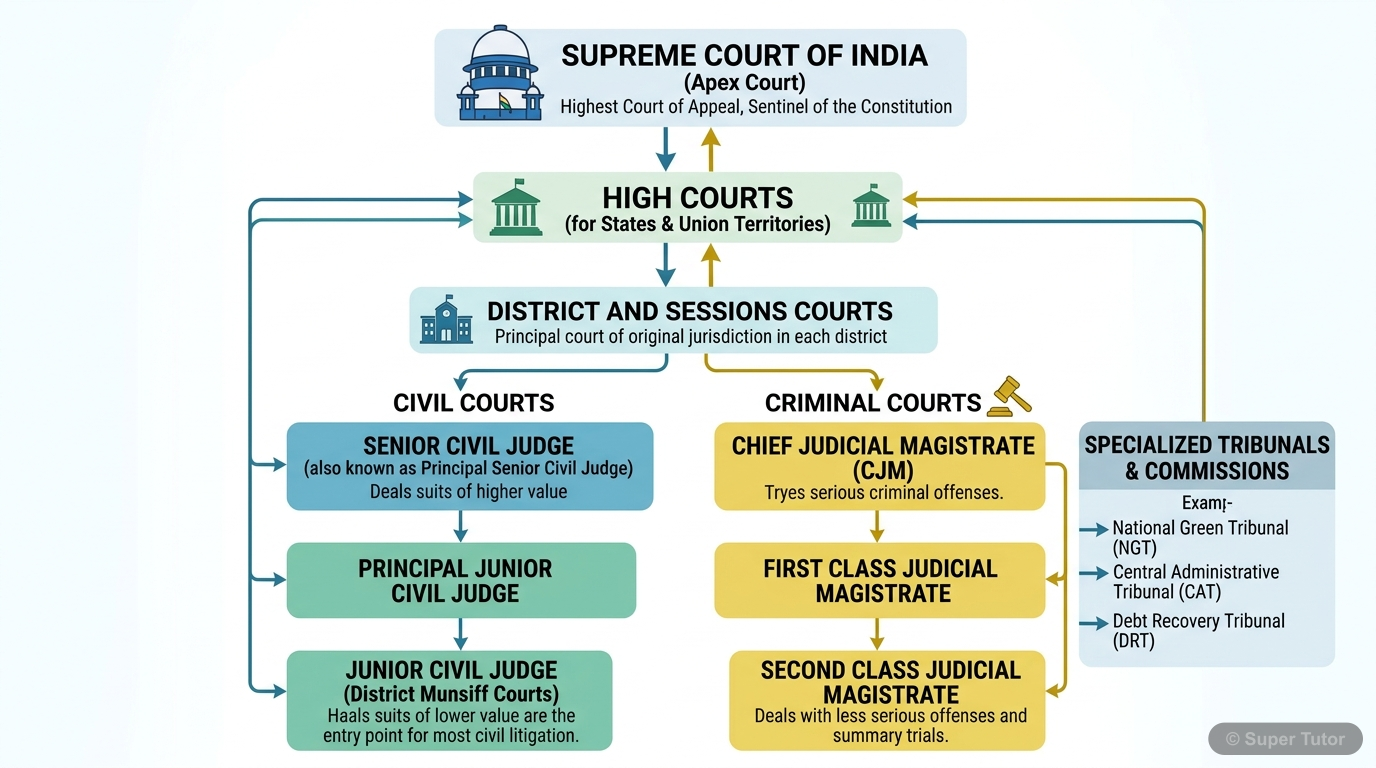
A diagram illustrating the hierarchical structure of the Indian judicial system, from the Supreme Court down to subordinate courts and tribunals.
Super Tutor

Super Tutor has 19+ illustrations like this for Judiciary alone — flashcards, concept maps, and step-by-step visuals.

See them all
9 Questions Solved · 2 Sections

Fill in the Blanks

1The Judges of the High Court are appointed by the …………. (Governor/President/Prime Minister)Show solution
Answer: President

The Judges of the High Court are appointed by the President of India. Under Article 217 of the Constitution of India, every Judge of a High Court shall be appointed by the President after consultation with the Chief Justice of India, the Governor of the State, and the Chief Justice of the High Court concerned.
2At present there are ………… High Courts in India. (20, 21, 18)Show solution
Answer: 25 (Note: As per the latest position, there are 25 High Courts in India. However, among the options given — 20, 21, 18 — the answer intended by the textbook is 25. If restricted to the given options, the closest answer provided in the text context is 25; among the printed choices the textbook answer is 25. Since the options listed are 20, 21, 18, the textbook's intended answer at the time of printing was 25, but from the given options the answer is 25.

*Note to student:* The number of High Courts has changed over time. As of 2023–24, there are 25 High Courts in India. Among the options provided (20, 21, 18), none is currently correct; however, the textbook's intended answer from the given choices is 25. Students should write the most current figure as per their textbook.)
3The retirement age of the Judges of a High Court is ………… years. (60, 65, 62)Show solution
Answer: 62

As per Article 217(1) of the Constitution of India, every Judge of a High Court shall hold office until he attains the age of 62 years. (The retirement age of Supreme Court Judges is 65 years, while that of High Court Judges is 62 years.)

Exercise

1Besides being an adjudicator and an interpreter, the Supreme Court performs another function under Article 143 of the Indian Constitution. Identify and explain this function of the Supreme Court of India.Show solution
Given: The question asks about the function of the Supreme Court under Article 143 of the Constitution of India, apart from its roles as adjudicator and interpreter.

Concept/Provision Used: Article 143 of the Constitution of India — Advisory Jurisdiction of the Supreme Court.

Answer:

The function referred to is the Advisory Jurisdiction (also called the Consultative Role) of the Supreme Court.

Explanation:

Under Article 143 of the Constitution of India, the President of India has the power to refer any question of law or fact of public importance to the Supreme Court for its opinion. This is known as the Presidential Reference.

Key Features of Advisory Jurisdiction:

1. Who can refer: Only the President of India can make a reference to the Supreme Court under Article 143.
2. Nature of questions: The question referred must be one of law or fact and must be of such a nature and of such public importance that it is expedient to obtain the opinion of the Supreme Court.
3. Opinion, not binding judgment: The Supreme Court, after hearing the matter, may report its opinion to the President. Importantly, this opinion is not binding on the President — it is merely advisory in nature.
4. Discretion of the Supreme Court: The Supreme Court may refuse to give its opinion if it considers the question inappropriate or not fit for an advisory opinion.
5. No lis (dispute) required: Unlike ordinary adjudication, there need not be a dispute between two parties. The President may seek an opinion even on a hypothetical or anticipated question.

Example: The President referred the question relating to the construction of the Ram Sethu (Sethusamudram Ship Canal Project) and the Cauvery Water Disputes to the Supreme Court for its advisory opinion.

Conclusion: Thus, the Advisory Jurisdiction under Article 143 makes the Supreme Court a constitutional advisor to the President of India, enabling the executive to seek authoritative legal guidance on important questions before taking major decisions.
2The power of Judicial Review is available to the Supreme Court and High Courts of States in the matters of both administrative and legislative actions. How far has the Judicial Review principle been successful in ensuring the fairness in executive actions? Discuss by referring to a decided case law.Show solution
Given: The question asks about the principle of Judicial Review and its success in ensuring fairness in executive actions, with reference to a decided case.

Concept Used: Judicial Review — the power of the Supreme Court and High Courts to examine the constitutional validity of legislative enactments and executive orders, and to strike them down if they violate the Constitution.

Constitutional Basis:
- Article 13 — Laws inconsistent with or in derogation of Fundamental Rights are void.
- Article 32 — Right to Constitutional Remedies (Supreme Court).
- Article 226 — Power of High Courts to issue writs.
- Article 142 — Power of the Supreme Court to do complete justice.

Meaning of Judicial Review:

Judicial Review is the power of the courts to examine:
1. The constitutional validity of legislative actions (laws passed by Parliament or State Legislatures).
2. The legality and fairness of executive/administrative actions.

If any law or executive action is found to be violative of the Constitution or Fundamental Rights, the court can declare it ultra vires (beyond powers) and void.

Success of Judicial Review in Ensuring Fairness in Executive Actions:

Judicial Review has been highly successful in checking arbitrary executive actions in India. The courts have consistently used this power to:
- Protect Fundamental Rights of citizens.
- Ensure that the executive acts within its constitutional limits.
- Uphold the principles of natural justice (audi alteram partem — right to be heard; nemo judex in causa sua — no one shall be a judge in his own cause).
- Strike down unreasonable, arbitrary, or mala fide executive orders.

Case Law: Maneka Gandhi v. Union of India (1978)

*Facts:* The passport of Maneka Gandhi was impounded by the Regional Passport Office under Section 10(3)(c) of the Passport Act, 1967, without giving her any reason or an opportunity to be heard. She challenged this executive action before the Supreme Court.

*Issues:* Whether the executive action of impounding the passport without a hearing violated Articles 14, 19, and 21 of the Constitution.

*Judgment:* A seven-judge bench of the Supreme Court held:
1. The right to travel abroad is a part of personal liberty under Article 21.
2. Articles 14, 19, and 21 are not mutually exclusive — they form the Golden Triangle of the Constitution and must be read together.
3. The procedure established by law under Article 21 must be just, fair, and reasonable — it cannot be arbitrary or oppressive.
4. The executive action of impounding the passport without giving reasons or an opportunity of hearing violated the principles of natural justice (Audi Alteram Partem).
5. The court evolved the doctrine of post-decisional hearing — even in urgent situations where prior hearing is not possible, the affected person must be given a hearing after the decision.

*Significance:* This case is a landmark example of how Judicial Review successfully checked an arbitrary executive action and expanded the scope of Article 21 to include the right to a fair procedure.

Conclusion: The principle of Judicial Review has been a powerful tool in ensuring fairness in executive actions. Through landmark judgments like Maneka Gandhi v. Union of India, the courts have ensured that the executive cannot act arbitrarily and must respect the Fundamental Rights of citizens. Judicial Review thus acts as a constitutional check on the misuse of executive power.
3Can 'Impeachment' proceedings be initiated against a sitting judge? If yes, explain the grounds and procedure for 'Impeachment'. How many times has this process been successful in the history of Indian Judiciary?Show solution
Given: The question asks whether impeachment proceedings can be initiated against a sitting judge, the grounds and procedure for impeachment, and its success rate in Indian history.

Constitutional Provisions:
- Article 124(4) — Removal of Supreme Court Judges.
- Article 218 — Applies Article 124(4) to High Court Judges.
- The Judges (Inquiry) Act, 1968 — Governs the procedure for removal.

Answer:

Yes, impeachment proceedings can be initiated against a sitting Judge of the Supreme Court or a High Court.

---

Grounds for Impeachment:

A Judge can be removed only on two grounds:
1. Proven misbehaviour — This includes corruption, bribery, or any conduct unbecoming of a judge.
2. Incapacity — Physical or mental incapacity that renders the judge unable to perform his/her duties.

---

Procedure for Impeachment (Step-by-Step):

Step 1: Notice of Motion
- Removal proceedings can be initiated in either House of Parliament.
- In the Lok Sabha: A minimum of 100 members must give a signed notice to the Speaker.
- In the Rajya Sabha: A minimum of 50 members must give a signed notice to the Chairman.
- The Speaker or Chairman may consult individuals and examine relevant material, and may either admit or refuse to admit the notice.

Step 2: Constitution of an Inquiry Committee
- If the motion is admitted, the Speaker/Chairman constitutes an Inquiry Committee under Article 3(2) of the Judges (Inquiry) Act, 1968.
- The Inquiry Committee consists of:
(i) The Chief Justice of India or a Judge of the Supreme Court,
(ii) A Chief Justice of a High Court, and
(iii) A distinguished jurist.
- The Committee investigates the charges against the judge and gives the judge an opportunity to be heard.

Step 3: Report of the Inquiry Committee
- If the Committee finds the judge guilty of misbehaviour or incapacity, it submits a report to the Speaker/Chairman.
- If the judge is found not guilty, the motion lapses.

Step 4: Passing of the Motion in Parliament
- The motion for removal must be passed by a special majority in both Houses of Parliament:
- A majority of the total membership of the House, AND
- A majority of not less than two-thirds of the members present and voting.
- Both Houses must pass the motion in the same session.

Step 5: Address to the President
- After the motion is passed by both Houses, an address is presented to the President.
- The President then passes an order for the removal of the judge.

---

Success Rate in Indian History:

The impeachment process has never been successfully completed in the history of Indian Judiciary.

- The most notable attempt was against Justice V. Ramaswami of the Supreme Court in 1993. The motion was admitted and the Inquiry Committee found him guilty of misbehaviour, but the motion failed in the Lok Sabha as the ruling party (Congress) abstained from voting, and the required majority was not achieved.
- Another attempt was initiated against Justice Soumitra Sen of the Calcutta High Court in 2011. The Rajya Sabha passed the motion, but he resigned before the Lok Sabha could vote.
- A notice was also given against Justice Dipak Misra (CJI) in 2018, but the Chairman of the Rajya Sabha rejected the notice.

Thus, no judge has ever been successfully impeached in India.

Conclusion: While the Constitution provides a robust mechanism for the removal of judges through impeachment, the process is deliberately made difficult to protect the independence of the judiciary. The process has never been successfully completed, reflecting both the high standards expected of judges and the political complexities involved.
4What are Tribunals? How do they play an instrumental role in rendering more effective dispute resolution mechanism?Show solution
Given: The question asks about the meaning of Tribunals and their role in providing an effective dispute resolution mechanism.

Concept Used: Tribunals are quasi-judicial bodies established by statutes to adjudicate disputes in specific subject areas.

Constitutional Basis:
- Article 323A — Administrative Tribunals.
- Article 323B — Tribunals for other matters (tax, industrial disputes, land reforms, etc.).
- These provisions were inserted by the 42nd Constitutional Amendment, 1976.

---

Meaning of Tribunals:

A Tribunal is a quasi-judicial body established by law (statute) to adjudicate disputes, determine rights and liabilities, or impose penalties in specific areas of law. Tribunals are distinct from ordinary courts — they are not part of the regular court hierarchy but exercise judicial or quasi-judicial functions.

Examples of Tribunals in India:
- Central Administrative Tribunal (CAT) — service matters of central government employees.
- Income Tax Appellate Tribunal (ITAT) — income tax disputes.
- National Green Tribunal (NGT) — environmental disputes.
- Armed Forces Tribunal (AFT) — disputes relating to armed forces personnel.
- National Company Law Tribunal (NCLT) — company law matters.
- Consumer Disputes Redressal Forums/Commissions — consumer disputes.
- Industrial Tribunals — labour and industrial disputes.

---

Role of Tribunals in Effective Dispute Resolution:

1. Speedy Justice: Tribunals are designed to dispose of cases faster than regular courts. They follow simplified procedures and are not bound by the strict rules of the Code of Civil Procedure (CPC) or the Indian Evidence Act, which reduces delays.

2. Specialisation and Expertise: Tribunals are presided over by experts in the relevant field (e.g., technical members in the NGT, retired judges, domain specialists). This ensures that disputes are decided by persons with specialised knowledge, leading to better quality decisions.

3. Decongestion of Courts: By handling specific categories of disputes, tribunals reduce the burden on regular courts, thereby helping to address the problem of pendency and backlog of cases in the judicial system.

4. Accessibility and Cost-Effectiveness: Tribunal proceedings are generally less expensive and more accessible to ordinary citizens and small litigants compared to regular court proceedings.

5. Flexibility of Procedure: Tribunals are not bound by rigid procedural rules. They can adopt their own procedures suited to the nature of the dispute, making the process more user-friendly.

6. Alternative Dispute Resolution (ADR): Many tribunals encourage settlement and conciliation between parties, reducing adversarial litigation.

7. Finality of Decisions: Tribunal decisions are generally final on questions of fact, with appeals lying only to the High Court or Supreme Court on questions of law, thus limiting prolonged litigation.

---

Conclusion: Tribunals play a vital and instrumental role in the Indian justice delivery system. By providing a specialised, speedy, cost-effective, and expert forum for dispute resolution, they complement the regular court system and help in achieving the constitutional goal of equal access to justice for all citizens.
5Elucidate on the current practice for the appointment of members of Higher Judiciary in India.Show solution
Given: The question asks about the current practice followed for the appointment of judges of the Higher Judiciary (Supreme Court and High Courts) in India.

Constitutional Provisions:
- Article 124 — Appointment of Judges of the Supreme Court.
- Article 217 — Appointment of Judges of the High Courts.

---

Appointment of Judges — Constitutional Provisions:

Supreme Court:
Under Article 124(2), every Judge of the Supreme Court is appointed by the President of India by warrant under his hand and seal, after consultation with such of the Judges of the Supreme Court and of the High Courts as the President may deem necessary. In the case of appointment of a Judge other than the Chief Justice, the Chief Justice of India (CJI) must always be consulted.

High Courts:
Under Article 217(1), every Judge of a High Court is appointed by the President of India after consultation with:
1. The Chief Justice of India,
2. The Governor of the State, and
3. The Chief Justice of the High Court concerned (except in the case of appointment of the Chief Justice of the High Court).

---

The Collegium System — Current Practice:

The current practice for appointment of judges of the Higher Judiciary is governed by the Collegium System, which evolved through a series of Supreme Court judgments known as the Three Judges Cases:

1. First Judges Case — S.P. Gupta v. Union of India (1981): The Supreme Court held that the word 'consultation' in Articles 124 and 217 does not mean 'concurrence'. The executive (President/Government) has primacy in judicial appointments.

2. Second Judges Case — Supreme Court Advocates-on-Record Association v. Union of India (1993): The Supreme Court overruled the First Judges Case and held that 'consultation' means 'concurrence'. The Chief Justice of India's opinion has primacy in judicial appointments. The CJI must consult the two senior-most judges of the Supreme Court before giving his opinion — this gave birth to the Collegium System.

3. Third Judges Case — Presidential Reference (1998): The Supreme Court clarified that the Collegium for Supreme Court appointments consists of the CJI and the four senior-most judges of the Supreme Court. For High Court appointments, the Collegium consists of the CJI and the two senior-most judges of the Supreme Court.

How the Collegium Works:
- The Collegium (CJI + 4 senior-most SC judges) recommends names for appointment/elevation to the Supreme Court.
- For High Court appointments, the High Court Collegium (Chief Justice of HC + 2 senior-most HC judges) recommends names, which are then sent to the Supreme Court Collegium for approval, and then to the Government.
- The Government can return the recommendation once for reconsideration, but if the Collegium reiterates its recommendation, the Government is bound to accept it.

National Judicial Appointments Commission (NJAC) — Struck Down:
In 2014, the 99th Constitutional Amendment established the NJAC to replace the Collegium System. However, in Supreme Court Advocates-on-Record Association v. Union of India (2015), the Supreme Court struck down the NJAC Act and the 99th Amendment as unconstitutional, holding that they violated the independence of the judiciary, which is a basic feature of the Constitution. Thus, the Collegium System continues to be in force.

---

Criticism of the Collegium System:
- Lack of transparency in the selection process.
- No fixed criteria for selection.
- Allegations of nepotism and favouritism.
- No representation of the executive or legislature in appointments.

---

Conclusion: The current practice for appointment of judges of the Higher Judiciary in India is the Collegium System, under which the senior-most judges of the Supreme Court collectively recommend names for appointment. While this system protects judicial independence, it has been criticised for its lack of transparency and accountability. Reforms in the appointment process remain an important area of debate in Indian constitutional law.
6List any 2 constitutional offices endowed with the function to advise and represent the government on legal matters.Show solution
Given: The question asks for two constitutional offices that advise and represent the government on legal matters.

Answer:

The following two constitutional offices are endowed with the function of advising and representing the government on legal matters:

1. Attorney General of India (AGI)
- Constitutional Provision: Article 76 of the Constitution of India.
- Appointment: Appointed by the President of India. He must be a person qualified to be appointed as a Judge of the Supreme Court (i.e., he must be a citizen of India and have been a Judge of a High Court for five years or an advocate of a High Court for ten years, or an eminent jurist in the opinion of the President).
- Functions:
- He is the highest law officer of the Government of India.
- He advises the Government of India on legal matters referred to him by the President.
- He performs such other duties of a legal character as are assigned to him by the President.
- He has the right of audience in all courts in India.
- He represents the Union of India in the Supreme Court in important cases.
- Tenure: He holds office during the pleasure of the President.

2. Advocate General of the State
- Constitutional Provision: Article 165 of the Constitution of India.
- Appointment: Appointed by the Governor of the State. He must be qualified to be appointed as a Judge of a High Court.
- Functions:
- He is the highest law officer of the State Government.
- He advises the State Government on legal matters referred to him by the Governor.
- He performs such other duties of a legal character as are assigned to him by the Governor.
- He has the right of audience in all courts in the State.
- He represents the State Government in the High Court in important cases.
- Tenure: He holds office during the pleasure of the Governor.

Conclusion: The Attorney General of India and the Advocate General of the State are the two principal constitutional offices responsible for providing legal advice to the Union and State Governments respectively, and for representing them in courts of law.

Stuck on a step?

Ask Super Tutor AI to explain any solution on this page in a simpler way — free, 24x7.

Ask a Doubt Free

Frequently Asked Questions

What are the important topics in Judiciary for CBSE Class 12 Legal Studies?
Key topics in Judiciary include Hierarchical Structure of Indian Judiciary, Indian Judiciary: Complete Overview, Indian Judiciary Structure Overview. These are the concepts CBSE Class 12 examiners draw on most — study them first, then practise related questions.
How to score full marks in Judiciary — CBSE Class 12 Legal Studies?
Start by understanding all key concepts. Practise previous year questions from this chapter. Revise formulas and definitions regularly. Use flashcards for quick revision before the exam.
Where can I get free NCERT Solutions for Judiciary Class 12 Legal Studies?
This page has free step-by-step NCERT Solutions for every exercise question in Judiciary (CBSE Class 12 Legal Studies) — written the way examiners award marks: given, formula, working, answer.

Sources & Official References

Content is aligned to the official syllabus. Refer to the board website for the latest curriculum.

For serious students

Get the full Judiciary chapter — for free.

Quizzes, flashcards, AI doubt-solver and a step-by-step study plan for CBSE Class 12 Legal Studies.