Alternative Dispute Resolution in India (ADR) — NCERT Solutions
CBSE · Class 12 · Legal Studies
NCERT Solutions for Alternative Dispute Resolution in India (ADR), CBSE Class 12 Legal Studies: 7 textbook questions solved step by step.
Interactive on Super Tutor
Studying Alternative Dispute Resolution in India (ADR)? Get the full interactive chapter.
Quizzes, flashcards, AI doubt-solver and a step-by-step study plan — built for NCERT solutions and more.
Free trial, no card needed.
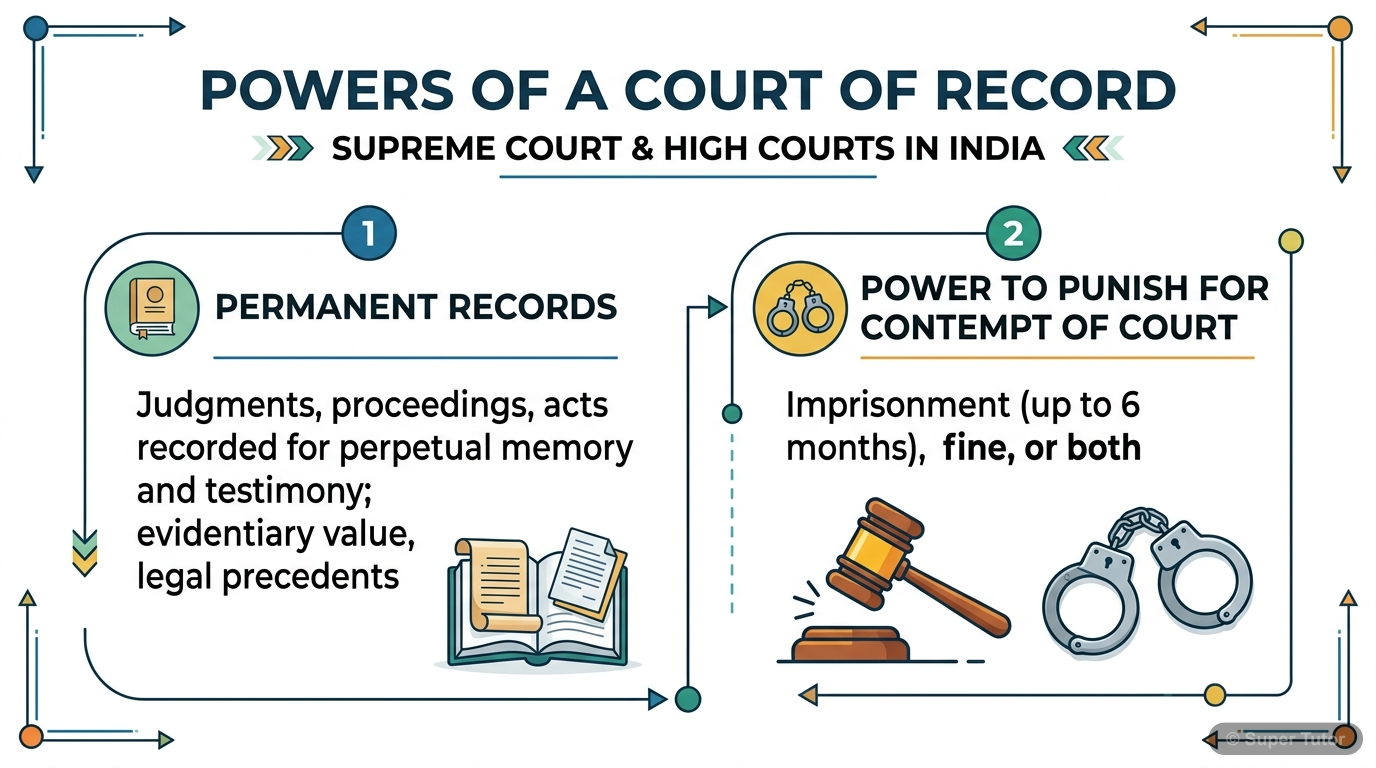
Learn better with visuals Super Tutor pairs illustrations like this with notes and quizzes for Alternative Dispute Resolution in India (ADR).
The first 4 solutions are open to read. The other 3 are free with a Super Tutor account.
Exercises — Alternative Dispute Resolution in India
1Ram and Sikander agreed in writing to resolve the disputes arising out of their contract by way of arbitration. A dispute arose between Ram and Sikander. Ram filed a case in the court. Will the court stay the legal proceedings filed by Ram? Discuss.Show solution
Given: Ram and Sikander had a written arbitration agreement. Despite this, Ram filed a suit in a civil court.
Concept/Law Applied: Section 8 of the Arbitration and Conciliation Act, 1996 deals with the power of a judicial authority to refer parties to arbitration where there is a valid arbitration agreement.
Discussion:
Step 1 – Validity of the Arbitration Agreement:
Ram and Sikander had entered into a written arbitration agreement, which is a legally binding contract under the Arbitration and Conciliation Act, 1996. Such an agreement signifies the mutual intention of the parties to resolve disputes outside the court system.
Step 2 – Effect of Filing a Suit Despite an Arbitration Agreement:
Under Section 8 of the Arbitration and Conciliation Act, 1996, if a party to an arbitration agreement files a suit in a court, the other party (Sikander) can apply to the court requesting that the matter be referred to arbitration. The court is then bound to refer the parties to arbitration, unless it finds that the arbitration agreement is null and void, inoperative, or incapable of being performed.
Step 3 – Stay of Legal Proceedings:
Once Sikander makes such an application (before submitting his first statement on the substance of the dispute), the court must stay the legal proceedings filed by Ram and refer the dispute to arbitration. The court cannot proceed with the case on merits as long as a valid arbitration agreement exists.
Step 4 – Rationale:
The law respects the autonomy of parties who have voluntarily chosen arbitration as their dispute resolution mechanism. Allowing one party to unilaterally bypass the agreed mechanism would defeat the purpose of the arbitration agreement.
Conclusion: Yes, the court will stay the legal proceedings filed by Ram. Since there is a valid written arbitration agreement between Ram and Sikander, the court is obligated under Section 8 of the Arbitration and Conciliation Act, 1996 to refer the parties to arbitration and stay the suit filed by Ram, provided Sikander makes the appropriate application.
2Mr Hari and his friend, Mr Suresh entered into a partnership deed to carry on the business of creative designing. After a year of starting a successful partnership firm, creative differences arose between Mr Hari and Mr Suresh, which created a rift between them. To help resolve the dispute, Mr Sharma, the secretary of a reputed firm, is facilitating them to help them achieve an acceptable agreement. Which dispute resolution method is Mr Sharma resorting to? Explain.Show solution
Given: Mr Hari and Mr Suresh have a dispute arising from creative differences. Mr Sharma is facilitating them to reach an acceptable agreement.
Identification of the Method:
Mr Sharma is resorting to Mediation as a method of Alternative Dispute Resolution (ADR).
Explanation of Mediation:
Step 1 – Meaning:
Mediation is a voluntary, informal, and confidential process in which a neutral third party, called the mediator, assists the disputing parties in reaching a mutually acceptable settlement. The mediator does not impose a decision but facilitates communication and negotiation between the parties.
Step 2 – Role of the Mediator (Mr Sharma):
- Mr Sharma acts as a neutral facilitator.
- He helps Mr Hari and Mr Suresh communicate their concerns, interests, and needs to each other.
- He guides the discussion without taking sides or imposing any solution.
- His goal is to help both parties arrive at a mutually acceptable agreement on their own.
Step 3 – Key Features of Mediation:
- Voluntary: Both parties willingly participate.
- Confidential: Discussions remain private.
- Non-binding (unless agreed upon): The mediator has no authority to impose a decision.
- Party-controlled: The parties themselves decide the outcome.
- Flexible and informal: There are no rigid procedural rules.
- Preserves relationships: Particularly useful in disputes between partners, friends, or family members, as it is non-adversarial.
Step 4 – Suitability in this Case:
Since Mr Hari and Mr Suresh are friends and business partners, mediation is the most appropriate method as it is non-adversarial, preserves their personal and professional relationship, and allows them to craft a solution that suits both parties.
Conclusion: Mr Sharma is using Mediation — a form of ADR where a neutral third party facilitates dialogue between the disputing parties to help them reach a voluntary, mutually acceptable resolution without imposing any decision.
3Sita and Reena are business partners. After sometime a dispute arose between them. Both of them agreed to submit the dispute between them to Mr Bajaj, a senior member of a law firm. Sita subsequently came to know that Reena and Mr Bajaj are related to each other. Can Sita challenge the authority of Mr Bajaj as an arbitrator? Discuss.Show solution
Given: Sita and Reena agreed to submit their dispute to Mr Bajaj as arbitrator. Sita later discovered that Reena and Mr Bajaj are related to each other.
Concept/Law Applied: Sections 12 and 13 of the Arbitration and Conciliation Act, 1996 deal with the grounds for challenging an arbitrator and the procedure for such a challenge.
Discussion:
Step 1 – Requirement of Independence and Impartiality:
An arbitrator must be independent and impartial. This is a fundamental principle of natural justice and is enshrined in the Arbitration and Conciliation Act, 1996. Any relationship — personal, financial, or professional — between an arbitrator and one of the parties that gives rise to justifiable doubts about the arbitrator's impartiality is a valid ground for challenge.
Step 2 – Grounds for Challenge (Section 12):
Under Section 12 of the Act, an arbitrator may be challenged if:
- Circumstances exist that give rise to justifiable doubts as to his independence or impartiality, OR
- He does not possess the qualifications agreed to by the parties.
The fact that Mr Bajaj is related to Reena creates a reasonable apprehension of bias and gives rise to justifiable doubts about his impartiality. This is a valid ground for challenge.
Step 3 – Procedure for Challenge (Section 13):
- Sita must send a written statement of the reasons for the challenge to the arbitral tribunal within 15 days of becoming aware of the constitution of the tribunal or of the circumstances giving rise to the challenge.
- If Mr Bajaj does not withdraw and Reena does not agree to the challenge, the arbitral tribunal shall decide on the challenge.
- If the challenge is not successful before the tribunal, Sita may request the court to decide the matter after the arbitral award is made.
Step 4 – Conclusion:
Yes, Sita can challenge the authority of Mr Bajaj as an arbitrator. The relationship between Mr Bajaj and Reena gives rise to justifiable doubts about his independence and impartiality, which is a valid ground for challenge under Section 12 of the Arbitration and Conciliation Act, 1996. Sita should file a written challenge within 15 days of coming to know of this relationship, following the procedure prescribed under Section 13 of the Act.
4What is the meaning of Ombudsman? Identify equivalent institutions within India. Discuss their roles and limitations.Show solution
Meaning of Ombudsman:
Step 1 – Definition:
The term 'Ombudsman' is of Scandinavian origin, meaning 'representative of the people' or 'grievance officer'. An Ombudsman is an independent, impartial authority appointed by the government or legislature to investigate complaints made by citizens against public officials, government departments, or service providers. The Ombudsman acts as a watchdog to protect citizens from maladministration, abuse of power, and injustice.
Step 2 – Equivalent Institutions in India:
India has adopted the concept of Ombudsman in various sectors under different names:
| Institution | Sector Covered |
|---|---|
| Lokpal | Central Government public functionaries |
| Lokayukta | State Government public functionaries |
| Banking Ombudsman | Banking services (RBI) |
| Insurance Ombudsman | Insurance services |
| Central Vigilance Commission (CVC) | Vigilance and anti-corruption at central level |
Step 3 – Roles:
(a) Lokpal:
- Investigates complaints of corruption against public functionaries including the Prime Minister (with certain restrictions), Ministers, Members of Parliament, and Group A, B, C, D officers of the Central Government.
- Has the power to recommend prosecution and impose penalties.
(b) Lokayukta:
- Functions at the state level, similar to Lokpal.
- Investigates complaints of corruption and maladministration against state government officials.
- Submits reports to the Governor/Legislature.
(c) Banking Ombudsman:
- Resolves complaints of bank customers regarding deficiency in banking services such as non-payment of deposits, delays in remittances, credit card complaints, etc.
- Provides a free and expeditious remedy.
(d) Insurance Ombudsman:
- Resolves complaints of policyholders against insurance companies regarding claim settlement, policy terms, and premium disputes.
Step 4 – Limitations:
- Limited Jurisdiction: Each Ombudsman has a defined and limited jurisdiction; they cannot address all types of grievances.
- Lack of Enforcement Power: Most Ombudsmen can only recommend action; they cannot enforce their decisions directly (except in some cases).
- Non-binding Recommendations: In many cases, the recommendations of the Ombudsman are not legally binding on the government or the institution.
- Lack of Awareness: A large section of the population, especially in rural areas, is unaware of the existence and functioning of these institutions.
- Inadequate Infrastructure: Many Ombudsman offices are understaffed and under-resourced, leading to delays.
- Political Influence: There are concerns about the independence of these institutions from political interference.
- Lokayukta Gap: Not all states have established Lokayuktas despite the mandate under the Lokpal and Lokayuktas Act, 2013.
Conclusion: The Ombudsman concept is a vital tool for ensuring accountability and transparency in governance. In India, institutions like Lokpal, Lokayukta, Banking Ombudsman, and Insurance Ombudsman serve this purpose, though they face significant limitations that need to be addressed for more effective functioning.
Free with a Super Tutor account
(a) Elaborate on the scope of The Lokpal and Lokayukta Act, 2013.
(b) Explain the composition of Lokpal under the Act.
Free with a Super Tutor account
Free with a Super Tutor account
3 more solved questions in Alternative Dispute Resolution in India (ADR)
They are free with a Super Tutor account, along with practice quizzes and flashcards for this chapter. Free to start, no card needed.
Frequently Asked Questions
What are the important topics in Alternative Dispute Resolution in India (ADR) for CBSE Class 12 Legal Studies?
Are these NCERT Solutions for Alternative Dispute Resolution in India (ADR) free?
Sources & Official References
- NCERT Official — ncert.nic.in
- CBSE Academic — cbseacademic.nic.in
- CBSE Official — cbse.gov.in
- National Education Policy 2020 — education.gov.in
Content is aligned to the official syllabus. Refer to the board website for the latest curriculum.
More resources for Alternative Dispute Resolution in India (ADR)
For serious students
Get the full Alternative Dispute Resolution in India (ADR) chapter — start free.
Quizzes, flashcards, an AI doubt solver and a study plan for CBSE Class 12 Legal Studies. Free to start, no card needed.