Attitude and Social Cognition
CBSE · Class 12 · Psychology
NCERT Solutions for Attitude and Social Cognition — CBSE Class 12 Psychology.
Interactive on Super Tutor
Studying Attitude and Social Cognition? Get the full interactive chapter.
Quizzes, flashcards, AI doubt-solver and a step-by-step study plan — built for ncert solutions and more.
1,000+ Class 12 students started this chapter today

This is just one of 12+ visuals inside Super Tutor's Attitude and Social Cognition chapter
Explore the full setReview Questions — Chapter 6: Attitude and Social Cognition
1Define attitude. Discuss the components of an attitude.Show solution
An attitude is a learned predisposition to respond in a consistently favourable or unfavourable manner with respect to a given object, person, group, issue, or event. It represents a combination of thoughts, feelings, and behavioural tendencies directed towards something.
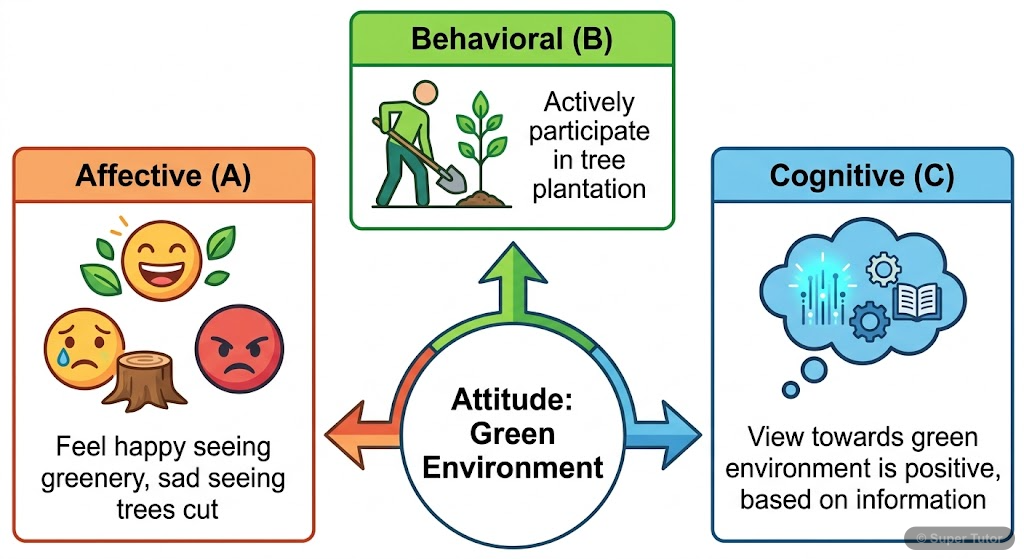
Components of an Attitude (A-B-C Model):
An attitude has three interrelated components:
1. Affective Component (A — 'A' for Affect/Feeling):
- This refers to the emotional or feeling aspect of an attitude.
- It involves the positive or negative feelings a person has towards the attitude object.
- Example: Feeling happy and excited about environmental conservation.
2. Behavioural Component (B — 'B' for Behaviour):
- This refers to the tendency or predisposition to act in a certain way towards the attitude object.
- It is the action-oriented component.
- Example: Actively participating in cleanliness drives or recycling activities.
3. Cognitive Component (C — 'C' for Cognition/Thought):
- This refers to the beliefs, thoughts, and knowledge a person holds about the attitude object.
- It includes what a person knows or believes to be true.
- Example: Believing that pollution is harmful to health and the environment.
Interrelation of Components:
All three components are interrelated. A change in one component often leads to a change in the others. For instance, if a person gains new knowledge (cognitive) about the dangers of junk food, their feelings (affective) and behaviour (behavioural) towards junk food may also change.
Conclusion: Attitudes are complex mental states that guide our perceptions, feelings, and actions towards objects, people, or situations in our social world.
2Are attitudes learnt? Explain how?Show solution
How Attitudes are Learnt — Major Processes:
1. Classical Conditioning:
- When a neutral stimulus is repeatedly paired with a stimulus that already produces a positive or negative response, the neutral stimulus begins to evoke a similar response.
- Example: A child who repeatedly sees their parent react with fear towards dogs will develop a negative attitude towards dogs.
2. Operant (Instrumental) Conditioning:
- Attitudes that are rewarded (reinforced) tend to be strengthened, while those that are punished tend to be weakened.
- Example: A child who is praised for expressing respect towards elders develops a positive attitude towards elders.
3. Observational Learning (Modelling):
- People learn attitudes by observing and imitating others, especially role models, parents, teachers, and peers.
- Example: A child who observes their parents donating to charity develops a positive attitude towards helping others.
4. Family and School Influences:
- Family is the primary agent of socialisation. Parents, siblings, and the home environment shape early attitudes.
- Schools and teachers further reinforce or modify these attitudes.
- Example: A family that values education instils a positive attitude towards learning in children.
5. Reference Groups:
- The groups to which a person belongs or aspires to belong (peer groups, religious groups, political groups) strongly influence attitude formation.
- Example: Peer pressure during adolescence can shape attitudes towards fashion, music, or social issues.
6. Media:
- Television, social media, newspapers, and advertisements play a powerful role in shaping attitudes by repeatedly presenting certain images, ideas, and values.
- Example: Advertisements promoting healthy eating can develop positive attitudes towards nutritious food.
Conclusion: Since attitudes are learnt through these various processes, they can also be changed or modified through similar learning experiences.
3What are the factors that influence the formation of an attitude?Show solution
Attitude formation is a gradual process influenced by multiple factors:
1. Family and Early Socialisation:
- The family is the first and most influential agent of socialisation.
- Children absorb the values, beliefs, and attitudes of their parents and siblings from a very early age.
- Example: Attitudes towards religion, caste, gender roles, and politics are often shaped within the family.
2. School and Educational Institutions:
- Teachers, curriculum, and the school environment contribute significantly to attitude formation.
- Schools promote attitudes towards discipline, patriotism, equality, and learning.
3. Peer Groups and Reference Groups:
- As children grow, peer groups become increasingly important in shaping attitudes.
- Reference groups (groups one identifies with or aspires to join) also influence attitudes strongly.
- Example: Adolescents may adopt the attitudes of their friend circle regarding fashion, music, or social issues.
4. Personal Experience:
- Direct personal experiences with objects, people, or events lead to the formation of strong attitudes.
- Example: A person who has had a bad experience with a particular community may develop a negative attitude towards that group.
5. Media:
- Mass media (television, internet, newspapers, films) shapes attitudes by repeatedly presenting certain viewpoints, stereotypes, and values.
- Advertising is a powerful tool for attitude formation and change.
6. Culture and Society:
- The broader cultural context, social norms, traditions, and values of a society influence what attitudes are considered acceptable or desirable.
7. Economic and Social Status:
- A person's socioeconomic background can influence their attitudes towards work, education, politics, and social issues.
Conclusion: Attitude formation is a complex, ongoing process shaped by the interplay of personal experiences and social influences throughout a person's life.
4Is behaviour always a reflection of one's attitude? Explain with a relevant example.Show solution
Explanation:
Although attitudes are predispositions to behave in a certain way, actual behaviour does not always correspond to attitudes. There can be a significant gap between what a person believes or feels (attitude) and what they actually do (behaviour). This is known as the attitude-behaviour gap.
Factors that cause a gap between attitude and behaviour:
1. Social Norms and Pressure: A person may hold a private attitude but behave differently in public due to social pressure or fear of disapproval.
- Example: A person may privately believe in gender equality but may not speak up against gender discrimination in a traditional family setting.
2. Situational Constraints: External circumstances may prevent a person from acting according to their attitude.
- Example: A person may have a positive attitude towards donating to charity but may not donate due to financial constraints.
3. Competing Attitudes: Sometimes two conflicting attitudes exist simultaneously, and the stronger one determines behaviour.
4. Lack of Awareness or Opportunity: A person may not always have the opportunity to act in accordance with their attitude.
Relevant Example:
A student may have a very positive attitude towards physical fitness and believe that exercise is important for health. However, due to a busy schedule, laziness, or peer influence, the same student may not exercise regularly. Here, the behaviour (not exercising) does not reflect the attitude (believing in fitness).
Conclusion: While attitudes do influence behaviour, the relationship between the two is not always direct or consistent. Behaviour is shaped by a combination of attitudes, situational factors, social norms, and personal constraints. Therefore, behaviour is not always a true reflection of one's attitude.
5Differentiate between prejudice and stereotype.Show solution
| Basis | Prejudice | Stereotype |
|---|---|---|
| Definition | A negative attitude towards a group or its members based on generalised and often incorrect beliefs. | A fixed, oversimplified, and generalised belief or image about a particular group of people. |
| Nature | It is an attitude (involves feelings, beliefs, and behavioural tendencies). | It is a cognitive belief or mental image (primarily the cognitive component). |
| Components | Has affective (emotional), cognitive, and behavioural components. | Primarily a cognitive (thought-based) generalisation. |
| Valence | Always negative in nature. | Can be positive, negative, or neutral. |
| Basis | Based on faulty generalisations and emotional biases. | Based on oversimplification; may contain a 'kernel of truth' but is exaggerated. |
| Example | Believing that people from a particular religion are untrustworthy and feeling hostility towards them. | Believing that all engineers are good at mathematics, or that all people from a certain region are lazy. |
| Relationship | Prejudice often uses stereotypes as its cognitive basis. | Stereotypes can lead to prejudice when they are negative and rigidly held. |
Key Relationship:
Stereotypes often serve as the cognitive foundation for prejudice. When a person holds a negative stereotype about a group and develops strong negative feelings about it, the stereotype becomes part of a prejudice. However, not all stereotypes lead to prejudice.
Conclusion: While stereotypes are generalised beliefs (cognitive), prejudice is a broader negative attitude that includes emotional hostility and a tendency to discriminate. Prejudice is more harmful as it can lead to discrimination and social conflict.
6Prejudice can exist without discrimination and vice versa. Comment.Show solution
This statement is correct. Prejudice and discrimination, though closely related, are distinct concepts and do not always occur together.
Definitions:
- Prejudice is a negative *attitude* towards a group or its members. It involves negative feelings, beliefs, and behavioural tendencies.
- Discrimination is the *behavioural expression* of prejudice — it involves treating members of a group unfairly or unequally based on their group membership.
Prejudice without Discrimination:
A person may hold strong prejudiced attitudes (negative feelings and beliefs) towards a group but may not discriminate against them in actual behaviour due to:
- Social norms and laws: Anti-discrimination laws may prevent a prejudiced person from acting on their bias.
- Social pressure: Fear of social disapproval may stop a person from expressing prejudice through behaviour.
- Situational constraints: The person may not have the opportunity or power to discriminate.
*Example:* An employer may personally dislike people from a particular community (prejudice) but may still hire them fairly because the law prohibits discrimination in employment.
Discrimination without Prejudice:
A person may discriminate against a group without personally holding prejudiced attitudes, due to:
- Institutional or systemic discrimination: A person may follow discriminatory rules or policies set by an institution without personally agreeing with them.
- Conformity to social norms: A person may discriminate simply because 'everyone else does it' or because it is the accepted norm in their society.
- Peer pressure: A person may act in a discriminatory way to fit in with a group, even without personal prejudice.
*Example:* A bank employee may deny loans to people from a certain community because of the bank's unofficial policy, even though the employee personally has no prejudice against that community.
Conclusion:
Prejudice is an internal attitude, while discrimination is an external behaviour. Although they are often linked — prejudice frequently leads to discrimination — they can and do exist independently of each other. This distinction is important for designing effective strategies to reduce both prejudice and discrimination in society.
7Your friend eats too much junk food, how would you be able to bring about a change in her/his attitude towards food?Show solution
To change my friend's attitude towards junk food, I would use the following strategies based on the principles of attitude change:
1. Providing Information and Education (Cognitive Route):
- I would share factual information about the harmful effects of junk food — such as obesity, diabetes, heart disease, skin problems, and poor concentration.
- Showing documentaries, articles, or research findings about the long-term health consequences of junk food can appeal to the cognitive component of my friend's attitude.
- Correcting misconceptions (e.g., 'junk food gives energy') with accurate nutritional information.
2. Appealing to Emotions (Affective Route):
- I would appeal to my friend's emotions by discussing how poor health affects quality of life, relationships, and future goals.
- Sharing real-life stories or examples of young people who suffered health problems due to junk food can create an emotional impact.
- This targets the affective (feeling) component of the attitude.
3. Using a Credible and Attractive Source:
- Attitude change is more effective when the message comes from a credible, trustworthy, and attractive source.
- I could encourage my friend to consult a nutritionist or doctor, or show them advice from a popular fitness influencer or celebrity they admire.
4. Modelling Healthy Behaviour:
- I would lead by example — eating healthy food in front of my friend, carrying nutritious snacks, and choosing healthy options when we eat together.
- Observational learning (modelling) is a powerful tool for attitude change.
5. Creating Cognitive Dissonance:
- I would help my friend realise the inconsistency between their desire to be healthy/fit (positive attitude towards health) and their habit of eating junk food (behaviour).
- This internal conflict (cognitive dissonance) can motivate them to change their behaviour to restore consistency.
6. Gradual and Positive Reinforcement:
- Instead of demanding an abrupt change, I would encourage small, gradual steps — like replacing one junk food item per week with a healthier alternative.
- Praising and positively reinforcing every healthy choice my friend makes will strengthen the new attitude.
7. Peer Group Influence:
- Encouraging our friend group to collectively adopt healthier eating habits can create a supportive social environment.
- Since peer groups are powerful reference groups, group norms favouring healthy eating can influence my friend's attitude.
Conclusion:
Attitude change is most effective when it targets all three components — cognitive (beliefs), affective (feelings), and behavioural (actions). By combining information, emotional appeal, modelling, and social support, I can gradually help my friend develop a healthier attitude towards food.
Stuck on a step?
Ask Super Tutor AI to explain any solution on this page in a simpler way — free, 24x7.
Ask a Doubt FreeFrequently Asked Questions
What are the important topics in Attitude and Social Cognition for CBSE Class 12 Psychology?
How to score full marks in Attitude and Social Cognition — CBSE Class 12 Psychology?
Where can I get free NCERT Solutions for Attitude and Social Cognition Class 12 Psychology?
Sources & Official References
- NCERT Official — ncert.nic.in
- CBSE Academic — cbseacademic.nic.in
- CBSE Official — cbse.gov.in
- National Education Policy 2020 — education.gov.in
Content is aligned to the official syllabus. Refer to the board website for the latest curriculum.
More resources for Attitude and Social Cognition
Important Questions
Practice with board exam-style questions
Syllabus
What topics to cover
Revision Notes
Key points for last-minute revision
Study Plan
Step-by-step plan to ace this chapter
Flashcards
Quick-fire cards for active recall
Formula Sheet
All formulas in one place
Chapter Summary
Understand the chapter at a glance
Practice Quiz
Test yourself with a quick quiz
Concept Maps
See how topics connect visually
For serious students
Get the full Attitude and Social Cognition chapter — for free.
Quizzes, flashcards, AI doubt-solver and a step-by-step study plan for CBSE Class 12 Psychology.