Variations in Psychological Attributes — NCERT Solutions
CBSE · Class 12 · Psychology
NCERT Solutions for Variations in Psychological Attributes, CBSE Class 12 Psychology: 12 textbook questions solved step by step. Covers Review Questions.
Interactive on Super Tutor
Studying Variations in Psychological Attributes? Get the full interactive chapter.
Quizzes, flashcards, AI doubt-solver and a step-by-step study plan — built for NCERT solutions and more.
Free trial, no card needed.
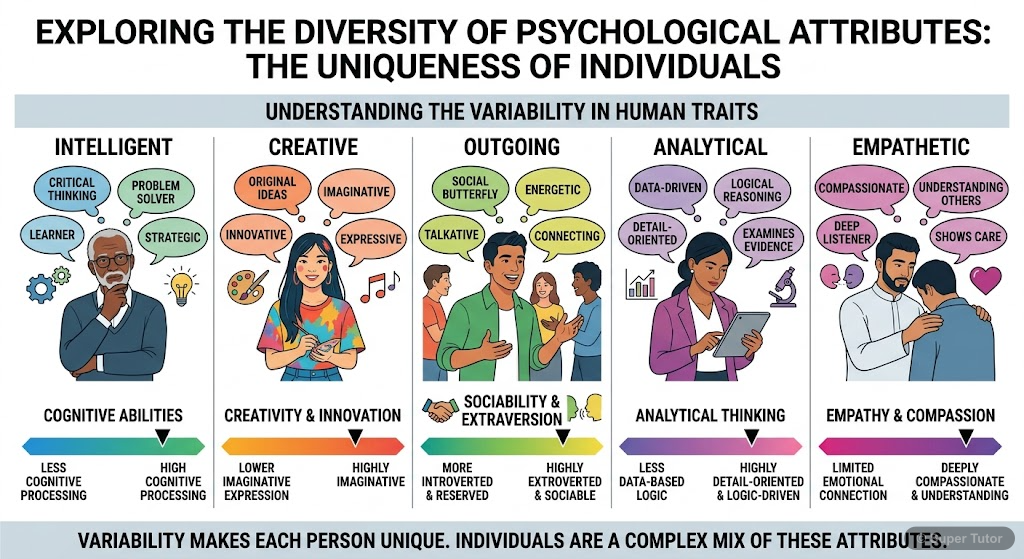
One of 16 illustrations for Variations in Psychological Attributes in Super Tutor — alongside flashcards, concept maps and practice questions.
See them allThe first 6 solutions are open to read. The other 6 are free with a Super Tutor account. Unlock all 12 free in Super Tutor
Review Questions
1How do psychologists characterise and define intelligence?Show solution
Psychologists characterise intelligence as a person's capacity to understand the world, think rationally, and use available resources effectively when faced with challenges. It is also described as the ability to perceive, learn, understand, and know. Different psychologists have emphasised different aspects: Binet stressed judging, understanding and reasoning well; Wechsler viewed it as the global and aggregate capacity to think rationally, act purposefully, and deal effectively with the environment. Thus, intelligence is not a single skill but a global cognitive competence that helps a person adapt to situations.
Not sure why a step works? check your working in Super Tutor
2To what extent is our intelligence the result of heredity (nature) and environment (nurture)? Discuss.Show solution
Intelligence is the result of a complex interaction of heredity and environment. Evidence for nature comes from twin and adoption studies: identical twins show very high similarity in intelligence, even when reared apart, and children's intelligence is often more similar to their biological than adoptive parents. Evidence for nurture comes from the fact that children raised in richer environments, with good nutrition, supportive families, and quality schooling, tend to improve in intelligence; environmental deprivation lowers intelligence. So neither heredity nor environment works alone. Heredity sets the range, and the environment shapes how much of that potential is actually developed.
Not sure why a step works? check your working in Super Tutor
3Explain briefly the multiple intelligences identified by Gardner.Show solution
Gardner proposed multiple intelligences, meaning intelligence is not one single ability but several independent types. The eight intelligences are:
- Linguistic: skill in using language fluently and flexibly.
- Logical-mathematical: ability to think logically, critically, and solve problems.
- Spatial: ability to form, use, and transform mental images and patterns.
- Musical: ability to produce and manipulate musical rhythms and patterns.
- Bodily-kinaesthetic: ability to use the body or parts of it flexibly and creatively.
- Interpersonal: ability to understand others' motives, feelings, and behaviour.
- Intrapersonal: ability to understand one's own feelings, motives, and desires.
- Naturalistic: ability to identify and discriminate features of the natural world.
Gardner also said these intelligences are independent, though they may work together in solving problems.
Not sure why a step works? check your working in Super Tutor
4How does the triarchic theory help us to understand intelligence?Show solution
Sternberg's triarchic theory helps us understand intelligence by showing that intelligent behaviour has three forms:
- Componential or analytical intelligence: analysing information and solving problems. It includes knowledge acquisition, meta-componential planning, and performance.
- Experiential or creative intelligence: using past experience creatively to solve novel problems and make new discoveries or inventions.
- Contextual or practical intelligence: dealing with everyday environmental demands, also called street smartness or business sense; it helps a person adapt to, select, or shape the environment.
This theory is helpful because it explains intelligence not just as school success or test scores, but as analytical, creative, and practical functioning.
Not sure why a step works? check your working in Super Tutor
5"Any intellectual activity involves the independent functioning of three neurological systems". Explain with reference to PASS model.Show solution
The PASS model says intellectual activity involves three interdependent neurological systems:
- Arousal/Attention: helps a person attend to relevant stimuli. An optimal level of arousal focuses attention on the task; too much or too little interferes.
- Simultaneous processing: integrating information at the same time to perceive relations and form a meaningful pattern. Example: solving a Raven's Progressive Matrices item.
- Successive processing: remembering and processing information in serial order, where one item leads to the next. Example: learning digits, alphabets, or multiplication tables.
- Planning: deciding possible courses of action, carrying them out, and evaluating them; if needed, plans are modified.
So, any intellectual activity depends on the coordinated functioning of attention/arousal, simultaneous-successive processing, and planning.
Not sure why a step works? check your working in Super Tutor
6Are there cultural differences in the conceptualisation of intelligence?Show solution
Yes, there are cultural differences in the conceptualisation of intelligence. Culture provides the context in which intelligence develops and is valued.
- In technologically advanced Western societies, intelligence is often linked with skills like analysis, speed, performance, and achievement orientation. The book calls this technological intelligence.
- In many non-Western societies, intelligence is seen more in terms of social and emotional competence, self-reflection, and the ability to relate well with others.
- In the Indian tradition, intelligence is viewed more holistically as integral intelligence or buddhi, which includes cognitive, social, emotional, and entrepreneurial competences.
Thus, intelligence is not understood in the same way everywhere; its meaning depends on cultural values and life conditions.
Not sure why a step works? check your working in Super Tutor
Free with a Super Tutor account
Free with a Super Tutor account
Free with a Super Tutor account
Free with a Super Tutor account
Free with a Super Tutor account
Free with a Super Tutor account
6 more solved questions in Variations in Psychological Attributes
They are free with a Super Tutor account, along with practice quizzes and flashcards for this chapter. Free to start, no card needed.
Frequently Asked Questions
What are the important topics in Variations in Psychological Attributes for CBSE Class 12 Psychology?
Are these NCERT Solutions for Variations in Psychological Attributes free?
How should I revise Variations in Psychological Attributes for the CBSE Class 12 board exam?
Sources & Official References
- NCERT Official — ncert.nic.in
- CBSE Academic — cbseacademic.nic.in
- CBSE Official — cbse.gov.in
- National Education Policy 2020 — education.gov.in
Content is aligned to the official syllabus. Refer to the board website for the latest curriculum.
More resources for Variations in Psychological Attributes
Practice Quiz
Test yourself with a quick quiz
Important Questions
Exam-style questions with answers
Revision Notes
Key points for last-minute revision
Chapter Summary
Understand the chapter at a glance
Concept Maps
See how topics connect
Study Plan
Step-by-step plan for this chapter
Flashcards
Quick-fire cards for active recall
Syllabus
What topics to cover
For serious students
Get the full Variations in Psychological Attributes chapter — start free.
Quizzes, flashcards, an AI doubt solver and a study plan for CBSE Class 12 Psychology. Free to start, no card needed.