Chapter 2 of 7
NCERT Solutions

Self and Personality

CBSE · Class 12 · Psychology

NCERT Solutions for Self and Personality — CBSE Class 12 Psychology.

33 questions25 flashcards5 concepts

Interactive on Super Tutor

Studying Self and Personality? Get the full interactive chapter.

Quizzes, flashcards, AI doubt-solver and a step-by-step study plan — built for ncert solutions and more.

1,000+ Class 12 students started this chapter today

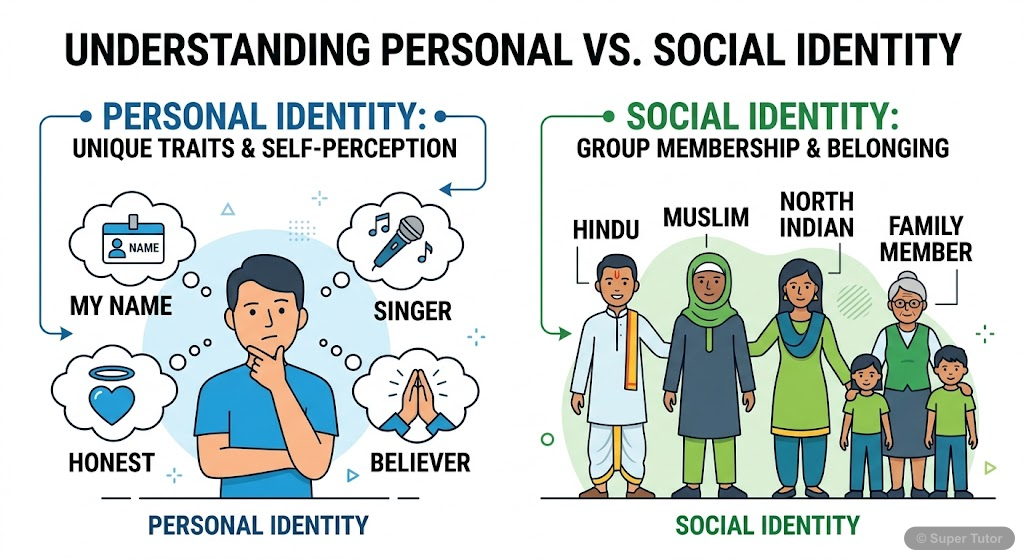
A comparison illustrating the attributes that define personal identity (e.g., name, qualities, beliefs) versus social identity (e.g., group affiliation, cultural background).
Super Tutor

This is just one of 26+ visuals inside Super Tutor's Self and Personality chapter

Explore the full set
11 Questions Solved · 1 Section

Review Questions — Chapter 2: Self and Personality

1What is self? How does the Indian notion of self differ from the Western notion?Show solution
What is Self?

The self refers to the totality of an individual's conscious experiences, ideas, thoughts, and feelings with regard to herself or himself. It is the awareness of one's own identity — who one is, what one values, and how one relates to others and the world.

The self has several components:
- Personal self – one's private identity, unique traits, and inner experiences.
- Social self – how one presents oneself in social situations.
- Relational self – identity defined through relationships with others.

Indian Notion of Self vs. Western Notion:

| Dimension | Western Notion | Indian Notion |
|---|---|---|
| Basic orientation | Individualistic — the self is seen as independent, autonomous, and separate from others. | Collectivistic / Spiritual — the self is seen as interdependent, embedded in family, community, and cosmos. |
| Boundaries | Self has clear, firm boundaries; personal goals and achievements are prioritised. | Self has fluid boundaries; group harmony and social duties are prioritised. |
| Identity | Identity is defined by personal attributes, achievements, and uniqueness. | Identity is defined by roles, relationships, and one's place in the social/cosmic order. |
| Ultimate goal | Self-actualisation and personal fulfilment. | Moksha (liberation) — transcending the individual ego to merge with the universal self (*Atman = Brahman*). |
| Locus | The individual is the basic unit of analysis. | The group (family, community) is the basic unit; the individual self is subordinate to it. |
| Nature of self | The self is relatively stable and fixed. | The self is seen as changeable and ultimately illusory (*Maya*); the true self is spiritual. |

Conclusion: The Western notion emphasises individuality, autonomy, and self-expression, whereas the Indian notion emphasises interconnectedness, duty (*dharma*), and spiritual transcendence of the ego-self.
2What is meant by delay of gratification? Why is it considered important for adult development?Show solution
Delay of Gratification:

Delay of gratification refers to the ability to resist an immediate, smaller reward in order to obtain a larger, more valuable reward at a later time. It is a form of self-regulation or self-control — the capacity to manage one's impulses and defer immediate pleasure for long-term benefit.

*Example:* A student who resists watching television and instead studies for an examination is delaying gratification.

The concept was famously studied by Walter Mischel through the Marshmallow Test, in which young children were offered one marshmallow immediately or two marshmallows if they waited.

Importance for Adult Development:

1. Academic and professional success: Children who could delay gratification were found to have better academic performance, higher SAT scores, and greater professional achievements in adulthood.

2. Emotional regulation: The ability to delay gratification is linked to better emotional control, lower levels of frustration, and greater resilience under stress.

3. Social competence: Individuals who can delay gratification tend to be more socially skilled, cooperative, and better at maintaining relationships.

4. Health and well-being: It is associated with healthier lifestyle choices — avoiding substance abuse, maintaining a balanced diet, and exercising regularly.

5. Goal-directed behaviour: It enables individuals to set long-term goals and work persistently towards them, which is essential for adult achievement and fulfilment.

Conclusion: Delay of gratification is a critical component of self-regulation and is considered a strong predictor of positive outcomes across multiple domains of adult life.
3How do you define personality? What are the main approaches to the study of personality?Show solution
Definition of Personality:

Personality refers to the relatively stable and enduring psychophysical characteristics of a person that make her/him unique and determine how she/he thinks, feels, and behaves across different situations and over time.

Key features of personality:
- It is relatively stable (consistent across situations and time).
- It is unique to each individual.
- It involves both psychological (mental) and physical (biological) characteristics.
- It helps the individual adapt to the environment.

Main Approaches to the Study of Personality:

1. Typological Approach:
- Attempts to classify people into a few distinct types based on a cluster of traits.
- *Example:* Sheldon's body-type theory (endomorph, mesomorph, ectomorph); Hippocrates' four humours.
- Allport, Cattell, and Eysenck advocated the trait approach, which identifies stable dimensions of personality (e.g., Eysenck's Introversion–Extraversion and Neuroticism).

2. Psychodynamic Approach (Freud):
- Personality is shaped by unconscious conflicts among the id (instinctual drives), ego (rational mediator), and superego (moral conscience).
- Development occurs through psychosexual stages: oral, anal, phallic, latency, and genital.
- Post-Freudians (Jung, Adler, Horney, Erikson) emphasised social and ego forces.

3. Behavioural Approach:
- Personality is the sum total of an individual's learned responses to environmental stimuli.
- The structural unit is the response, emitted to satisfy a specific need.
- Bandura's Social Learning Theory added the role of observation and self-efficacy.

4. Cultural Approach:
- Personality is shaped by the cultural demands placed on individuals by their economic and social environment.
- Different cultures produce different personality patterns through child-rearing practices and social norms.

5. Humanistic Approach:
- Focuses on subjective experience, free will, and the potential for growth.
- Rogers emphasised congruence between the *real self* and the *ideal self*.
- Maslow proposed a hierarchy of needs, with self-actualisation at the top.

Conclusion: Each approach offers a different lens to understand personality, and together they provide a comprehensive picture of human individuality.
4What is trait approach to personality? How does it differ from type approach?Show solution
Trait Approach to Personality:

A trait is a relatively stable, consistent, and enduring characteristic or disposition that influences an individual's behaviour across a variety of situations. The trait approach attempts to identify, describe, and measure these stable dimensions of personality.

Key theorists:
- Gordon Allport classified traits into *cardinal traits* (dominant), *central traits* (general characteristics), and *secondary traits* (situational).
- Raymond Cattell used factor analysis to identify 16 source traits (measured by the 16PF questionnaire).
- Hans Eysenck identified two major dimensions: Introversion–Extraversion and Neuroticism–Stability, later adding Psychoticism.
- The Big Five model (OCEAN) identifies five broad traits: Openness, Conscientiousness, Extraversion, Agreeableness, and Neuroticism.

Type Approach to Personality:

The type approach classifies people into a small number of discrete categories or types, each characterised by a specific cluster of traits. A person either belongs to a type or does not.

*Examples:*
- Hippocrates' four temperament types (sanguine, choleric, melancholic, phlegmatic).
- Sheldon's somatotypes (endomorph, mesomorph, ectomorph).
- Jung's introvert vs. extrovert types.

Differences between Trait Approach and Type Approach:

| Dimension | Trait Approach | Type Approach |
|---|---|---|
| Nature | Describes personality along continuous dimensions (a matter of degree). | Classifies people into discrete categories (either/or). |
| Flexibility | More flexible; recognises that people differ in the *degree* to which they possess a trait. | Less flexible; places people into fixed boxes. |
| Complexity | Captures the complexity and uniqueness of individuals. | Oversimplifies personality by forcing people into a few categories. |
| Measurement | Traits are measured on scales (e.g., high to low extraversion). | Types are assigned categorically. |
| View of individual | Offers a unified, multidimensional view of a person. | Provides a broad, generalised description. |

Conclusion: The trait approach is more nuanced and scientifically rigorous than the type approach, as it acknowledges that personality characteristics exist on a continuum rather than in fixed categories.
5How does Freud explain the structure of personality?Show solution
Freud's Structural Model of Personality:

Sigmund Freud, the founder of psychoanalysis, proposed that personality is structured into three distinct but interacting systems: the Id, the Ego, and the Superego. Personality emerges from the constant dynamic conflict among these three systems.

---

1. Id (The Pleasure Principle):
- The id is the most primitive part of personality, present from birth.
- It is entirely unconscious and contains all the basic biological drives and instincts (hunger, sex, aggression).
- It operates on the pleasure principle — it seeks immediate gratification of desires without regard for reality or morality.
- It uses primary process thinking (wish-fulfilment, fantasy).
- *Example:* A newborn crying immediately when hungry is driven purely by the id.

---

2. Ego (The Reality Principle):
- The ego develops from the id as the child interacts with the real world (around age 2–3).
- It operates on the reality principle — it mediates between the demands of the id, the superego, and external reality.
- It uses secondary process thinking (logical, rational thought).
- The ego decides when, how, and whether to satisfy id impulses in a socially acceptable manner.
- It operates at conscious, preconscious, and unconscious levels.
- *Example:* A person who is hungry waits until an appropriate time to eat rather than grabbing food immediately.

---

3. Superego (The Morality Principle):
- The superego develops around age 4–5 through internalisation of parental and societal values and moral standards.
- It represents the moral conscience and the ego ideal (what one aspires to be).
- It operates on the morality principle — it strives for perfection and punishes the ego with guilt when moral standards are violated.
- It is partly conscious and partly unconscious.
- *Example:* Feeling guilty after lying is the superego at work.

---

Interaction among Id, Ego, and Superego:

Id (impulse)Ego (mediator)Superego (morality)\text{Id (impulse)} \longleftrightarrow \text{Ego (mediator)} \longleftrightarrow \text{Superego (morality)}

- A healthy personality results when the ego successfully balances the demands of the id and superego.
- When the ego fails, anxiety results, and the ego employs defence mechanisms (repression, projection, rationalisation, etc.) to manage it.

Psychosexual Stages: Freud also proposed that personality develops through five stages — oral, anal, phallic, latency, and genital — and that unresolved conflicts at any stage lead to fixation and later psychological problems.

Conclusion: Freud's structural model highlights that personality is the product of dynamic, largely unconscious conflicts, and that understanding these conflicts is key to understanding human behaviour.
6How would Horney's explanation of depression be different from that of Alfred Adler?Show solution
Horney's Explanation of Depression:

Karen Horney was a Neo-Freudian who emphasised social and cultural factors in personality development. She rejected Freud's biological determinism and focused on interpersonal relationships and anxiety.

According to Horney:
- Depression arises from basic anxiety — a feeling of being isolated and helpless in a potentially hostile world, rooted in disturbed parent-child relationships (lack of warmth, love, and security in childhood).
- To cope with this anxiety, individuals adopt neurotic needs and three coping strategies: moving *towards* people (compliance), moving *against* people (aggression), or moving *away* from people (withdrawal).
- Depression results when these neurotic strategies fail to provide security, leading to a conflict between the idealised self (an unrealistic, glorified self-image) and the real self.
- The person becomes depressed because they cannot live up to their idealised self-image, leading to self-hatred and despair.
- Cultural and social pressures (especially on women) contribute significantly to depression.

---

Adler's Explanation of Depression:

Alfred Adler developed Individual Psychology and emphasised the role of social interest, inferiority feelings, and striving for superiority.

According to Adler:
- All humans are born with a sense of inferiority (due to their helplessness as children), which motivates them to strive for superiority or perfection.
- Depression arises when an individual develops an inferiority complex — an exaggerated, paralysing sense of inferiority that prevents healthy striving.
- A depressed person has a mistaken lifestyle — they have set unrealistic goals and, when they fail to achieve them, retreat into helplessness.
- Depression is also linked to a lack of social interest (*Gemeinschaftsgefühl*) — a failure to connect with and contribute to the community.
- The depressed person uses their symptoms as an excuse to avoid the tasks of life (work, love, and social relationships).

---

Key Differences:

| Dimension | Horney's View | Adler's View |
|---|---|---|
| Root cause | Basic anxiety from disturbed early relationships and cultural pressures. | Inferiority complex and mistaken lifestyle. |
| Central concept | Conflict between real self and idealised self; neurotic needs. | Striving for superiority gone wrong; lack of social interest. |
| Role of culture | Strong emphasis on cultural and gender-based social forces. | Less emphasis on culture; more on individual goal-setting and social interest. |
| Mechanism | Failure of neurotic coping strategies leads to self-hatred and depression. | Unrealistic goals + inferiority complex + withdrawal from social tasks leads to depression. |

Conclusion: While both Horney and Adler moved beyond Freud's biological focus, Horney attributed depression primarily to interpersonal anxiety and cultural conflict, whereas Adler attributed it to feelings of inferiority and a failure of social interest.
7What is the main proposition of humanistic approach to personality? What did Maslow mean by self-actualisation?Show solution
Main Proposition of the Humanistic Approach:

The humanistic approach to personality, developed by theorists such as Carl Rogers and Abraham Maslow, is based on the following core propositions:

1. Focus on subjective experience: Human beings are best understood through their own subjective, conscious experiences — their feelings, perceptions, and personal meanings — rather than through external observation alone.

2. Free will and agency: Humans are not merely driven by unconscious forces (as Freud argued) or environmental stimuli (as behaviourists argued). They have free will and the capacity to make choices.

3. Positive view of human nature: Humans are inherently good and growth-oriented. They have an innate drive towards self-actualisation — the realisation of their full potential.

4. Holistic perspective: The person must be understood as a whole, not reduced to parts or mechanisms.

5. Rogers' contribution: Carl Rogers emphasised the importance of the real self (who one actually is) and the ideal self (who one wishes to be). Congruence between these two selves leads to a fully functioning person — someone who is open to experience, lives fully in the present, and trusts their own judgement. Incongruence leads to anxiety and maladjustment. Rogers also stressed unconditional positive regard as essential for healthy personality development.

---

Maslow's Concept of Self-Actualisation:

Abraham Maslow proposed a hierarchy of needs (often depicted as a pyramid) to explain human motivation and personality:

PhysiologicalSafetyLove/BelongingEsteemSelf-Actualisation\text{Physiological} \rightarrow \text{Safety} \rightarrow \text{Love/Belonging} \rightarrow \text{Esteem} \rightarrow \text{Self-Actualisation}

- The lower four levels are deficiency needs (D-needs): they arise from a lack of something and must be satisfied before higher needs emerge.
- Self-actualisation is the highest level — a growth need (B-need or Being-need).

Self-actualisation refers to the process of realising and fulfilling one's unique potential — becoming the best version of oneself. It involves:
- Pursuing meaningful goals aligned with one's deepest values and talents.
- Experiencing peak experiences — moments of intense joy, wonder, and fulfilment.
- Being creative, spontaneous, and authentic.
- Having a deep concern for others and a sense of purpose beyond oneself.

Maslow studied self-actualised individuals (e.g., Abraham Lincoln, Albert Einstein) and identified common characteristics: acceptance of self and others, problem-centred focus, autonomy, deep interpersonal relationships, and a philosophical sense of humour.

Conclusion: The humanistic approach affirms the dignity and potential of every human being. Self-actualisation, in Maslow's view, is not a destination but an ongoing process of becoming — continuously growing towards one's fullest human potential.
8Discuss the main observational methods used in personality assessment. What problems do we face in using these methods?Show solution
Observational Methods in Personality Assessment:

Observational methods (also called observer reports) involve assessing personality by observing and recording an individual's behaviour. The main methods are:

---

1. Interview:
- A trained interviewer asks the individual a series of questions (structured or unstructured) to gather information about their personality, history, and behaviour.
- *Types:* Structured (fixed questions), unstructured (open-ended), and semi-structured.
- *Advantage:* Allows in-depth exploration; non-verbal cues can be observed.

2. Observation:
- The assessor directly watches the individual's behaviour in natural or controlled settings and records it systematically.
- *Types:* Naturalistic observation (in real-life settings) and controlled observation (in a laboratory).
- *Advantage:* Provides direct, first-hand information about actual behaviour.

3. Ratings:
- Observers (teachers, peers, supervisors) rate the individual on specific personality traits using rating scales.
- *Example:* A teacher rates a student on a scale of 1–5 for traits like cooperativeness, leadership, and honesty.
- *Advantage:* Quantifies subjective judgements; allows comparison across individuals.

4. Nomination:
- Individuals in a group are asked to nominate peers who best fit a particular description (e.g., "Who is the most helpful person in your class?").
- *Advantage:* Provides a peer-based, socially validated assessment of personality.

5. Situational Tests:
- Individuals are placed in standardised, lifelike situations and their responses are observed.
- *Example:* The Situational Stress Test used in military selection.
- *Advantage:* Assesses how a person actually behaves under realistic conditions.

---

Problems with Observational Methods:

1. Observer bias: The observer's own expectations, prejudices, and prior knowledge of the individual may distort their observations and ratings (halo effect — rating someone high on all traits because of one positive impression).

2. Lack of reliability: Different observers may interpret the same behaviour differently, leading to inconsistent results.

3. Reactivity: When individuals know they are being observed, they may change their behaviour (social desirability bias), making the observation less valid.

4. Limited scope: Observation captures behaviour only at a specific time and place; it may not reflect the individual's typical behaviour.

5. Time-consuming and expensive: Systematic observation and situational tests require considerable time, trained personnel, and resources.

6. Ethical concerns: Covert observation (without the person's knowledge) raises serious ethical issues regarding privacy and consent.

7. Subjectivity in interviews: The quality of an interview depends heavily on the skill of the interviewer; leading questions or poor rapport can distort responses.

Conclusion: While observational methods provide rich, direct information about personality, their effectiveness depends on the skill of the observer, the conditions of observation, and careful control of biases.
9What is meant by structured personality tests? Which are the two most widely used structured personality tests?Show solution
Structured Personality Tests:

Structured personality tests (also called self-report measures or objective tests) are standardised questionnaires or inventories in which individuals respond to a fixed set of questions or statements about themselves. The responses are typically in a structured format — Yes/No, True/False, or on a Likert scale (e.g., strongly agree to strongly disagree).

Key features:
- The questions are predetermined and fixed for all respondents.
- Responses are scored objectively using a standardised key.
- They are easy to administer (individually or in groups) and score.
- They provide quantitative data that can be compared across individuals and groups.
- They are based on the assumption that individuals can accurately report on their own personality traits.

---

Two Most Widely Used Structured Personality Tests:

1. Minnesota Multiphasic Personality Inventory (MMPI):
- Developed by Hathaway and McKinley (1943); revised as MMPI-2.
- Contains 567 true/false statements covering a wide range of psychological symptoms and personality characteristics.
- Originally designed to diagnose clinical/psychiatric conditions (e.g., depression, schizophrenia, paranoia), but is now widely used in personality assessment.
- Has 10 clinical scales and 3 validity scales (to detect lying, carelessness, or defensiveness).
- *Example item:* "I feel sad most of the time" — True/False.

2. Eysenck Personality Questionnaire (EPQ) / Sixteen Personality Factor Questionnaire (16PF):
- 16PF was developed by Raymond Cattell and measures 16 source traits of personality (e.g., warmth, reasoning, emotional stability, dominance).
- Widely used in occupational and educational settings.
- Alternatively, Eysenck's EPQ measures personality along the dimensions of Extraversion–Introversion, Neuroticism–Stability, and Psychoticism.

*(Note: Both MMPI and 16PF are the most commonly cited structured tests in the NCERT curriculum.)*

Conclusion: Structured personality tests are valuable tools for personality assessment because of their objectivity, standardisation, and ease of use, though they rely on honest self-reporting and may be influenced by social desirability.
10Explain how projective techniques assess personality. Which projective tests of personality are widely used by psychologists?Show solution
Projective Techniques — How They Assess Personality:

Projective techniques are based on the assumption that when individuals are presented with ambiguous, unstructured stimuli (such as inkblots or vague pictures), they project their own unconscious thoughts, feelings, desires, conflicts, and personality characteristics onto the stimulus in their responses.

The term "projection" (from Freud) refers to the tendency to attribute one's own inner states to external objects or people.

Key features:
- The stimuli are deliberately vague and ambiguous so that there is no single correct answer.
- The individual's response reveals their unconscious motivations, conflicts, and personality dynamics.
- They are particularly useful for assessing aspects of personality that individuals may be unwilling or unable to report directly.
- Responses are interpreted by a trained clinician using standardised scoring systems.
- They provide qualitative, in-depth information about personality.

---

Two Most Widely Used Projective Tests:

1. Rorschach Inkblot Test:
- Developed by Swiss psychiatrist Hermann Rorschach (1921).
- Consists of 10 cards, each containing a symmetrical inkblot — some in black and white, some in colour.
- The individual is asked: *"What might this be? What does this look like to you?"*
- Responses are scored on the basis of:
- Location (which part of the blot was used)
- Determinants (shape, colour, movement)
- Content (human, animal, object)
- Popularity (common vs. unusual responses)
- Interpretation reveals the individual's perceptual style, emotional responsiveness, reality testing, and unconscious conflicts.

2. Thematic Apperception Test (TAT):
- Developed by Henry Murray and Christiana Morgan (1935).
- Consists of 31 cards — 30 black-and-white pictures depicting ambiguous social situations and 1 blank card.
- The individual is asked to tell a story about each picture: What is happening? What led to this? What are the characters thinking and feeling? What will happen next?
- The stories are analysed for recurring themes, needs, conflicts, and emotions.
- Particularly useful for assessing achievement motivation, interpersonal relationships, and unconscious needs.

---

Conclusion: Projective techniques provide a window into the unconscious dimensions of personality that structured tests cannot easily access. However, their interpretation requires extensive training and their reliability and validity are sometimes questioned, as scoring can be subjective.
11Arihant wants to become a singer even though he belongs to a family of doctors. Though his family members claim to love him but strongly disapprove his choice of career. Using Carl Rogers' terminology, describe the attitudes shown by Arihant's family.Show solution
Application of Carl Rogers' Terminology:

Carl Rogers, the founder of Person-Centred (Humanistic) Psychology, proposed that healthy personality development requires unconditional positive regard — accepting and valuing a person completely, without conditions or judgements.

---

Analysis of Arihant's Situation:

Arihant's family claims to love him, but their love is conditional — it is contingent upon him following the family's preferred career path (medicine) rather than his own chosen path (singing).

In Rogers' terminology, the attitudes shown by Arihant's family represent:

1. Conditional Positive Regard:
- Rogers distinguished between unconditional positive regard (accepting a person fully, regardless of their choices) and conditional positive regard (accepting a person only when they meet certain expectations or conditions).
- Arihant's family is showing conditional positive regard: they love him *on the condition* that he becomes a doctor. Their approval is withdrawn when he pursues singing.
- This creates conditions of worth — Arihant learns that he is valued only if he behaves in certain ways.

2. Conditions of Worth:
- When significant others (parents, family) impose conditions on their love and acceptance, the individual internalises these as conditions of worth — "I am worthy of love only if I do what my family expects."
- Arihant may begin to feel that his own desires and choices are wrong or unworthy, leading to incongruence between his real self (a person who loves singing and wants to be a singer) and his ideal self (shaped by family expectations — a doctor).

3. Incongruence:
- Rogers argued that incongruence between the real self and the ideal self leads to anxiety, low self-esteem, and psychological maladjustment.
- Arihant is likely to experience inner conflict and distress because his genuine aspirations are being denied by those whose approval he values.

What Rogers Would Recommend:
- Rogers would argue that Arihant's family should offer unconditional positive regard — loving and accepting Arihant as a person regardless of his career choice.
- This would allow Arihant to develop a congruent self, trust his own experiences, and become a fully functioning person — open to experience, self-directed, and living authentically.

Conclusion: Arihant's family, despite claiming to love him, is displaying conditional positive regard and imposing conditions of worth. According to Rogers, this attitude is harmful to Arihant's psychological well-being and personal growth, as it creates incongruence between his real self and the self his family wants him to be.

Stuck on a step?

Ask Super Tutor AI to explain any solution on this page in a simpler way — free, 24x7.

Ask a Doubt Free

Frequently Asked Questions

What are the important topics in Self and Personality for CBSE Class 12 Psychology?
Key topics in Self and Personality include Freudian Personality Structure — Id, Ego and Superego Compared, Chapter Overview – Self and Personality, Chapter Overview: Self and Personality – Complete Concept Map. These are the concepts CBSE Class 12 examiners draw on most — study them first, then practise related questions.
How to score full marks in Self and Personality — CBSE Class 12 Psychology?
Understand the core concepts first, then work through the 33 practice questions available for this chapter. Revise formulas and definitions regularly, and use flashcards for quick recall before the exam.
Where can I get free NCERT Solutions for Self and Personality Class 12 Psychology?
This page has free step-by-step NCERT Solutions for every exercise question in Self and Personality (CBSE Class 12 Psychology) — written the way examiners award marks: given, formula, working, answer.

Sources & Official References

Content is aligned to the official syllabus. Refer to the board website for the latest curriculum.

For serious students

Get the full Self and Personality chapter — for free.

Quizzes, flashcards, AI doubt-solver and a step-by-step study plan for CBSE Class 12 Psychology.