Meeting Life Challenges — NCERT Solutions
CBSE · Class 12 · Psychology
NCERT Solutions for Meeting Life Challenges, CBSE Class 12 Psychology: 12 textbook questions solved step by step. Covers Review Questions.
Interactive on Super Tutor
Studying Meeting Life Challenges? Get the full interactive chapter.
Quizzes, flashcards, AI doubt-solver and a step-by-step study plan — built for NCERT solutions and more.
Free trial, no card needed.
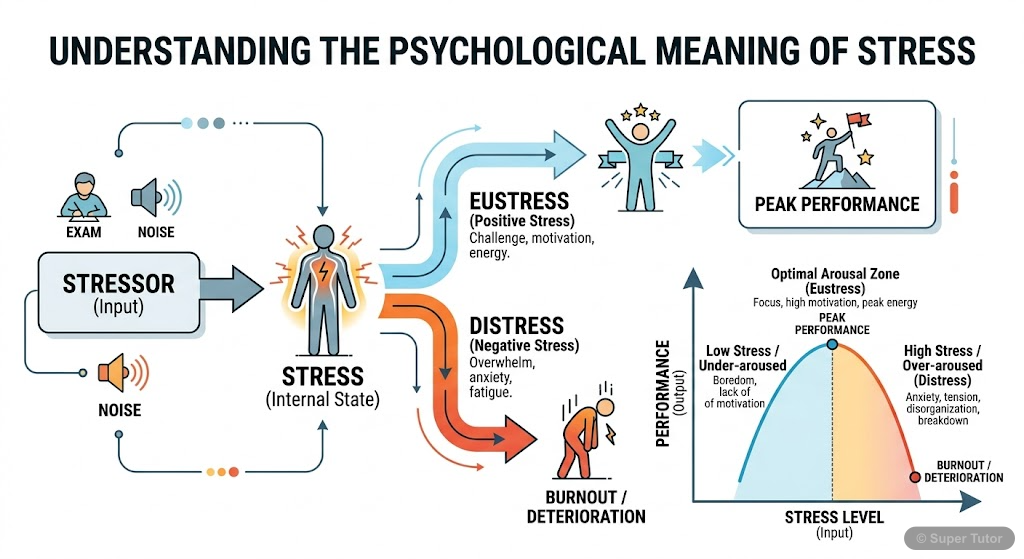
One of 12 illustrations for Meeting Life Challenges in Super Tutor — alongside flashcards, concept maps and practice questions.
See them allThe first 6 solutions are open to read. The other 6 are free with a Super Tutor account. Unlock all 12 free in Super Tutor
Review Questions
1Explain the concept of stress. Give examples from daily life.Show solution
Stress is a dynamic mental/cognitive state and an ongoing transactional process between the individual and the environment. It is the pattern of responses an organism makes when a stimulus event disturbs homeostasis and exceeds the person’s ability to cope. Stress is not always bad: a moderate level can improve performance, while very high or very low stress can reduce it.
Examples from daily life include:
- Examination stress, such as fear before a test.
- Traffic or commuting stress.
- Stress due to noise, crowding, or pollution.
- Stress from a bad relationship, loneliness, or family illness.
- Stress from low grades, conflicts, or frustration.
Not sure why a step works? check your working in Super Tutor
2State the symptoms and sources of stress.Show solution
The symptoms of stress may be physical, emotional, and behavioural.
- Physical symptoms: headache, stomach upset, backache, difficulty in sleeping, difficulty in eating, weakness, fatigue, increased heart rate, sweating, etc.
- Emotional symptoms: worry, anxiety, fear, depression, mood swings, embarrassment, anger, helplessness, hopelessness, and emotional outbursts.
- Behavioural symptoms: lack of concentration, memory loss, poor decision-making, inconsistency, irregular attendance, low self-esteem, frantic bursts of energy, misuse of drugs, disrupted sleep patterns, and reduced work performance.
The sources of stress are of three main types:
- Physical and environmental stress — overexertion, lack of nutritious diet, injury, lack of sleep, air pollution, crowding, noise, heat, cold, disasters like fire, earthquake, floods.
- Psychological stress — frustration, conflicts, internal pressures, and social pressures.
- Social stress — death or illness in the family, strained relationships, trouble with neighbours, or social situations that are stressful for a person.
Not sure why a step works? check your working in Super Tutor
3Describe the GAS model and illustrate the relevance of this model with the help of an example.Show solution
Selye’s General Adaptation Syndrome (GAS) explains the body’s response when stress is prolonged. It has three stages:
- Alarm reaction stage: A stressor activates the adrenal-pituitary-cortex system. Hormones are released, and the body gets ready for fight or flight.
- Resistance stage: If the stress continues, the body tries to cope by using its resources more cautiously. The person makes efforts to deal with the threat.
- Exhaustion stage: If exposure continues, the body’s resources are drained. The body becomes vulnerable and stress-related diseases become more likely.
Relevance with example: Suppose a student is under continuous examination stress. At first, the student feels alarm and anxiety and becomes alert. If the exams continue, the student tries to study and manage the pressure, showing resistance. If the stress continues for a long time without relief, the student may become physically and mentally exhausted, tired, and ill. This shows how prolonged stress can weaken the body.
Not sure why a step works? check your working in Super Tutor
4Enumerate the different ways of coping with stress.Show solution
The different ways of coping with stress are:
1. Task-oriented strategy
This means gathering information, planning, deciding priorities, and taking direct action to handle the stressful situation.
2. Emotion-oriented strategy
This involves managing emotions by maintaining hope, controlling feelings, venting frustration, or accepting that nothing can be done.
3. Avoidance-oriented strategy
This means denying or minimising the problem and distracting oneself, such as by watching TV, phoning a friend, or being with other people.
4. Problem-focused coping
This aims to change the problem itself by finding information, planning, and taking action.
5. Emotion-focused coping
This aims to reduce the emotional distress caused by the situation when the event itself cannot easily be changed.
The chapter states that both problem-focused and emotion-focused coping are useful, but people generally use problem-focused coping more often.
Not sure why a step works? check your working in Super Tutor
5Explain the effect of stress on psychological functioning.Show solution
Stress affects psychological functioning in four major ways:
1. Emotional effects
Stress can cause mood swings, anxiety, depression, increased psychological tension, irritability, anger, helplessness, and emotional instability. It may also alienate a person from family and friends.
2. Physiological effects
Stress increases hormones like adrenaline and cortisol, which change heart rate, blood pressure, metabolism, breathing, and physical activity. It may also slow digestion, increase heart rate, and constrict blood vessels.
3. Cognitive effects
Stress can overload the mind, leading to poor concentration, reduced short-term memory, inability to make sound decisions, and intrusive or repetitive thoughts.
4. Behavioural effects
Stress may lead to unhealthy eating, increased use of caffeine, cigarettes, alcohol, and drugs, disturbed sleep, increased absenteeism, and reduced work performance.
When stress is prolonged, it can also lead to burnout, which is a state of physical, emotional, and psychological exhaustion.
Not sure why a step works? check your working in Super Tutor
6Describe how life skills can help meet life's challenges.Show solution
Life skills are abilities for adaptive and positive behaviour that help individuals deal effectively with the demands and challenges of everyday life. They help us maintain balance, cope better, and respond more effectively to stress.
Important life skills mentioned in the chapter are:
- Assertiveness: Helps one express feelings, needs, and opinions clearly and confidently, and say no when necessary.
- Time management: Helps reduce time stress by planning time realistically and using it for important goals.
- Rational thinking: Helps challenge distorted thinking and irrational beliefs, and replace negative thoughts with positive ones.
- Improving relationships: Helps through communication, listening, expressing feelings, and accepting others’ views.
- Self-care: Keeping oneself healthy, fit, and relaxed prepares one to handle stress better.
- Overcoming unhelpful habits: Reducing perfectionism, avoidance, and procrastination makes a person less vulnerable to stress.
Thus, life skills strengthen coping ability and help a person meet life’s challenges more successfully.
Not sure why a step works? check your working in Super Tutor
Free with a Super Tutor account
Free with a Super Tutor account
Free with a Super Tutor account
Free with a Super Tutor account
Free with a Super Tutor account
Free with a Super Tutor account
6 more solved questions in Meeting Life Challenges
They are free with a Super Tutor account, along with practice quizzes and flashcards for this chapter. Free to start, no card needed.
Frequently Asked Questions
What are the important topics in Meeting Life Challenges for CBSE Class 12 Psychology?
Are these NCERT Solutions for Meeting Life Challenges free?
How should I revise Meeting Life Challenges for the CBSE Class 12 board exam?
Sources & Official References
- NCERT Official — ncert.nic.in
- CBSE Academic — cbseacademic.nic.in
- CBSE Official — cbse.gov.in
- National Education Policy 2020 — education.gov.in
Content is aligned to the official syllabus. Refer to the board website for the latest curriculum.
More resources for Meeting Life Challenges
Practice Quiz
Test yourself with a quick quiz
Important Questions
Exam-style questions with answers
Revision Notes
Key points for last-minute revision
Chapter Summary
Understand the chapter at a glance
Concept Maps
See how topics connect
Study Plan
Step-by-step plan for this chapter
Flashcards
Quick-fire cards for active recall
Syllabus
What topics to cover
For serious students
Get the full Meeting Life Challenges chapter — start free.
Quizzes, flashcards, an AI doubt solver and a study plan for CBSE Class 12 Psychology. Free to start, no card needed.