Social Influence and Group Processes — NCERT Solutions
CBSE · Class 12 · Psychology
NCERT Solutions for Social Influence and Group Processes, CBSE Class 12 Psychology: 5 textbook questions solved step by step. Covers Review Questions.
Interactive on Super Tutor
Studying Social Influence and Group Processes? Get the full interactive chapter.
Quizzes, flashcards, AI doubt-solver and a step-by-step study plan — built for NCERT solutions and more.
Free trial, no card needed.
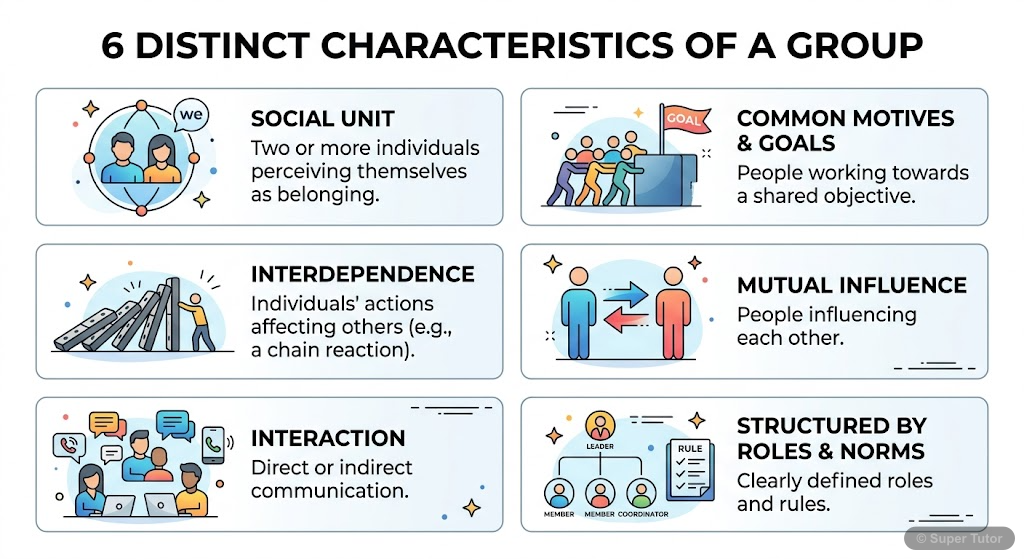
Learn better with visuals Super Tutor pairs illustrations like this with notes and quizzes for Social Influence and Group Processes.
Get startedThe first 3 solutions are open to read. The other 2 are free with a Super Tutor account. Unlock all 5 free in Super Tutor
Review Questions
1Compare and contrast formal and informal groups, and ingroups and outgroups.Show solution
Formal groups and informal groups differ in how they are formed and organised. In formal groups, the functions of the group are stated explicitly and formally. Their formation is based on specific rules or laws, and members have definite roles and a set of norms. A university is an example of a formal group.
In informal groups, the formation is not based on rules or laws, and there is a close relationship among members. Their roles are not formally fixed.
Ingroups and outgroups are based on membership and comparison. An ingroup is one's own group, while an outgroup is another group. We use the word “we” for the ingroup and “they” for the outgroup. Ingroup members are usually seen as similar, viewed favourably, and thought to have desirable traits. Outgroup members are often viewed less favourably and seen as different.
So, formal/informal groups are distinguished by structure and rules, whereas ingroup/outgroup are distinguished by membership and social comparison.
Not sure why a step works? check your working in Super Tutor
2Are you a member of a certain group? Discuss what motivated you to join that group.Show solution
Yes, a person can be a member of many groups such as family, class, friends, sports team, club, or community. According to the chapter, people join groups because they satisfy several needs. The main motivations are:
- Security: groups reduce insecurity and provide comfort and protection.
- Status: membership in an important group gives recognition and a sense of power.
- Self-esteem: being part of a prestigious group improves self-worth and social identity.
- Satisfaction of psychological and social needs: groups give belongingness, attention, love, and support.
- Goal achievement: some goals cannot be achieved alone, so people join groups to accomplish them.
- Knowledge and information: groups provide information and broaden our understanding.
So, if I were to answer personally, I would say I joined a group because it gave me belongingness, support, and a chance to achieve a common goal.
Not sure why a step works? check your working in Super Tutor
3How does Tuckman's stage model help you to understand the formation of groups?Show solution
Tuckman's stage model helps us understand that groups do not form at once; they develop through stages over time. The chapter gives five stages:
- Forming: members first meet; there is uncertainty, excitement, and apprehension.
- Storming: intragroup conflict appears about goals, control, and tasks.
- Norming: members develop group norms and a positive group identity.
- Performing: the group structure is accepted and members work towards achieving the goal.
- Adjourning: for some groups, the group is disbanded after the task is over.
This model helps us understand that group formation is a process, not a single event. It also shows how a group changes from uncertainty to conflict, then to cooperation, productive work, and sometimes ending. The chapter also notes that groups may not always move neatly in one sequence; some stages may overlap, repeat, or be skipped.
Not sure why a step works? check your working in Super Tutor
Free with a Super Tutor account
Free with a Super Tutor account
2 more solved questions in Social Influence and Group Processes
They are free with a Super Tutor account, along with practice quizzes and flashcards for this chapter. Free to start, no card needed.
Frequently Asked Questions
What are the important topics in Social Influence and Group Processes for CBSE Class 12 Psychology?
Are these NCERT Solutions for Social Influence and Group Processes free?
How should I revise Social Influence and Group Processes for the CBSE Class 12 board exam?
Sources & Official References
- NCERT Official — ncert.nic.in
- CBSE Academic — cbseacademic.nic.in
- CBSE Official — cbse.gov.in
- National Education Policy 2020 — education.gov.in
Content is aligned to the official syllabus. Refer to the board website for the latest curriculum.
More resources for Social Influence and Group Processes
Practice Quiz
Test yourself with a quick quiz
Important Questions
Exam-style questions with answers
Revision Notes
Key points for last-minute revision
Chapter Summary
Understand the chapter at a glance
Concept Maps
See how topics connect
Study Plan
Step-by-step plan for this chapter
Flashcards
Quick-fire cards for active recall
Syllabus
What topics to cover
For serious students
Get the full Social Influence and Group Processes chapter — start free.
Quizzes, flashcards, an AI doubt solver and a study plan for CBSE Class 12 Psychology. Free to start, no card needed.