Constitutional Design
CBSE · Class 9 · Social Science
NCERT Solutions for Constitutional Design — CBSE Class 9 Social Science.
Interactive on Super Tutor
Studying Constitutional Design? Get the full interactive chapter.
Quizzes, flashcards, AI doubt-solver and a step-by-step study plan — built for ncert solutions and more.
1,000+ Class 9 students started this chapter today
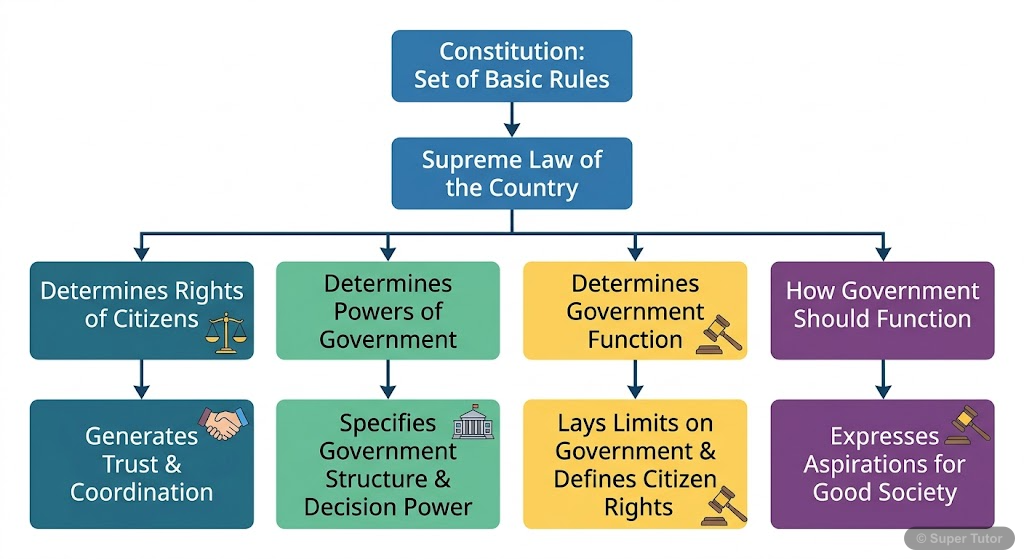
Super Tutor has 8+ illustrations like this for Constitutional Design alone — flashcards, concept maps, and step-by-step visuals.
See them allConstitutional Design — Exercises
1Here are some false statements. Identify the mistake in each case and rewrite these correctly based on what you have read in this chapter.
a. Leaders of the freedom movement had an open mind about whether the country should be democratic or not after independence.
b. Members of the Constituent Assembly of India held the same views on all provisions of the Constitution.
c. A country that has a constitution must be a democracy.
d. Constitution cannot be amended because it is the supreme law of a country.Show solution
Mistake: The leaders of the freedom movement were NOT open-minded or undecided about democracy. They were firmly committed to democracy.
Corrected statement: The leaders of the freedom movement were firmly committed to the idea that independent India would be a democratic country. The struggle against colonial rule had itself been a struggle for democratic rights, and there was no doubt in their minds that free India would be a democracy.
---
b. Incorrect statement: Members of the Constituent Assembly of India held the same views on all provisions of the Constitution.
Mistake: Members of the Constituent Assembly did NOT hold the same views on all provisions. There were debates, disagreements, and discussions on many issues.
Corrected statement: Members of the Constituent Assembly did not always agree with each other. There were serious debates and differences of opinion on many provisions of the Constitution. The Constitution was the result of deliberations, compromises, and consensus reached after extensive discussions.
---
c. Incorrect statement: A country that has a constitution must be a democracy.
Mistake: Having a constitution does not automatically make a country a democracy. Many non-democratic and authoritarian countries also have constitutions.
Corrected statement: A country that has a constitution need not necessarily be a democracy. Several non-democratic countries also have constitutions. However, a democratic country must have a constitution that guarantees rights and limits the power of the government.
---
d. Incorrect statement: Constitution cannot be amended because it is the supreme law of a country.
Mistake: The Constitution CAN be amended. Being the supreme law does not mean it is unchangeable. In India, the Constitution can be amended by Parliament following a special procedure.
Corrected statement: The Constitution can be amended when the need arises. In India, Parliament can amend the Constitution by following a special procedure laid down in the Constitution itself. The Constitution has been amended many times since its adoption in 1950.
2Which of these was the most salient underlying conflict in the making of a democratic constitution in South Africa?
a. Between South Africa and its neighbours
b. Between men and women
c. Between the white majority and the black minority
d. Between the coloured minority and the black majorityShow solution
Justification: This option is factually incorrect in one detail — in South Africa, the whites were actually the *minority* and the blacks were the *majority*. However, among the given options, option (c) most closely captures the central conflict: the apartheid regime was a system of racial segregation and discrimination in which the white minority ruled over and oppressed the black majority. The making of the democratic constitution in South Africa was primarily about ending this apartheid system and ensuring equal rights for the black majority. The negotiations between the African National Congress (ANC), representing the black majority, and the white minority government led to the new democratic constitution.
*(Note: The option should ideally read 'between the white minority and the black majority', but among the given choices, option c is the most appropriate answer.)*
3Which of these is a provision that a democratic constitution does not have?
a. Powers of the head of the state
b. Name of the head of the state
c. Powers of the legislature
d. Name of the countryShow solution
Justification: A democratic constitution lays down the framework of government — it specifies the powers of the head of state (a), the powers of the legislature (c), and the name of the country (d), as these are essential structural and foundational elements. However, a constitution does not mention the *name* of the head of state (i.e., the name of a specific individual), because the head of state changes over time through elections or appointments. The constitution only defines the *office* and its powers, not the person holding it.
4Match the following leaders with their roles in the making of the Constitution:
a. Motilal Nehru
b. President of the Constituent Assembly
c. B.R. Ambedkar
d. Member of the Constituent Assembly
e. Rajendra Prasad
f. Chairman of the Drafting Committee
g. Sarojini Naidu
h. Prepared a Constitution for India in 1928Show solution
| Leader | Role |
|---|---|
| Motilal Nehru | Prepared a Constitution for India in 1928 |
| B.R. Ambedkar | Chairman of the Drafting Committee |
| Rajendra Prasad | President of the Constituent Assembly |
| Sarojini Naidu | Member of the Constituent Assembly |
Correct Matching:
Brief explanation:
- Motilal Nehru drafted the Nehru Report in 1928, which was a proposed constitution for India.
- B.R. Ambedkar was the Chairman of the Drafting Committee of the Constituent Assembly and is regarded as the chief architect of the Indian Constitution.
- Rajendra Prasad was elected as the President of the Constituent Assembly and later became the first President of India.
- Sarojini Naidu was a prominent member of the Constituent Assembly, representing women's participation in constitution-making.
5Read again the extracts from Nehru's speech 'Tryst with Destiny' and answer the following:
a. Why did Nehru use the expression 'not wholly or in full measure' in the first sentence?
b. What pledge did he want the makers of the Indian Constitution to take?
c. 'The ambition of the greatest man of our generation has been to wipe every tear from every eye'. Who was he referring to?Show solution
Nehru used the expression "not wholly or in full measure" because he was being realistic and honest. India had achieved independence, which was a fulfilment of the long-cherished pledge made by the freedom fighters. However, Nehru acknowledged that the task was not yet complete:
- The country had been partitioned, causing immense suffering and displacement.
- Poverty, illiteracy, and inequality still existed.
- The goals of social and economic justice had not yet been achieved.
Thus, while independence was a great achievement, the full promise of freedom — justice, equality, and prosperity for all — had not yet been realised. The expression reflects both celebration and a sense of responsibility for the work that still lay ahead.
---
b. What pledge did Nehru want the makers of the Indian Constitution to take?
Nehru wanted the makers of the Indian Constitution to take a pledge of dedication to the service of India and her people, and to the still larger cause of humanity. Specifically, the pledge was:
- To serve India and her people.
- To work towards the fulfilment of the aims and aspirations of the freedom struggle.
- To ensure that every person in India — especially the poor, the downtrodden, and the suffering — gets justice, opportunity, and a better life.
- To wipe every tear from every eye, so that India could take her rightful place in the world.
---
c. Who was Nehru referring to when he said 'the greatest man of our generation'?
Nehru was referring to Mahatma Gandhi (Mohandas Karamchand Gandhi). Gandhi's entire life was dedicated to the service of the poor and the suffering. His ambition was not personal glory or power, but the upliftment of every ordinary Indian — to wipe every tear from every eye. Nehru deeply admired Gandhi and considered him the greatest leader of their generation.
6Here are some of the guiding values of the Constitution and their meaning. Rewrite them by matching them correctly.
a. Sovereign
b. Government will not favour any religion.
c. Republic
d. People have the supreme right to make decisions.
e. Fraternity
f. Head of the state is an elected person.
g. Secular
h. People should live like brothers and sisters.Show solution
Explanation:
- Sovereign: The word means that India is not under the control of any foreign power. The people of India have the supreme right to make decisions about the country's governance.
- Republic: In a republic, the head of state is not a hereditary monarch but an elected representative. In India, the President is elected.
- Fraternity: This means a sense of brotherhood and sisterhood among all citizens, promoting unity and dignity.
- Secular: The state does not have an official religion and treats all religions equally, without favouring any particular religion.
7How did your school celebrate the Constitution Day on November 26th? Prepare a brief report.Show solution
---
Report on Constitution Day Celebration
Date: 26th November 20XX
Venue: School Assembly Hall / Playground
Our school celebrated Constitution Day (Samvidhan Diwas) on 26th November with great enthusiasm and patriotic fervour. The day was observed to mark the adoption of the Constitution of India by the Constituent Assembly on 26th November, 1949.
The celebration began with the reading of the Preamble to the Constitution by the Principal, followed by all students and teachers reading it together in unison. This was a solemn and inspiring moment that reminded everyone of the core values of our nation — Justice, Liberty, Equality, and Fraternity.
A special assembly was held in which students delivered speeches on the importance of the Constitution, the role of Dr. B.R. Ambedkar, and the significance of fundamental rights and duties. A quiz competition on constitutional provisions was also organised for students of Classes 8 to 10.
The Social Science teacher gave a brief talk on the making of the Constitution and the contributions of the Constituent Assembly members. A poster-making competition on the theme 'Our Constitution, Our Pride' was held, and the best entries were displayed on the school notice board.
The programme concluded with the National Anthem. The day was a reminder of our responsibility as citizens to uphold the values of the Constitution.
*Report prepared by: [Student's Name], Class IX*
8Here are different opinions about what made India a democracy. How much importance would you give to each of these factors?
a. Democracy in India is a gift of the British rulers. We received training to work with representative legislative institutions under the British rule.
b. Freedom Struggle challenged the colonial exploitation and denial of different freedoms to Indians. Free India could not be anything but democratic.
c. We were lucky to have leaders who had democratic convictions. The denial of democracy in several other newly independent countries shows the important role of these leaders.Show solution
a. Democracy as a gift of British rulers:
*Importance: Low*
This factor deserves the least importance. While it is true that Indians gained some experience with representative institutions under British rule (like the Indian Councils Act, 1909 and the Government of India Act, 1935), these were very limited and were not given out of goodwill. The British actually denied Indians full democratic rights and exploited the country. The colonial rule was fundamentally undemocratic — Indians had no real power. Therefore, democracy in India cannot be called a 'gift' from the British.
---
b. Freedom Struggle as the foundation of democracy:
*Importance: Very High*
This factor deserves the most importance. The freedom struggle was itself a movement for democratic rights — the right to self-governance, freedom of speech, equality, and justice. The Indian National Congress and other organisations mobilised millions of people and gave them a sense of political participation. The values of democracy were deeply embedded in the freedom movement. A country that fought so hard for freedom could not have accepted anything less than a democratic system for its people.
---
c. Role of democratic leaders:
*Importance: High*
This factor also deserves high importance. India was fortunate to have visionary leaders like Jawaharlal Nehru, Dr. B.R. Ambedkar, Sardar Patel, and others who had strong democratic convictions. They could have chosen to concentrate power in their own hands, as happened in many other newly independent nations. Instead, they chose to build democratic institutions, guarantee fundamental rights, and create a constitution based on equality and justice. The contrast with other newly independent countries that became dictatorships shows how crucial the role of these leaders was.
---
Conclusion: All three factors played some role, but the freedom struggle (b) and democratic leadership (c) were the most important. The British contribution (a) was minimal and incidental.
9Read the following extract from a conduct book for 'married women', published in 1912. 'God has made the female species delicate and fragile both physically and emotionally, pitiably incapable of self-defence. They are destined thus by God to remain in male protection – of father, husband and son – all their lives. Women should, therefore, not despair, but feel obliged that they can dedicate themselves to the service of men'. Do you think the values expressed in this para reflected the values underlying our constitution? Or does this go against the constitutional values?Show solution
The values expressed in this extract from the 1912 conduct book completely go against the constitutional values of India. They do not reflect the values underlying our Constitution in any way.
How this extract contradicts Constitutional values:
1. Equality (Article 14 & 15): The Constitution guarantees equality before law and prohibits discrimination on the basis of sex. The extract treats women as inferior and subordinate to men, which is a direct violation of the principle of equality.
2. Right to Dignity: The Constitution upholds the dignity of every individual. The extract describes women as "pitiably incapable" and destined only to serve men, which is deeply degrading and violates human dignity.
3. Fraternity with Dignity: The Preamble of the Constitution assures the dignity of the individual. Treating women as dependent and incapable denies them their dignity.
4. Fundamental Rights (Article 19 & 21): The Constitution guarantees freedom and the right to life and personal liberty to all citizens, regardless of gender. The extract denies women any independent existence or freedom.
5. Secular and Democratic values: The Constitution does not allow religious or traditional justifications to be used to deny rights to any group. The extract uses religion ("God has made...") to justify the subjugation of women, which is contrary to constitutional values.
Conclusion: Our Constitution was built on the values of liberty, equality, fraternity, and justice for ALL citizens — men and women alike. The 1912 extract reflects a patriarchal and regressive mindset that the Constitution explicitly sought to overcome. The makers of the Constitution were aware of such social inequalities and deliberately included provisions to ensure gender equality and women's rights.
10Read the following statements about a constitution. Give reasons why each of these is true or not true.
a. The authority of the rules of the constitution is the same as that of any other law.
b. Constitution lays down how different organs of the government will be formed.
c. Rights of citizens and limits on the power of the government are laid down in the constitution.
d. A constitution is about institutions, not about values.Show solution
This statement is NOT TRUE.
Reason: The Constitution is the supreme law of the land. Its authority is far higher than that of any ordinary law. All other laws made by Parliament or State Legislatures must be consistent with the Constitution. If any law contradicts the Constitution, it can be declared null and void by the Supreme Court. Ordinary laws can be changed by a simple majority in Parliament, but the Constitution requires a special procedure (special majority and sometimes ratification by states) to be amended. This shows that the Constitution has a higher authority than ordinary laws.
---
b. Constitution lays down how different organs of the government will be formed.
This statement is TRUE.
Reason: One of the most important functions of a constitution is to define the structure of government. The Indian Constitution clearly lays down:
- How Parliament (Lok Sabha and Rajya Sabha) is constituted and how members are elected.
- How the President and Vice-President are elected.
- How the Supreme Court and High Courts are established and how judges are appointed.
- The powers and functions of the Executive, Legislature, and Judiciary.
Thus, the Constitution is the foundational document that creates and organises all organs of the government.
---
c. Rights of citizens and limits on the power of the government are laid down in the constitution.
This statement is TRUE.
Reason: The Constitution of India contains a detailed list of Fundamental Rights (Part III, Articles 12–35) that are guaranteed to all citizens. These include the right to equality, right to freedom, right against exploitation, right to freedom of religion, cultural and educational rights, and right to constitutional remedies. At the same time, the Constitution places limits on the power of the government — for example, the government cannot take away these fundamental rights arbitrarily. The judiciary acts as a guardian to ensure that the government does not exceed its constitutional powers. This balance between rights and limits on power is a core feature of a democratic constitution.
---
d. A constitution is about institutions, not about values.
This statement is NOT TRUE.
Reason: A constitution is not merely about creating institutions (like Parliament, the Presidency, or the Courts). It is equally, if not more, about values and ideals. The Indian Constitution is deeply rooted in values such as:
- Justice (social, economic, and political)
- Liberty (of thought, expression, belief, faith, and worship)
- Equality (of status and opportunity)
- Fraternity (assuring dignity of the individual and unity of the nation)
- Secularism, Democracy, and Socialism
These values are enshrined in the Preamble and run through the entire Constitution. The institutions created by the Constitution are meant to serve and uphold these values. Therefore, a constitution is fundamentally about both institutions AND values.
Stuck on a step?
Ask Super Tutor AI to explain any solution on this page in a simpler way — free, 24x7.
Ask a Doubt FreeFrequently Asked Questions
What are the important topics in Constitutional Design for CBSE Class 9 Social Science?
How to score full marks in Constitutional Design — CBSE Class 9 Social Science?
Where can I get free NCERT Solutions for Constitutional Design Class 9 Social Science?
Sources & Official References
- NCERT Official — ncert.nic.in
- CBSE Academic — cbseacademic.nic.in
- CBSE Official — cbse.gov.in
- National Education Policy 2020 — education.gov.in
Content is aligned to the official syllabus. Refer to the board website for the latest curriculum.
More resources for Constitutional Design
Important Questions
Practice with board exam-style questions
Syllabus
What topics to cover
Revision Notes
Key points for last-minute revision
Study Plan
Step-by-step plan to ace this chapter
Flashcards
Quick-fire cards for active recall
Formula Sheet
All formulas in one place
Chapter Summary
Understand the chapter at a glance
Practice Quiz
Test yourself with a quick quiz
Concept Maps
See how topics connect visually
For serious students
Get the full Constitutional Design chapter — for free.
Quizzes, flashcards, AI doubt-solver and a step-by-step study plan for CBSE Class 9 Social Science.