Drainage
CBSE · Class 9 · Social Science
NCERT Solutions for Drainage — CBSE Class 9 Social Science.
Interactive on Super Tutor
Studying Drainage? Get the full interactive chapter.
Quizzes, flashcards, AI doubt-solver and a step-by-step study plan — built for ncert solutions and more.
1,000+ Class 9 students started this chapter today
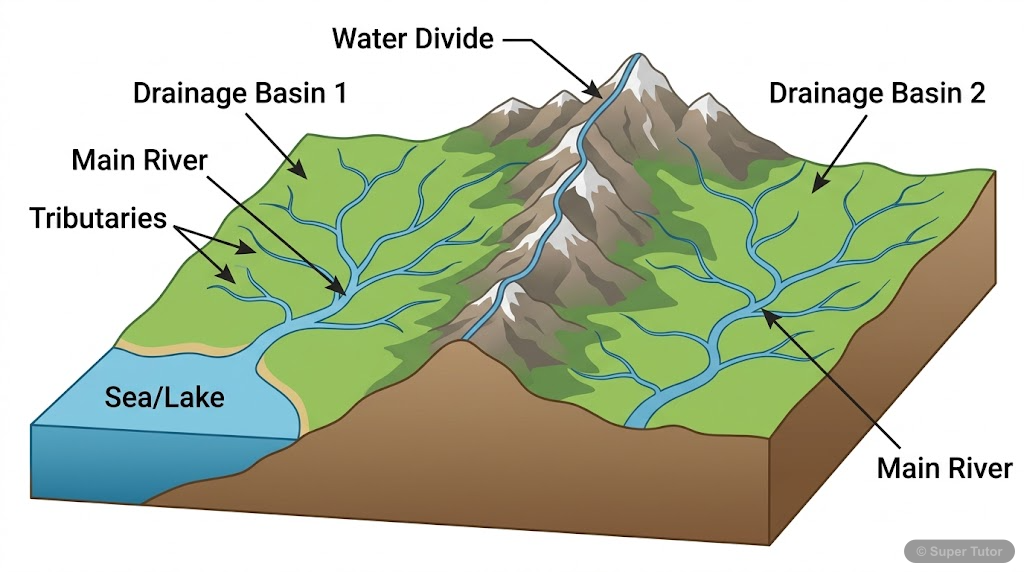
This is just one of 12+ visuals inside Super Tutor's Drainage chapter
Explore the full setExercise — Chapter: Drainage (Contemporary India - 1, Class 9)
1(i)In which of the following states is the Wular lake located?
(a) Rajasthan
(b) Uttar Pradesh
(c) Punjab
(d) Jammu and KashmirShow solution
Wular lake is the largest freshwater lake in India and is located in the Baramulla district of Jammu and Kashmir. It was formed as a result of tectonic activity.
1(ii)The river Narmada has its source at
(a) Satpura
(b) Brahmagiri
(c) Amarkantak
(d) Slopes of the Western GhatsShow solution
The river Narmada originates from the Amarkantak hills in Madhya Pradesh. It flows westward through a rift valley and drains into the Arabian Sea.
1(iii)Which one of the following lakes is a salt water lake?
(a) Sambhar
(b) Dal
(c) Wular
(d) Gobind SagarShow solution
Sambhar lake, located in Rajasthan, is a salt water (saline) lake. It is India's largest inland salt lake. Dal, Wular, and Gobind Sagar are all freshwater lakes.
1(iv)Which one of the following is the longest river of the Peninsular India?
(a) Narmada
(b) Krishna
(c) Godavari
(d) MahanadiShow solution
The Godavari is the longest river of Peninsular India with a total length of about 1,500 km. It is also called the 'Dakshin Ganga' (Ganga of the South) because of its large size and significance.
1(v)Which one amongst the following rivers flows through a rift valley?
(a) Mahanadi
(b) Tungabhadra
(c) Krishna
(d) TapiShow solution
The Tapi (also called Tapti) river flows through a rift valley (trough) between the Satpura range in the north and the Ajanta range in the south, and drains into the Arabian Sea. Like the Narmada, it is one of the two major west-flowing rivers of Peninsular India that flow through rift valleys.
2(i)What is meant by a water divide? Give an example.Show solution
Explanation: Any elevated area, such as a mountain range or an upland, that separates two drainage basins is called a water divide. Rainfall falling on one side of the divide flows into one river system, while rainfall on the other side flows into a different river system.
Example: The Western Ghats act as a water divide between the rivers flowing westward into the Arabian Sea (e.g., Narmada, Tapi) and the rivers flowing eastward into the Bay of Bengal (e.g., Godavari, Krishna, Cauvery).
Another example: The Ambala region acts as a water divide between the Indus and the Ganga river systems.
2(ii)Which is the largest river basin in India?Show solution
The Ganga basin covers about 8.6 lakh sq km, spreading across the states of Uttarakhand, Uttar Pradesh, Bihar, Jharkhand, and West Bengal. It is one of the most densely populated river basins in the world.
2(iii)Where do the rivers Indus and Ganga have their origin?Show solution
The Indus river originates from a glacier near Bokhar Chu in the Tibetan plateau, close to Lake Mansarovar. It flows northwest through Ladakh and then enters Pakistan.
Origin of the Ganga River:
The Ganga originates from the Gangotri glacier in the Uttarakhand Himalayas. Its headstream, the Bhagirathi, rises at Gangotri, and it is joined by the Alaknanda at Devprayag to form the Ganga.
2(iv)Name the two headstreams of the Ganga. Where do they meet to form the Ganga?Show solution
1. Bhagirathi — rises from the Gangotri glacier
2. Alaknanda — rises from the Satopanth glacier near Badrinath
Meeting point: The two headstreams meet at Devprayag in Uttarakhand to form the river Ganga. From Devprayag, the combined river is known as the Ganga.
2(v)Why does the Brahmaputra in its Tibetan part have less silt, despite a longer course?Show solution
Reason: In its Tibetan part, the Brahmaputra flows through a cold and dry region where:
- The climate is arid (very little rainfall), so there is minimal surface runoff and erosion.
- The river carries a smaller volume of water in Tibet.
- Vegetation is sparse but the hard rocky terrain and low rainfall mean less weathering and erosion.
However, once the Brahmaputra enters the high rainfall region of Assam and Arunachal Pradesh, it receives a large volume of water from its tributaries and causes heavy erosion, carrying a huge amount of silt. This is why it has less silt in Tibet despite a longer course there.
2(vi)Which two Peninsular rivers flow through trough?Show solution
1. Narmada — flows through a rift valley between the Vindhya range in the north and the Satpura range in the south, and drains into the Arabian Sea.
2. Tapi (Tapti) — flows through a rift valley between the Satpura range in the north and the Ajanta range in the south, and also drains into the Arabian Sea.
Both rivers flow westward and are antecedent rivers that predate the formation of the Western Ghats.
2(vii)State some economic benefits of rivers and lakes.Show solution
1. Irrigation: Rivers provide water for irrigating agricultural fields, which is essential for food production.
2. Hydro-power generation: Fast-flowing rivers are used to generate hydroelectric power (e.g., Bhakra Nangal on Satluj).
3. Navigation: Rivers serve as inland waterways for transportation of goods and people.
4. Domestic and industrial water supply: Rivers are the primary source of fresh water for cities, towns, and industries.
5. Fishing: Rivers support the fishing industry and provide livelihood to many communities.
6. Tourism and recreation: Scenic river valleys attract tourists.
Economic Benefits of Lakes:
1. Regulate river flow: Lakes prevent flooding during heavy rains and maintain even flow during dry seasons.
2. Hydel power: Lakes formed by dams are used for generating hydroelectric power.
3. Tourism and recreation: Lakes enhance natural beauty and promote tourism.
4. Moderate climate: Lakes moderate the climate of surrounding areas.
5. Aquatic ecosystem: Lakes maintain aquatic biodiversity and support fishing.
6. Water supply: Lakes serve as reservoirs for drinking water and irrigation.
3Group the following lakes under two categories — natural and created by human beings:
(a) Wular (b) Dal (c) Nainital (d) Bhimtal (e) Gobind Sagar (f) Loktak (g) Barapani (h) Chilika (i) Sambhar (j) Rana Pratap Sagar (k) Nizam Sagar (l) Pulicat (m) Nagarjuna Sagar (n) HirakundShow solution
| S.No. | Lake | State |
|-------|------|-------|
| 1 | Wular | Jammu & Kashmir |
| 2 | Dal | Jammu & Kashmir |
| 3 | Nainital | Uttarakhand |
| 4 | Bhimtal | Uttarakhand |
| 5 | Loktak | Manipur |
| 6 | Chilika | Odisha |
| 7 | Sambhar | Rajasthan |
| 8 | Pulicat | Tamil Nadu/Andhra Pradesh |
Man-made Lakes (created by damming rivers for hydel power, irrigation, etc.):
| S.No. | Lake | Project/River |
|-------|------|---------------|
| 1 | Gobind Sagar | Bhakra Nangal Project on Satluj |
| 2 | Barapani (Umiam Lake) | Meghalaya |
| 3 | Rana Pratap Sagar | Rajasthan (on Chambal) |
| 4 | Nizam Sagar | Telangana (on Manjira) |
| 5 | Nagarjuna Sagar | Telangana/Andhra Pradesh (on Krishna) |
| 6 | Hirakund | Odisha (on Mahanadi) |
*Note: Barapani (Umiam Lake) is a man-made reservoir in Meghalaya.*
4Discuss the significant difference between the Himalayan and the Peninsular rivers.Show solution
| Feature | Himalayan Rivers | Peninsular Rivers |
|---------|-----------------|-------------------|
| Origin | Originate from glaciers in the Himalayas | Originate from plateaus and hills of the Peninsula (e.g., Western Ghats, Central Highlands) |
| Nature | Perennial (flow throughout the year) — fed by both rainfall and snowmelt | Mostly seasonal (depend on rainfall); some are perennial |
| Course | Long course; flow through young, soft rocks — cause heavy erosion | Shorter course; flow through hard, ancient rocks — less erosion |
| Valley | Flow through deep gorges and V-shaped valleys in mountains; broad plains in lower course | Shallow valleys; flow through plateaus |
| Tributaries | Have large number of tributaries | Have fewer and shorter tributaries |
| Drainage area | Cover a very large drainage basin (e.g., Ganga basin — 8.6 lakh sq km) | Cover smaller drainage basins |
| Direction of flow | Generally flow from north/northwest to east/southeast | Flow both eastward (into Bay of Bengal) and westward (into Arabian Sea) |
| Silt | Carry a large amount of silt and form extensive deltas | Carry less silt; form smaller deltas |
| Examples | Ganga, Indus, Brahmaputra | Godavari, Krishna, Cauvery, Narmada, Tapi |
Conclusion: Himalayan rivers are longer, perennial, and carry more water and silt, while Peninsular rivers are shorter, mostly seasonal, and flow through hard rock terrain.
5Compare the east flowing and the west flowing rivers of the Peninsular plateau.Show solution
| Feature | East-Flowing Rivers | West-Flowing Rivers |
|---------|--------------------|-----------------------|
| Direction | Flow eastward and drain into the Bay of Bengal | Flow westward and drain into the Arabian Sea |
| Examples | Mahanadi, Godavari, Krishna, Cauvery | Narmada, Tapi |
| Origin | Originate from the Western Ghats or Central Highlands | Originate from the Central Highlands (Amarkantak, Betul) |
| Delta | Form well-developed deltas at their mouths (e.g., Godavari delta, Mahanadi delta) | Do not form deltas; form estuaries |
| Valley | Flow through broad valleys | Flow through rift valleys (troughs) |
| Number | Larger in number | Only two major rivers (Narmada and Tapi) |
| Tributaries | Have many tributaries | Have very few tributaries |
| Length | Generally longer | Relatively shorter |
| Drainage pattern | Dendritic pattern | Mostly linear, through rift valleys |
Key Point: Most Peninsular rivers flow eastward because the general slope of the Peninsula is from west to east. The Western Ghats act as the main water divide. Only Narmada and Tapi flow westward through rift valleys.
6Why are rivers important for the country's economy?Show solution
1. Irrigation:
Rivers are the primary source of water for irrigation. India is an agrarian country where the majority of the population depends on agriculture. River water is used to irrigate millions of hectares of farmland through canals and other means.
2. Hydro-power Generation:
Fast-flowing rivers, especially in hilly areas, are harnessed to generate hydroelectric power. Projects like Bhakra Nangal (Satluj), Hirakund (Mahanadi), and Nagarjuna Sagar (Krishna) generate large amounts of electricity.
3. Inland Navigation:
Rivers serve as natural waterways for the transportation of goods and people, especially in the plains. This reduces the cost of transportation.
4. Domestic and Industrial Water Supply:
Rivers supply fresh water to cities, towns, and industries. Most major cities of India (Delhi, Kolkata, Patna, Varanasi) are located on riverbanks.
5. Fishing:
Rivers support a large fishing industry and provide livelihood to millions of fishermen.
6. Tourism:
Scenic river valleys, ghats, and pilgrimage sites along rivers (e.g., Varanasi on Ganga, Rishikesh on Ganga) attract tourists and generate revenue.
7. Fertile Plains:
Rivers deposit silt and form fertile alluvial plains (e.g., the Indo-Gangetic Plain), which are among the most productive agricultural lands in the world.
8. Historical Significance:
Riverbanks have been centres of civilisation since ancient times. Cities that grew on riverbanks have become major economic and cultural centres.
Conclusion: Rivers are the lifeline of India's economy. They support agriculture, industry, transportation, and human settlements, making them indispensable for the country's development.
Map Skills (i)On an outline map of India mark and label the following rivers: Ganga, Satluj, Damodar, Krishna, Narmada, Tapi, Mahanadi, and Brahmaputra.Show solution
1. Ganga: Originates from Gangotri glacier (Uttarakhand), flows eastward through UP, Bihar, and West Bengal, and drains into the Bay of Bengal.
2. Satluj: Originates from Rakas Lake (Tibet) near Mansarovar, flows through Himachal Pradesh and Punjab, and joins the Indus in Pakistan.
3. Damodar: Originates from the Chota Nagpur Plateau (Jharkhand), flows eastward through Jharkhand and West Bengal, and joins the Hooghly river.
4. Krishna: Originates near Mahabaleshwar (Maharashtra), flows eastward through Karnataka and Andhra Pradesh, and drains into the Bay of Bengal.
5. Narmada: Originates from Amarkantak (Madhya Pradesh), flows westward through MP and Gujarat, and drains into the Arabian Sea.
6. Tapi: Originates from Betul district (Madhya Pradesh), flows westward through Maharashtra and Gujarat, and drains into the Arabian Sea.
7. Mahanadi: Originates from Raipur district (Chhattisgarh), flows eastward through Odisha, and drains into the Bay of Bengal.
8. Brahmaputra: Originates from Chemayungdung glacier (Tibet), flows eastward through Tibet, then turns south through Arunachal Pradesh and Assam, and drains into the Bay of Bengal.
*Note: Mark each river with a blue line and label it clearly on the outline map of India.*
Map Skills (ii)On an outline map of India mark and label the following lakes: Chilika, Sambhar, Wular, Pulicat, Kolleru.Show solution
1. Chilika Lake: Located in Odisha, on the eastern coast, south of the Mahanadi delta. It is a brackish water lagoon — the largest coastal lagoon in India.
2. Sambhar Lake: Located in Rajasthan (near Jaipur). It is India's largest inland salt water lake.
3. Wular Lake: Located in Baramulla district, Jammu and Kashmir. It is the largest freshwater lake in India, formed due to tectonic activity.
4. Pulicat Lake: Located on the border of Tamil Nadu and Andhra Pradesh, on the eastern coast. It is a brackish water lagoon.
5. Kolleru Lake: Located in Andhra Pradesh, between the deltas of the Krishna and Godavari rivers. It is a freshwater lake.
*Note: Mark each lake with a blue dot/oval and label it clearly on the outline map of India.*
Project/Activity — CrosswordSolve the crossword puzzle with the given clues (Across and Down).Show solution
1. Nagarjuna Sagar is a river valley project. Name the river?
→ KRISHNA
2. The longest river of India.
→ GANGA
3. The river which originates from a place known as Beas Kund.
→ BEAS
4. The river which rises in the Betul district of MP and flows westwards.
→ TAPI (Tapti)
5. The river which was known as the "Sorrow" of West Bengal.
→ DAMODAR
6. The river on which the reservoir for Indira Gandhi Canal has been built.
→ SATLUJ (Sutlej)
7. The river whose source lies near Rohtang Pass.
→ BEAS *(Note: The Beas originates near Rohtang Pass; Ravi also originates nearby — Beas is the standard answer for Rohtang Pass)*
8. The longest river of Peninsular India?
→ GODAVARI
DOWN:
9. A tributary of Indus originating from Himachal Pradesh.
→ SPITI (or BEAS)
10. The river flowing through fault, drains into the Arabian Sea.
→ NARMADA
11. A river of south India, which receives rainwater both in summer and winter.
→ CAUVERY (Kaveri — receives rain from SW monsoon in summer and NE monsoon in winter)
12. A river which flows through Ladakh, Gilgit and Pakistan.
→ INDUS
13. An important river of the Indian desert.
→ LUNI
14. The river which joins Chenab in Pakistan.
→ JHELUM
15. A river which rises at Yamunotri glacier.
→ YAMUNA
Stuck on a step?
Ask Super Tutor AI to explain any solution on this page in a simpler way — free, 24x7.
Ask a Doubt FreeFrequently Asked Questions
What are the important topics in Drainage for CBSE Class 9 Social Science?
How to score full marks in Drainage — CBSE Class 9 Social Science?
Where can I get free NCERT Solutions for Drainage Class 9 Social Science?
Sources & Official References
- NCERT Official — ncert.nic.in
- CBSE Academic — cbseacademic.nic.in
- CBSE Official — cbse.gov.in
- National Education Policy 2020 — education.gov.in
Content is aligned to the official syllabus. Refer to the board website for the latest curriculum.
More resources for Drainage
Important Questions
Practice with board exam-style questions
Syllabus
What topics to cover
Revision Notes
Key points for last-minute revision
Study Plan
Step-by-step plan to ace this chapter
Flashcards
Quick-fire cards for active recall
Formula Sheet
All formulas in one place
Chapter Summary
Understand the chapter at a glance
Practice Quiz
Test yourself with a quick quiz
Concept Maps
See how topics connect visually
For serious students
Get the full Drainage chapter — for free.
Quizzes, flashcards, AI doubt-solver and a step-by-step study plan for CBSE Class 9 Social Science.