Population
CBSE · Class 9 · Social Science
NCERT Solutions for Population — CBSE Class 9 Social Science.
Interactive on Super Tutor
Studying Population? Get the full interactive chapter.
Quizzes, flashcards, AI doubt-solver and a step-by-step study plan — built for ncert solutions and more.
1,000+ Class 9 students started this chapter today
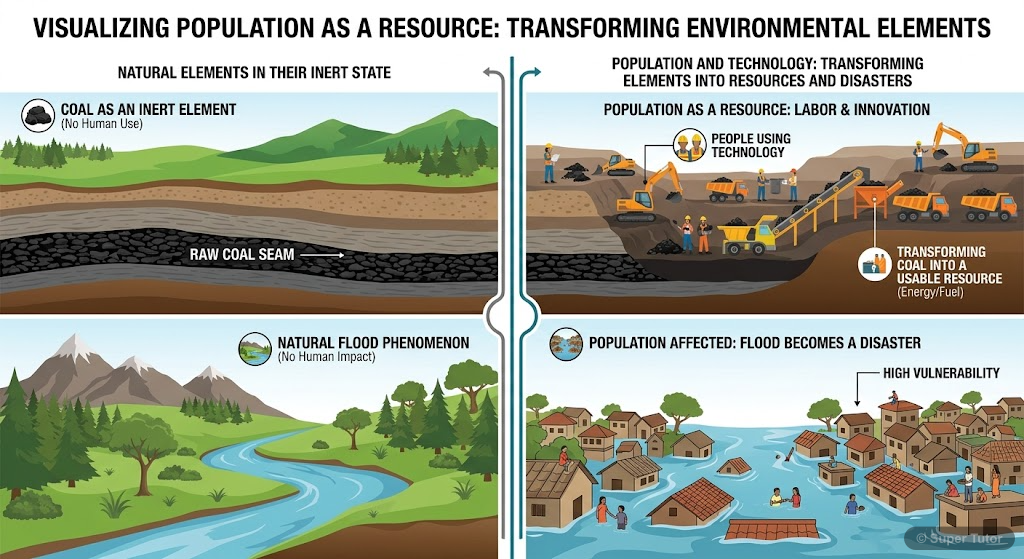
Super Tutor has 9+ illustrations like this for Population alone — flashcards, concept maps, and step-by-step visuals.
See them allEXERCISE
1(i)Migrations change the number, distribution and composition of the population in
(a) the area of departure
(b) the area of arrival
(c) both the area of departure and arrival
(d) none of the aboveShow solution
Justification: When people migrate, the population of the area they leave (area of departure) decreases, while the population of the area they move to (area of arrival) increases. Thus, migration affects the number, distribution, and composition of population in both areas simultaneously.
1(ii)A large proportion of children in a population is a result of
(a) high birth rates
(b) high life expectancies
(c) high death rates
(d) more married couplesShow solution
Justification: When the birth rate is high, more children are born per 1000 persons each year. This leads to a large proportion of children in the total population, making the age structure bottom-heavy (young population).
1(iii)The magnitude of population growth refers to
(a) the total population of an area
(b) the number of persons added each year
(c) the rate at which the population increases
(d) the number of females per thousand malesShow solution
Justification: The magnitude of population growth refers to the absolute number (actual count) of persons added to the population each year, as opposed to the growth rate, which is a relative (percentage) measure.
1(iv)According to the Census, a 'literate' person is one who
(a) can read and write his/her name
(b) can read and write any language
(c) is 7 years old and can read and write any language with understanding
(d) knows the 3 'R's (reading, writing, arithmetic)Show solution
Justification: According to the Indian Census definition, a literate person is one who is at least 7 years of age and can read and write with understanding in any language. Merely being able to sign one's name or read without understanding does not qualify a person as literate.
2(i)Why is the rate of population growth in India declining since 1981?Show solution
Reasons for the declining rate of population growth:
1. Decline in Birth Rate: Increased awareness about family planning and the use of contraceptives has led to a fall in birth rates. Couples are opting for smaller families.
2. Rise in the Age of Marriage: The legal age of marriage has been raised (18 years for girls and 21 years for boys), which has reduced the number of childbearing years, thereby lowering birth rates.
3. Spread of Education, especially Female Education: Educated women tend to marry later, have fewer children, and are more aware of family planning methods.
4. Improved Health and Family Welfare Programmes: Government initiatives such as the National Family Welfare Programme have promoted the small family norm.
5. Urbanisation: Urban families prefer smaller families due to higher cost of living and better access to education and healthcare.
6. Improved Status of Women: Greater participation of women in the workforce and decision-making has contributed to lower fertility rates.
Conclusion: The combined effect of lower birth rates, better education, urbanisation, and government policies has caused the rate of population growth to decline since 1981.
2(ii)Discuss the major components of population growth.Show solution
The three major components of population growth are:
1. Birth Rate:
- Birth rate is defined as the number of live births per 1000 persons in a year.
- A high birth rate increases the population, while a low birth rate slows population growth.
- India has experienced a gradual decline in birth rates due to family planning and education.
2. Death Rate:
- Death rate is defined as the number of deaths per 1000 persons in a year.
- A decline in death rate (due to better healthcare, sanitation, and nutrition) leads to population growth.
- India's death rate has declined significantly since independence.
3. Migration:
- Migration is the movement of people from one place to another — either within the country (internal migration) or between countries (international migration).
- Immigration (people moving into an area) increases the population of that area.
- Emigration (people moving out of an area) decreases the population of that area.
- Migration also changes the age, sex, and occupational composition of the population.
Conclusion: The natural growth of population is determined by the difference between birth rate and death rate, while migration is the third component that causes spatial redistribution of population.
2(iii)Define age structure, death rate and birth rate.Show solution
- Age structure refers to the number of people in different age groups in a population.
- It is usually divided into three broad groups:
(a) Children (below 15 years) — economically dependent
(b) Working age adults (15–59 years) — economically productive
(c) Aged/Elderly (60 years and above) — economically dependent
- The age structure of a population determines its dependency ratio and future growth potential.
2. Death Rate:
- Death rate is defined as the number of deaths per 1000 persons in a year.
- Formula:
- A declining death rate indicates improved healthcare and living standards.
3. Birth Rate:
- Birth rate is defined as the number of live births per 1000 persons in a year.
- Formula:
- Birth rate is the primary factor responsible for population growth in India.
2(iv)How is migration a determinant factor of population change?Show solution
Migration as a determinant of population change:
1. Change in Population Size:
- Immigration (in-migration) increases the population of the destination area.
- Emigration (out-migration) decreases the population of the source area.
2. Change in Population Distribution:
- Migration leads to uneven distribution of population. For example, people migrate from rural areas to urban areas in search of employment, making cities more densely populated.
3. Change in Population Composition:
- Migration alters the age and sex composition of both the source and destination regions.
- Typically, young adult males migrate more, leaving behind a higher proportion of women, children, and elderly in the source area.
- The destination area gains a younger and more male-dominated workforce.
4. Types of Migration:
- Internal Migration: Movement within the country (e.g., rural to urban, state to state).
- International Migration: Movement between countries, which affects the national population.
Conclusion: Migration is a significant determinant of population change as it affects not only the total number of people in an area but also their spatial distribution and demographic composition.
3Distinguish between population growth and population change.Show solution
Conclusion: Population growth is a narrower concept that focuses only on numerical increase or decrease, whereas population change is a broader concept that encompasses all qualitative and quantitative changes in the population.
4What is the relation between occupational structure and development?Show solution
Occupational Structure and its Relation to Development:
Occupations are broadly classified into three sectors:
1. Primary Sector: Agriculture, fishing, forestry, mining (extraction of natural resources).
2. Secondary Sector: Manufacturing and industrial activities.
3. Tertiary Sector: Services such as trade, transport, banking, education, healthcare.
Relation with Development:
1. In Developing Countries (like India):
- A large proportion of the workforce is engaged in the primary sector (agriculture).
- This indicates a lower level of economic development, as agriculture is less productive and provides lower incomes.
2. In Developed Countries:
- A larger proportion of the workforce is employed in the secondary and tertiary sectors.
- This reflects higher industrialisation, technological advancement, and better standards of living.
3. Indicator of Development:
- As a country develops, the share of the workforce in agriculture decreases and the share in industry and services increases.
- This shift is a key indicator of economic development and modernisation.
4. India's Situation:
- Although a large percentage of India's population is still engaged in agriculture, there has been a gradual shift towards the secondary and tertiary sectors, indicating economic progress.
Conclusion: The occupational structure of a country is a reliable indicator of its level of development. A shift from primary to secondary and tertiary sectors signifies economic growth and improved living standards.
5What are the advantages of having a healthy population?Show solution
Advantages of a Healthy Population:
1. Higher Productivity:
- Healthy individuals are more productive and efficient in their work, contributing more to the national economy.
- They can work longer hours with greater concentration and physical strength.
2. Economic Growth:
- A healthy workforce reduces absenteeism and increases output in agriculture, industry, and services, thereby boosting GDP.
3. Lower Healthcare Expenditure:
- A healthy population reduces the burden on healthcare infrastructure and government spending on medical facilities.
4. Better Quality of Life:
- Healthy people enjoy a better quality of life, have higher life expectancy, and can participate more actively in social and civic activities.
5. Human Resource Development:
- Healthy children can attend school regularly, learn better, and grow into skilled and educated adults — a valuable human resource for the nation.
6. Social Benefits:
- A healthy population leads to lower crime rates, greater social harmony, and better community participation.
7. National Security:
- A physically fit population provides a stronger defence force and better emergency response capability.
Conclusion: A healthy population is the most valuable asset of a nation. It forms the foundation of economic development, social progress, and national well-being. As stated in the chapter, people are the real wealth of a nation.
6What are the significant features of the National Population Policy 2000?Show solution
Significant Features of the National Population Policy 2000:
1. Immediate Objective:
- To meet the unmet needs for contraception, healthcare infrastructure, and health personnel, and to provide integrated service delivery for basic reproductive and child health care.
2. Medium-term Objective:
- To bring the Total Fertility Rate (TFR) to replacement level by 2010 through integrated development of primary and secondary education, delayed marriage for girls, making school education up to age 14 free and compulsory, and reducing dropout rates.
3. Long-term Objective:
- To achieve a stable population by 2045 at a level consistent with the requirements of sustainable economic growth, social development, and environmental protection.
4. Focus on Adolescents:
- The NPP 2000 identified adolescents as an important group and called for programmes to address their nutritional requirements, provide education about reproductive health, and encourage delayed marriage and childbearing.
- It aimed to make contraceptive services accessible and affordable.
5. Free and Compulsory Education:
- The policy emphasised making school education free and compulsory up to the age of 14 years and reducing school dropout rates among girls.
6. Reducing Infant Mortality Rate (IMR):
- The policy set a target to reduce the IMR to below 30 per 1000 live births.
7. Reducing Maternal Mortality Rate (MMR):
- The policy aimed to reduce the MMR to below 100 per 100,000 live births.
8. Universal Immunisation:
- It called for universal immunisation of children against all vaccine-preventable diseases.
9. Promotion of Small Family Norm:
- The policy promoted the two-child norm and encouraged delayed marriage for girls (minimum 18 years) and boys (minimum 21 years).
10. Integration of Services:
- It emphasised integrating population concerns with development programmes, including education, health, and women's empowerment.
Conclusion: The NPP 2000 is a comprehensive policy that addresses population stabilisation through a combination of education, healthcare, women's empowerment, and voluntary family planning measures, with a long-term vision of achieving a stable and healthy population by 2045.
Stuck on a step?
Ask Super Tutor AI to explain any solution on this page in a simpler way — free, 24x7.
Ask a Doubt FreeFrequently Asked Questions
What are the important topics in Population for CBSE Class 9 Social Science?
How to score full marks in Population — CBSE Class 9 Social Science?
Where can I get free NCERT Solutions for Population Class 9 Social Science?
Sources & Official References
- NCERT Official — ncert.nic.in
- CBSE Academic — cbseacademic.nic.in
- CBSE Official — cbse.gov.in
- National Education Policy 2020 — education.gov.in
Content is aligned to the official syllabus. Refer to the board website for the latest curriculum.
More resources for Population
Important Questions
Practice with board exam-style questions
Syllabus
What topics to cover
Revision Notes
Key points for last-minute revision
Study Plan
Step-by-step plan to ace this chapter
Flashcards
Quick-fire cards for active recall
Formula Sheet
All formulas in one place
Chapter Summary
Understand the chapter at a glance
Practice Quiz
Test yourself with a quick quiz
Concept Maps
See how topics connect visually
For serious students
Get the full Population chapter — for free.
Quizzes, flashcards, AI doubt-solver and a step-by-step study plan for CBSE Class 9 Social Science.