Physical Features of India
CBSE · Class 9 · Social Science
NCERT Solutions for Physical Features of India — CBSE Class 9 Social Science.
Interactive on Super Tutor
Studying Physical Features of India? Get the full interactive chapter.
Quizzes, flashcards, AI doubt-solver and a step-by-step study plan — built for ncert solutions and more.
1,000+ Class 9 students started this chapter today
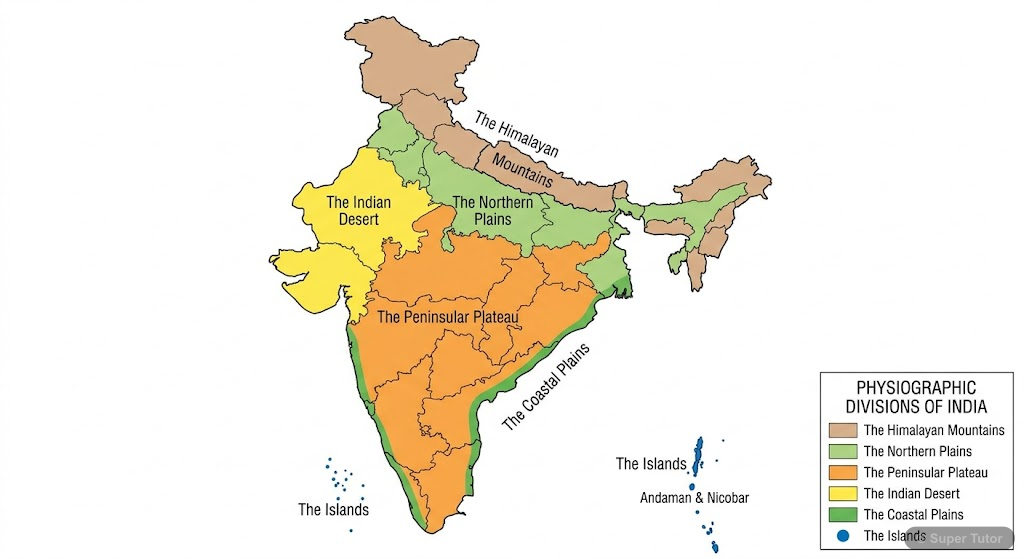
Learn better with visuals Super Tutor has hundreds of illustrations like this across every chapter — all free to try.
Get startedExercise
1(i)A landmass bounded by sea on three sides is referred to as
(a) Coast
(b) Island
(c) Peninsula
(d) None of the aboveShow solution
A peninsula is a landmass that is surrounded by water (sea) on three sides while remaining connected to the mainland on one side. India itself is a classic example of a peninsula, bounded by the Arabian Sea on the west, the Bay of Bengal on the east, and the Indian Ocean on the south.
1(ii)Mountain ranges in the eastern part of India forming its boundary with Myanmar are collectively called
(a) Himachal
(b) Uttarakhand
(c) Purvachal
(d) None of the aboveShow solution
The mountain ranges in the north-eastern part of India that run along the boundary with Myanmar are collectively known as the Purvachal (meaning 'Eastern Mountains'). These include the Patkai Bum, the Naga Hills, the Manipur Hills, and the Mizo Hills.
1(iii)The western coastal strip, south of Goa is referred to as
(a) Coromandel
(b) Konkan
(c) Kannad
(d) Northern CircarShow solution
The western coastal strip is divided into different sections. The coast north of Goa is called the Konkan coast, while the coastal strip south of Goa is known as the Kannad (or Karnataka) coast. The Coromandel coast lies on the eastern side, and the Northern Circars are also on the eastern coast.
1(iv)The highest peak in the Eastern Ghats is
(a) Anai Mudi
(b) Kanchenjunga
(c) Mahendragiri
(d) KhasiShow solution
Mahendragiri (height: 1,501 m) is the highest peak in the Eastern Ghats. Anai Mudi (2,695 m) is the highest peak of the Western Ghats and the entire Peninsular India. Kanchenjunga is in the Himalayas, and Khasi is a hill range in Meghalaya.
2(i)What is the bhabar?Show solution
Answer:
When the rivers descend from the mountains onto the plains, they deposit pebbles and coarse sediments in a narrow belt running parallel to the Himalayan foothills. This narrow belt (about 8–16 km wide) is called the Bhabar. The streams disappear underground in this region because the porous and rocky bed absorbs the river water. It is not suitable for agriculture as the soil is porous and streams disappear here.
2(ii)Name the three major divisions of the Himalayas from north to south.Show solution
The three major divisions of the Himalayas from north to south are:
1. Himadri (Greater Himalayas / Inner Himalayas): The northernmost and the most continuous range; contains the highest peaks like Everest, Kanchenjunga, etc.
2. Himachal (Lesser Himalayas / Middle Himalayas): Lies south of Himadri; ranges like Pir Panjal, Dhauladhar, and Mahabharat are part of it. Famous hill stations like Shimla, Mussoorie, and Nainital are located here.
3. Shiwaliks (Outer Himalayas): The southernmost and outermost range; composed of unconsolidated sediments. The valleys between Himachal and Shiwaliks are called 'duns' (e.g., Dehradun).
2(iii)Which plateau lies between the Aravali and the Vindhyan ranges?Show solution
The Malwa Plateau lies between the Aravali ranges (to the northwest) and the Vindhyan ranges (to the south). It is a part of the Peninsular plateau and is drained by rivers like the Chambal and the Betwa, which flow northward to join the Yamuna.
2(iv)Name the island group of India having coral origin.Show solution
The Lakshadweep Islands are the island group of India having coral origin. These islands are located in the Arabian Sea, off the Kerala coast. They are formed from coral reefs and atolls. The entire group of islands covers a small area of 32 sq km. Kavaratti is the administrative headquarters of Lakshadweep.
3(i)Distinguish between Bhangar and Khadar.Show solution
| Feature | Bhangar | Khadar |
|---|---|---|
| Definition | The older alluvial soil, forming the largest part of the Northern Plains | The newer, younger alluvial soil deposited by rivers |
| Location | Found away from the floodplains, on higher ground (terraces) | Found in the floodplains and river valleys |
| Renewal | Not renewed every year | Renewed almost every year by fresh deposits during floods |
| Fertility | Less fertile; contains lime nodules called 'kankar' | More fertile due to fresh silt deposits |
| Texture | Coarser in texture | Finer in texture |
| Suitability | Less suitable for intensive agriculture | Highly suitable for intensive agriculture |
3(ii)Distinguish between Western Ghats and Eastern Ghats.Show solution
| Feature | Western Ghats | Eastern Ghats |
|---|---|---|
| Location | Run parallel to the western coast of India | Run parallel to the eastern coast of India |
| Continuity | Continuous and can be crossed only through passes | Discontinuous and irregular; dissected by rivers |
| Height | Higher (average elevation: 900–1600 m) | Lower (average elevation: 600 m) |
| Highest Peak | Anai Mudi (2,695 m) | Mahendragiri (1,501 m) |
| Rainfall | Cause heavy rainfall on the western slopes (windward side) | Receive less rainfall |
| Rivers | Peninsular rivers originate here and flow eastward | Major rivers like Mahanadi, Godavari, Krishna, Cauvery cut through them |
| Local Name | Known as Sahyadri | No single common name |
4Which are the major physiographic divisions of India? Contrast the relief of the Himalayan region with that of the Peninsular plateau.Show solution
India can be divided into the following six major physiographic divisions:
1. The Himalayan Mountains
2. The Northern Plains
3. The Peninsular Plateau
4. The Indian Desert
5. The Coastal Plains
6. The Islands
---
Contrast between the Himalayan Region and the Peninsular Plateau:
| Feature | Himalayan Region | Peninsular Plateau |
|---|---|---|
| Origin | Young fold mountains formed by tectonic activity (relatively recent) | One of the oldest landmasses; formed from ancient crystalline, igneous and metamorphic rocks |
| Age | Young (geologically recent) | Very old (part of the Gondwana land) |
| Relief | Rugged, high, and complex relief with deep valleys and high peaks | Relatively flat with broad and shallow valleys and rounded hills |
| Height | Very high; peaks like Everest (8,848 m), Kanchenjunga (8,598 m) | Moderate elevation; average height 600–900 m above sea level |
| Rivers | Perennial rivers fed by glaciers and rainfall (e.g., Ganga, Indus, Brahmaputra) | Seasonal rivers dependent on rainfall (e.g., Godavari, Krishna, Cauvery) |
| Soil | Young, fertile alluvial soil in valleys | Black soil (Deccan trap), red and laterite soils |
| Earthquakes | Prone to earthquakes due to tectonic instability | More stable; less prone to earthquakes |
| Minerals | Rich in forests; limited hard rock minerals | Rich in minerals like iron ore, coal, manganese, mica |
5Give an account of the Northern Plains of India.Show solution
Formation:
The Northern Plains have been formed by the interplay of three major river systems — the Indus, the Ganga, and the Brahmaputra — along with their tributaries. These rivers brought alluvial deposits from the Himalayas and the Peninsular plateau over millions of years, filling the large trough (depression) between the Himalayas and the Peninsular plateau.
Area and Extent:
The Northern Plains spread over an area of about 7 lakh sq km. The plain is about 2,400 km long and 240–320 km wide.
Physiographic Divisions:
From north to south, the Northern Plains are divided into four regions:
1. Bhabar: A narrow belt (8–16 km) at the foothills of the Himalayas where rivers deposit pebbles and coarse material. Streams disappear underground here.
2. Terai: South of the Bhabar, the underground streams re-emerge in this wet, swampy, and forested region. It was once a dense forest but has been cleared for cultivation.
3. Bhangar: The largest part of the Northern Plains, composed of older alluvial soil. It lies above the floodplain level and contains lime nodules called 'kankar'. It is less fertile.
4. Khadar: The newer alluvial deposits found in the floodplains. It is renewed almost every year and is very fertile, ideal for intensive agriculture.
Importance:
- The Northern Plains are the most fertile region of India.
- They are densely populated and agriculturally very productive.
- They are drained by perennial rivers, ensuring year-round water supply.
- The flat terrain makes construction of roads, railways, and cities easy.
- They are often called the 'food bowl' of India.
6(i)Write a short note on The Indian Desert.Show solution
Location: The Indian Desert, also known as the Thar Desert, lies towards the western margins of the Aravali Hills in the state of Rajasthan. It extends into Pakistan as well.
Physical Features:
- It is an undulating sandy plain covered with sand dunes.
- The region receives very low rainfall — less than 150 mm per year — and has an arid climate with extreme temperatures (very hot days and cold nights).
- The vegetation is sparse, consisting of thorny bushes and drought-resistant plants.
Rivers:
- The region has ephemeral (seasonal) streams that disappear into the sand.
- The Luni is the only large river in this region.
Formation:
- It is believed that during the Mesozoic era, this region was under the sea. The Aravali Hills block the moisture-laden Arabian Sea winds, causing rain shadow effect and resulting in the desert conditions.
Significance:
- Despite harsh conditions, the desert supports a unique ecosystem.
- The Indira Gandhi Canal has brought irrigation to parts of this region, transforming it into agricultural land.
- It is home to the Rajasthan Canal project and the famous Rann of Kutch lies to its south.
6(ii)Write a short note on The Central Highlands.Show solution
Location: The Central Highlands form the northern extension of the Peninsular plateau, lying north of the Narmada river. They are bounded by the Aravali Hills in the northwest and the Vindhyan range in the south.
Physical Features:
- The Central Highlands are broader in the west and narrower in the east.
- The Malwa Plateau forms the major part of the Central Highlands in the west.
- In the east, the Central Highlands merge with the Chotanagpur Plateau.
- The eastward extensions of the Central Highlands are locally known as the Bundelkhand and Baghelkhand.
- Further east, the Chotanagpur Plateau extends, drained by the Damodar river.
Rivers:
- The rivers of this region, such as the Chambal, Sind, Betwa, and Ken, flow from south to north and ultimately join the Yamuna.
- These rivers flow through deep gorges and ravines, especially the Chambal, creating the famous Chambal ravines.
Significance:
- The region is rich in minerals, especially the Chotanagpur Plateau, which has large deposits of coal, iron ore, and mica.
- The Malwa Plateau has fertile black soil suitable for agriculture.
6(iii)Write a short note on The Island groups of India.Show solution
India has two major groups of islands:
1. Andaman and Nicobar Islands:
- Located in the Bay of Bengal.
- These are an elevated portion of submarine mountains.
- They are bigger in size and more numerous (about 572 islands).
- The islands are divided into two groups: the Andaman in the north and the Nicobar in the south.
- They are separated from each other by the Ten Degree Channel.
- The islands have a rich tropical rainforest cover and diverse flora and fauna.
- Port Blair is the capital of the Andaman and Nicobar Islands.
- The Barren Island (only active volcano in India) and Narcondam (dormant volcano) are located here.
- These islands are of great strategic importance.
2. Lakshadweep Islands:
- Located in the Arabian Sea, off the Kerala coast.
- These are small coral islands formed from coral reefs and atolls.
- They cover a very small area of about 32 sq km.
- Kavaratti is the administrative headquarters.
- The islands have great diversity of flora and fauna and are surrounded by rich marine life.
- The Indira Point in the Nicobar Islands is the southernmost point of India.
Significance:
- Both island groups are of strategic, ecological, and economic importance.
- They are rich in marine biodiversity and have potential for tourism.
Map SkillsOn an outline map of India show the following:
(i) Mountain and hill ranges – the Karakoram, the Zaskar, the Patkai Bum, the Jaintia, the Vindhya range, the Aravali, and the Cardamom hills.
(ii) Peaks – K2, Kanchenjunga, Nanga Parbat and the Anai Mudi.
(iii) Plateaus – Chotanagpur and Malwa.
(iv) The Indian Desert, Western Ghats, Lakshadweep Islands.Show solution
(i) Mountain and Hill Ranges:
- Karakoram: Northernmost range in Jammu & Kashmir (Ladakh), running northwest to southeast.
- Zaskar: South of the Indus river in Ladakh, running parallel to the Himalayas.
- Patkai Bum: On the India-Myanmar border in Arunachal Pradesh/Nagaland.
- Jaintia Hills: In Meghalaya, east of the Khasi Hills.
- Vindhya Range: Running east-west across Madhya Pradesh, south of the Ganga plain.
- Aravali: Running from Gujarat (southwest) to Delhi (northeast) through Rajasthan.
- Cardamom Hills: In the southern part of the Western Ghats, in Kerala/Tamil Nadu border.
(ii) Peaks:
- K2 (8,611 m): In the Karakoram range, Ladakh (PoK).
- Kanchenjunga (8,598 m): On the India-Nepal border in Sikkim.
- Nanga Parbat (8,126 m): In the western Himalayas, Jammu & Kashmir.
- Anai Mudi (2,695 m): In the Western Ghats, Kerala — highest peak of Peninsular India.
(iii) Plateaus:
- Chotanagpur Plateau: In Jharkhand, extending into West Bengal, Odisha, and Chhattisgarh.
- Malwa Plateau: In Madhya Pradesh and Rajasthan, between the Aravali and Vindhya ranges.
(iv) Other Features:
- Indian Desert (Thar Desert): In western Rajasthan, near the Pakistan border.
- Western Ghats: Running parallel to the western coast from the Tapti river in the north to Kanyakumari in the south.
- Lakshadweep Islands: In the Arabian Sea, off the coast of Kerala.
*Students should mark all these features accurately on the outline map using appropriate symbols and a legend.*
Stuck on a step?
Ask Super Tutor AI to explain any solution on this page in a simpler way — free, 24x7.
Ask a Doubt FreeFrequently Asked Questions
What are the important topics in Physical Features of India for CBSE Class 9 Social Science?
How to score full marks in Physical Features of India — CBSE Class 9 Social Science?
Where can I get free NCERT Solutions for Physical Features of India Class 9 Social Science?
Sources & Official References
- NCERT Official — ncert.nic.in
- CBSE Academic — cbseacademic.nic.in
- CBSE Official — cbse.gov.in
- National Education Policy 2020 — education.gov.in
Content is aligned to the official syllabus. Refer to the board website for the latest curriculum.
More resources for Physical Features of India
Important Questions
Practice with board exam-style questions
Syllabus
What topics to cover
Revision Notes
Key points for last-minute revision
Study Plan
Step-by-step plan to ace this chapter
Flashcards
Quick-fire cards for active recall
Formula Sheet
All formulas in one place
Chapter Summary
Understand the chapter at a glance
Practice Quiz
Test yourself with a quick quiz
Concept Maps
See how topics connect visually
For serious students
Get the full Physical Features of India chapter — for free.
Quizzes, flashcards, AI doubt-solver and a step-by-step study plan for CBSE Class 9 Social Science.