Forest Society and Colonialism
CBSE · Class 9 · Social Science
NCERT Solutions for Forest Society and Colonialism — CBSE Class 9 Social Science.
Interactive on Super Tutor
Studying Forest Society and Colonialism? Get the full interactive chapter.
Quizzes, flashcards, AI doubt-solver and a step-by-step study plan — built for ncert solutions and more.
1,000+ Class 9 students started this chapter today
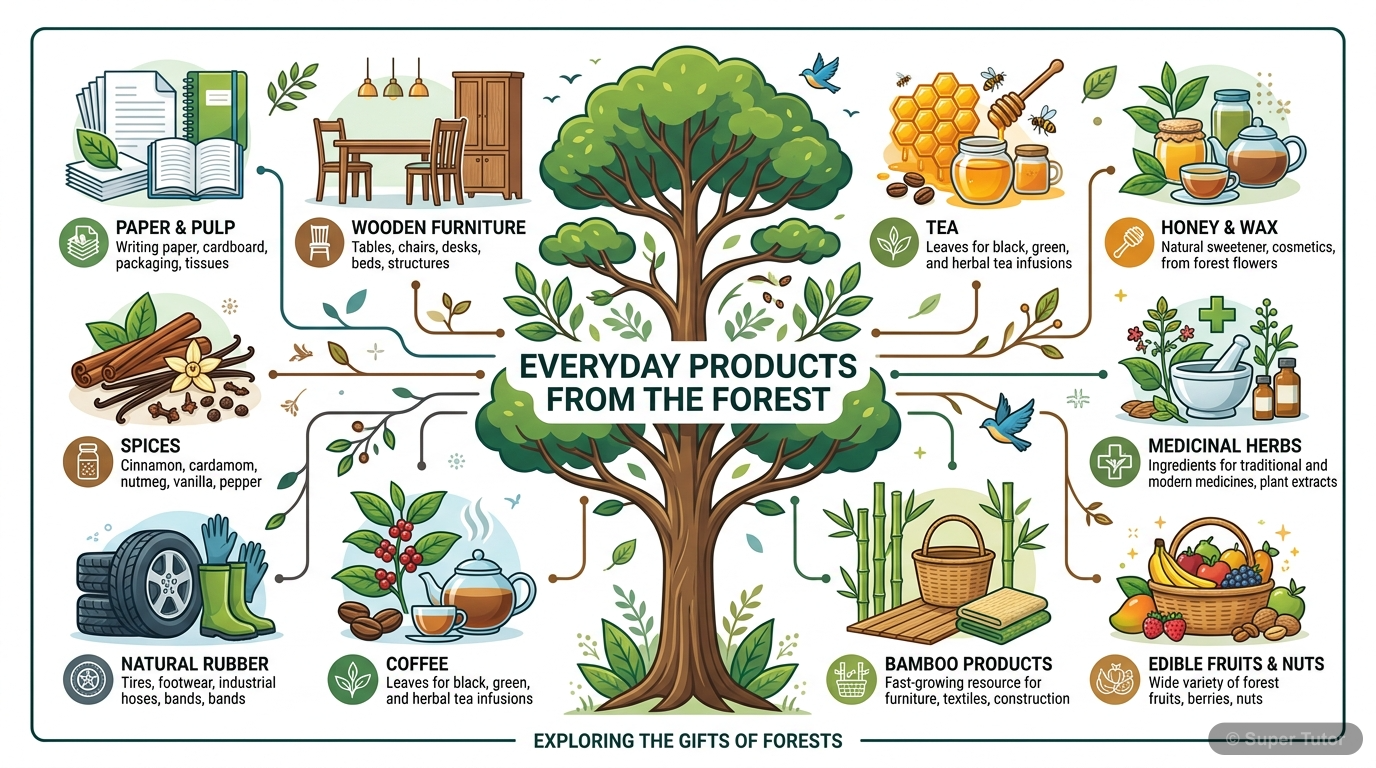
Learn better with visuals Super Tutor has hundreds of illustrations like this across every chapter — all free to try.
Get startedActivities
1Have there been changes in forest areas where you live? Find out what these changes are and why they have happened.Show solution
Step 1 – Observe and gather information:
Visit or inquire about nearby forest areas, national parks, reserved forests, or green belts in your district/state.
Step 2 – Identify changes (sample answer for reference):
- Forest cover may have decreased due to urbanisation, construction of roads/highways, mining, or agricultural expansion.
- In some areas, social forestry programmes or afforestation drives may have increased green cover.
- Encroachment by industries or real-estate developers may have reduced forest land.
Step 3 – Analyse reasons:
- Economic reasons: Demand for timber, firewood, and land for cultivation.
- Developmental reasons: Construction of dams, railways, and roads cutting through forests.
- Policy reasons: Inadequate enforcement of forest protection laws.
- Population pressure: Growing population needing more agricultural land and fuel.
Conclusion: Students should write a short report based on their own locality, citing specific examples of forest loss or gain and the human/natural factors responsible.
2Write a dialogue between a colonial forester and an adivasi discussing the issue of hunting in the forest.Show solution
---
Setting: A forest in Central India, early 20th century.
Colonial Forester (CF): You there! Stop! Do you not know that hunting in this reserved forest is strictly prohibited under the Indian Forest Act?
Adivasi (A): Sir, my family has hunted in these forests for generations. This is our home. We know every tree and every animal here.
CF: That may be so, but the Government of India has declared this a reserved forest. All resources here belong to the Crown. You cannot hunt, graze cattle, or even collect wood without permission.
A: But how will we feed our children? We do not just hunt for sport — we hunt to survive. The deer and the boar are our food. The forest is our market, our kitchen, and our medicine.
CF: I understand your difficulty, but the law is the law. The forests must be protected for scientific management — for timber production and railway sleepers. Uncontrolled hunting disturbs the ecology.
A: You say you protect the forest, yet you cut thousands of trees for your railways. You allow the British officers to go on shikar and shoot tigers for sport. Why is their hunting allowed and ours a crime?
CF: The rules apply to everyone equally. Officers require special permits. You must apply for a licence if you wish to hunt.
A: A licence? We cannot read or write your forms. And even if we could, we have no money to pay your fees. You have taken our forest and called it the Government's forest. We have lost our rights and our livelihood.
CF: *(pausing)* I suggest you take up settled cultivation. The Government will provide land.
A: Cultivation on cleared land is not our way. We are people of the forest. Without the forest, we are nothing.
---
Note: The dialogue highlights the conflict between colonial forest laws and the traditional rights of adivasi communities, showing how colonialism disrupted the lives of forest-dwelling peoples.
Questions
1Discuss how the changes in forest management in the colonial period affected the following groups of people: Shifting cultivators, Nomadic and pastoralist communities, Firms trading in timber/forest produce, Plantation owners, Kings/British officials engaged in shikar (hunting).Show solution
---
1. Shifting Cultivators:
- Shifting cultivation (also called *dhya*, *penda*, *bewar*, *dahiya* in different regions) involved cutting and burning patches of forest, cultivating for a few years, and then moving on to allow the land to recover.
- The colonial government considered this practice harmful to forests and wasteful of timber resources.
- Effect: Shifting cultivation was banned or severely restricted in reserved forests. Cultivators were forced to take up settled plough agriculture, which disrupted their traditional way of life. Many lost access to the forest land they had cultivated for generations and became impoverished.
---
2. Nomadic and Pastoralist Communities:
- Communities such as the Korava, Karacha, and Yerukula in South India, and many others across the subcontinent, moved seasonally with their herds, grazing in forests.
- Effect: The Forest Acts restricted or banned grazing in reserved forests. Pastoralists were prevented from entering forests with their cattle. This destroyed their livelihoods. Many were branded as 'criminal tribes' under the Criminal Tribes Act (1871) and forced into settled life. Their mobility — essential for their survival — was criminalised.
---
3. Firms Trading in Timber/Forest Produce:
- The colonial government needed large quantities of timber for railways, ships, and construction.
- Effect: Certain large European trading firms were given exclusive contracts (monopoly rights) to fell trees in specific forest areas. This was highly profitable for them. Small local traders and communities who had previously traded in forest produce were pushed out. The big firms benefited enormously from colonial forest policy.
---
4. Plantation Owners:
- The British encouraged the conversion of forests into tea, coffee, and rubber plantations, especially in Assam, the Nilgiris, and other hilly regions.
- Effect: Large tracts of natural forest were cleared and handed over to European planters at cheap rates. Plantation owners benefited greatly from colonial policy. However, local communities lost their forest rights. Adivasis were often forced to work on these plantations under exploitative conditions (e.g., the Inland Emigration Act, 1859, bound workers to plantations).
---
5. Kings/British Officials Engaged in Shikar (Hunting):
- Before colonialism, local kings and chiefs hunted in forests as a demonstration of their power and bravery. Hunting was also part of adivasi culture.
- Effect: The Forest Acts banned hunting by local communities and adivasis, but colonial officials and Indian princes were given special permits and even encouraged to hunt. Shikar became a sport of the elite. Hunting parties were organised on a grand scale. This was deeply discriminatory — the same forests that were closed to poor adivasis for survival were open to the powerful for sport. Over time, this led to a drastic reduction in wildlife populations.
---
Conclusion: Colonial forest management benefited commercial interests (firms, plantation owners) and the powerful (kings, British officials) while severely harming the livelihoods and rights of ordinary forest-dwelling communities such as shifting cultivators and pastoralists.
2What are the similarities between colonial management of the forests in Bastar and in Java?Show solution
Concept: Despite being managed by different colonial powers (British in India, Dutch in Java), the forest policies in both regions showed striking similarities.
---
Similarities:
| Aspect | Bastar (British India) | Java (Dutch Indonesia) |
|---|---|---|
| Scientific Forestry | The British introduced 'scientific forestry' — forests were managed for maximum timber production. | The Dutch introduced the *blandongdiensten* system — scientific management of teak forests for timber. |
| Reservation of Forests | Large areas were declared 'reserved forests'; local communities lost customary rights. | Large areas of teak forest were reserved; Javanese peasants lost access to forests they had used for generations. |
| Forced Labour | Forest communities were forced to provide free labour (*begar*) and were displaced from their homes. | Peasants were forced to provide free labour for cutting and transporting timber under the *blandongdiensten* system. |
| Displacement | Two-thirds of Bastar's forest was declared reserved in 1905; villages inside were relocated. | Entire villages were moved out of reserved forests; people were resettled in new villages outside forest boundaries. |
| Loss of Livelihoods | Adivasis could no longer hunt, graze cattle, collect forest produce, or practise shifting cultivation freely. | Javanese peasants lost the right to cultivate forest land, graze animals, and collect forest produce. |
| Resistance | The people of Bastar rose in revolt in 1910 under the leadership of Gunda Dhur — the *Bhumkal* rebellion. | The Javanese resisted under Surontiko Samin in 1890, arguing that the state had no right over forests. |
| Exploitation for Colonial Needs | Forests were exploited for railway sleepers, shipbuilding, and export. | Teak forests were exploited for shipbuilding by the Dutch East India Company (VOC) and later the Dutch colonial government. |
---
Conclusion: In both Bastar and Java, colonial powers used similar strategies — reservation of forests, denial of community rights, forced labour, and displacement — to gain control over valuable timber resources. In both cases, local communities resisted these policies. The similarities show that colonialism followed a common pattern of resource extraction regardless of the specific colonial power involved.
3Between 1880 and 1920, forest cover in the Indian subcontinent declined by 9.7 million hectares, from 108.6 million hectares to 98.9 million hectares. Discuss the role of the following factors in this decline: Railways, Shipbuilding, Agricultural expansion, Commercial farming, Tea/Coffee plantations, Adivasis and other peasant users.Show solution
Concept: Multiple factors — colonial economic needs, infrastructure development, and agricultural pressure — contributed to this massive deforestation.
---
1. Railways:
- The railway network expanded rapidly under British rule — from a few hundred kilometres in the 1850s to over 25,000 miles by the early 20th century.
- Railways required two things from forests:
- (a) Sleepers (ties): Each mile of railway track needed between 1,760 and 2,000 wooden sleepers. Durable hardwoods like sal and teak were preferred.
- (b) Fuel: Steam engines burned wood as fuel in the early decades.
- Role in decline: Millions of trees were felled to meet the enormous demand for railway sleepers. By the 1850s, the government was alarmed at the rapid disappearance of forests near railway lines. This was one of the single largest causes of deforestation.
---
2. Shipbuilding:
- Britain had a powerful navy and merchant fleet that required large quantities of strong timber, especially teak and oak.
- By the early 19th century, oak forests in England were nearly exhausted.
- Role in decline: The British turned to Indian forests, particularly the teak forests of Malabar (Kerala), to build warships and merchant vessels. The Surveyor-General of Forests was appointed partly to ensure a steady supply of timber for shipbuilding. Large-scale felling of teak trees contributed significantly to forest loss.
---
3. Agricultural Expansion:
- The colonial government believed that expanding agriculture would increase land revenue and make the land more 'productive.'
- Forests were seen as 'wasteland' that needed to be brought under cultivation.
- Role in decline: The government actively encouraged the clearing of forests for agriculture. Between 1880 and 1920, millions of hectares of forest were converted to farmland. The colonial revenue system rewarded peasants who cleared forests and cultivated the land.
---
4. Commercial Farming:
- The demand for commercial crops like cotton, jute, sugarcane, and wheat grew rapidly due to industrialisation in Britain and global trade.
- Role in decline: To grow these crops, large areas of forest were cleared. Zamindars and peasants converted forest land into fields for commercial crops. This was encouraged by the colonial government as it increased exports and revenue.
---
5. Tea/Coffee Plantations:
- The British promoted tea plantations in Assam and Darjeeling, and coffee plantations in Coorg and the Nilgiris.
- Role in decline: Dense natural forests were cleared on a large scale to establish these plantations. The colonial government gave land to European planters at very cheap rates. Entire hillsides were stripped of their original forest cover and replaced with monoculture plantations. This caused significant loss of biodiversity and forest cover.
---
6. Adivasis and Other Peasant Users:
- Forest communities had traditionally used forests for shifting cultivation, grazing, collecting firewood, hunting, and gathering food.
- Role in decline: While their individual impact was smaller compared to commercial and industrial demands, the cumulative effect of millions of people using forests for daily needs did contribute to forest degradation. Shifting cultivation, in particular, involved burning patches of forest. However, it is important to note that traditional use was sustainable over centuries — it was the scale of colonial commercial exploitation that caused the dramatic decline. Adivasis and peasants were often blamed by colonial authorities for deforestation, but their role was far less significant than railways, plantations, and commercial farming.
---
Conclusion: The decline of 9.7 million hectares was primarily driven by colonial economic policies — the need for railway sleepers, timber for shipbuilding, land for plantations and commercial farming. While adivasis and peasants contributed to forest use, they were not the primary cause of this large-scale deforestation. The colonial period fundamentally transformed India's relationship with its forests, treating them as a commercial resource rather than a living ecosystem.
4Why are forests affected by wars?Show solution
Concept: Forests are affected by wars because they are a strategic resource and because wartime conditions lead to rapid, unregulated exploitation of natural resources.
---
Reasons why forests are affected by wars:
1. Demand for Timber for War Effort:
- Wars require enormous quantities of timber for building warships, military barracks, bridges, railway sleepers for troop movement, and fuel.
- Example: During the First and Second World Wars, the British colonial government in India massively increased timber felling to meet war needs. The normal rules of scientific forestry were suspended. Forests that had been carefully managed were rapidly cut down.
- In Java (Indonesia), the Dutch followed a 'scorched earth' policy during World War II — they destroyed teak forests to prevent them from falling into Japanese hands.
2. Suspension of Conservation Rules:
- In peacetime, forest departments regulate the rate of felling to ensure sustainability.
- During wars, these regulations are relaxed or ignored entirely in the urgency of meeting military demands.
- Effect: Trees are felled far faster than they can regenerate, leading to permanent loss of forest cover.
3. Direct Destruction:
- Warfare itself destroys forests through bombing, the use of chemical defoliants (e.g., Agent Orange used by the USA in Vietnam), and fires caused by military operations.
- Forests are also deliberately cleared to deny cover to enemy forces.
4. Post-War Reconstruction:
- After wars, there is a huge demand for timber to rebuild destroyed towns, cities, railways, and infrastructure.
- This puts additional pressure on forests even after the fighting has ended.
5. Displacement of People:
- Wars displace large populations who may move into forest areas and clear land for shelter and agriculture, adding to deforestation.
---
Example from the chapter:
- During World War II, the forest department in India overexploited forests to meet British war needs. After the war, the forest department found it difficult to manage the forests as the local people, who had been watching the British cut trees indiscriminately, began to resist forest regulations and assert their own rights over forest resources.
- In Java, the Dutch destroyed teak forests before retreating from the Japanese, and after the war, the Indonesian forest service found it very difficult to get local people to respect forest boundaries, as they had seen the Dutch themselves destroy the forests.
---
Conclusion: Wars affect forests in multiple ways — through direct destruction, massive unregulated felling for military needs, suspension of conservation rules, and post-war reconstruction demands. Wars accelerate deforestation far beyond normal rates and often cause irreversible damage to forest ecosystems. The examples of India and Java during the World Wars clearly illustrate how forests become casualties of human conflict.
Stuck on a step?
Ask Super Tutor AI to explain any solution on this page in a simpler way — free, 24x7.
Ask a Doubt FreeFrequently Asked Questions
What are the important topics in Forest Society and Colonialism for CBSE Class 9 Social Science?
How to score full marks in Forest Society and Colonialism — CBSE Class 9 Social Science?
Where can I get free NCERT Solutions for Forest Society and Colonialism Class 9 Social Science?
Sources & Official References
- NCERT Official — ncert.nic.in
- CBSE Academic — cbseacademic.nic.in
- CBSE Official — cbse.gov.in
- National Education Policy 2020 — education.gov.in
Content is aligned to the official syllabus. Refer to the board website for the latest curriculum.
More resources for Forest Society and Colonialism
Important Questions
Practice with board exam-style questions
Syllabus
What topics to cover
Revision Notes
Key points for last-minute revision
Study Plan
Step-by-step plan to ace this chapter
Flashcards
Quick-fire cards for active recall
Formula Sheet
All formulas in one place
Chapter Summary
Understand the chapter at a glance
Practice Quiz
Test yourself with a quick quiz
Concept Maps
See how topics connect visually
For serious students
Get the full Forest Society and Colonialism chapter — for free.
Quizzes, flashcards, AI doubt-solver and a step-by-step study plan for CBSE Class 9 Social Science.