Understanding Social Science
CBSE · Class 9 · Social Science
NCERT Solutions for Understanding Social Science — CBSE Class 9 Social Science.
Interactive on Super Tutor
Studying Understanding Social Science? Get the full interactive chapter.
Quizzes, flashcards, AI doubt-solver and a step-by-step study plan — built for ncert solutions and more.
1,000+ Class 9 students started this chapter today
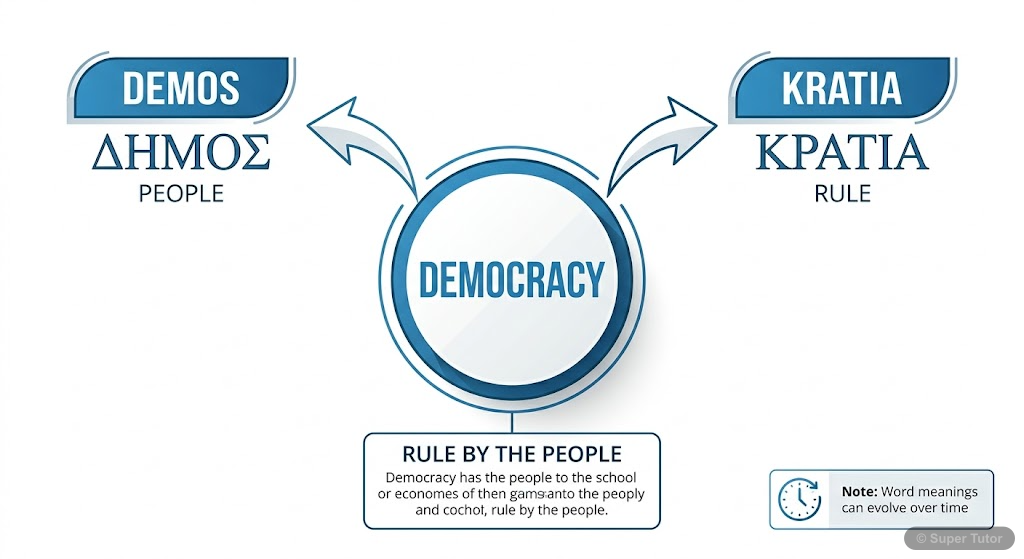
This is just one of 5+ visuals inside Super Tutor's Understanding Social Science chapter
Explore the full set5 worked solutions below. Unlock all 10 free in Super Tutor
Exercises — What is Democracy? Why is Democracy?
1Here is some information about four countries. Based on this information, how would you classify each of these countries. Write 'democratic', 'undemocratic' or 'not sure' against each of these.
a. Country A: People who do not accept the country's official religion do not have a right to vote.
b. Country B: The same party has been winning elections for the last twenty years.
c. Country C: Ruling party has lost in the last three elections.
d. Country D: There is no independent election commission.Show solution
Concept: A democracy must ensure universal adult franchise (right to vote for all citizens), free and fair elections conducted by an independent body, and the possibility of change of government through elections.
a. Country A — Undemocratic
Denying the right to vote on the basis of religion violates the principle of universal adult franchise. Every citizen must have an equal right to vote regardless of religion. Hence, Country A is undemocratic.
b. Country B — Not Sure
The same party winning elections for twenty years does not by itself make a country undemocratic. It is possible that people genuinely prefer that party. However, it raises suspicion about whether elections are truly free and fair. Hence, Country B is not sure.
c. Country C — Democratic
The ruling party has lost in the last three elections, which means elections are being held regularly and people are able to change the government through the ballot. This is a key feature of democracy. Hence, Country C is democratic.
d. Country D — Undemocratic
An independent election commission is essential to conduct free and fair elections. Without it, the ruling party can manipulate elections. Hence, Country D is undemocratic.
Not sure why a step works? check your working in Super Tutor
2Here is some information about four countries. Based on this information, how would you classify each of these countries. Write 'democratic', 'undemocratic' or 'not sure' against each of these.
a. Country P: The parliament cannot pass a law about the army without the consent of the Chief of Army.
b. Country Q: The parliament cannot pass a law reducing the powers of the judiciary.
c. Country R: The country's leaders cannot sign any treaty with another country without taking permission from its neighbouring country.
d. Country S: All the major economic decisions about the country are taken by officials of the central bank which the ministers cannot change.Show solution
Concept: In a democracy, the elected government must have supreme authority. It should not be controlled by non-elected bodies (army, foreign powers, unaccountable institutions). However, checks and balances within the constitutional framework (like an independent judiciary) are acceptable.
a. Country P — Undemocratic
In a democracy, the elected parliament must have control over the military. If the army chief can veto parliamentary decisions, it means the military has power over the elected government. This is a feature of military rule, not democracy. Hence, Country P is undemocratic.
b. Country Q — Democratic
An independent judiciary is a constitutional safeguard in a democracy. Parliament not being able to arbitrarily reduce judicial powers protects citizens' rights and maintains the rule of law. This is a healthy check and balance. Hence, Country Q is democratic.
c. Country R — Undemocratic
A sovereign democratic country must be free to take its own foreign policy decisions. If it requires permission from a neighbouring country to sign treaties, it is not truly sovereign or self-governing. Hence, Country R is undemocratic.
d. Country S — Not Sure
Central banks in many democracies are given independence to manage monetary policy without political interference, which can be a legitimate arrangement. However, if *all* major economic decisions are beyond the reach of elected ministers, it undermines democratic accountability. Hence, Country S is not sure (leaning undemocratic).
Not sure why a step works? check your working in Super Tutor
3Which of these is not a good argument in favour of democracy? Why?
a. People feel free and equal in a democracy.
b. Democracies resolve conflict in a better way than others.
c. Democratic government is more accountable to the people.
d. Democracies are more prosperous than others.Show solution
Reason:
Prosperity (economic development) is not an exclusive feature of democracy. Many non-democratic countries (for example, some oil-rich monarchies or authoritarian states like China in certain periods) have also achieved high economic growth. Economic prosperity depends on many factors such as natural resources, policies, geography, and global trade — not just the form of government.
Therefore, claiming that democracies are *more* prosperous than others is not a reliable or universally valid argument. It is not a defining or guaranteed feature of democracy.
The other three options — (a), (b), and (c) — are valid arguments because they relate to the core values and functioning of democracy: freedom, equality, conflict resolution, and accountability to citizens.
Not sure why a step works? check your working in Super Tutor
4Each of these statements contains a democratic and an undemocratic element. Write out the two separately for each statement.
a. A minister said that some laws have to be passed by the parliament in order to conform to the regulations decided by the World Trade Organisation (WTO).
b. The Election Commission ordered re-polling in a constituency where large-scale rigging was reported.
c. Women's representation in the parliament has barely reached 10 per cent. This led women's organisations to demand one-third seats for women.Show solution
a. WTO and Parliament:
- Democratic element: Laws have to be passed by the parliament — this means the elected legislature has the authority to make laws, which is democratic.
- Undemocratic element: The laws are being passed to conform to regulations decided by the WTO, an international body that is not elected by the people of that country. The parliament is not acting freely but under external pressure, which undermines the sovereignty of the elected body.
b. Election Commission and Re-polling:
- Democratic element: The Election Commission ordered re-polling — this shows that an independent constitutional body is working to ensure free and fair elections, which is a democratic feature.
- Undemocratic element: Large-scale rigging was reported in the constituency — electoral rigging is a violation of democratic principles as it denies citizens their genuine right to vote.
c. Women's Representation:
- Democratic element: Women's organisations are demanding one-third seats for women in parliament — this demand for greater representation and equality is democratic in spirit.
- Undemocratic element: Women's representation has barely reached 10 per cent — this shows that half the population is grossly under-represented in the legislature, which is contrary to the democratic principle of equal political participation for all.
Not sure why a step works? check your working in Super Tutor
5Which of these is not a valid reason for arguing that there is a lesser possibility of famine in a democratic country?
a. Opposition parties can draw attention to hunger and starvation.
b. Free press can report suffering from famine in different parts of the country.
c. Government fears its defeat in the next elections.
d. People are free to believe in and practise any religion.Show solution
Reason:
Freedom of religion has no direct connection with the prevention of famine. Famine is prevented in a democracy because:
- The opposition (option a) can highlight food shortages and pressurise the government.
- A free press (option b) can report starvation and create public awareness.
- The government (option c) is accountable to voters and fears electoral defeat if it fails to address hunger.
Religious freedom is a valuable democratic right, but it does not contribute to preventing famine. Hence, option (d) is the correct answer.
Not sure why a step works? check your working in Super Tutor
a. Filing a case in the courts claiming that water is part of right to life.
b. Boycotting the next elections to give a message to all parties.
c. Organising public meetings against government's policies.
d. Paying money to government officials to get water.
a. Army is the most disciplined and corruption-free organisation in the country. Therefore army should rule the country.
b. Rule of the majority means the rule of ignorant people. What we need is the rule of the wise, even if they are in small numbers.
c. If we want religious leaders to guide us in spiritual matters, why not invite them to guide us in politics as well. The country should be ruled by religious leaders.
a. Father to daughter: I don't want to hear your opinion about your marriage. In our family children marry where the parents tell them to.
b. Teacher to student: Don't disturb my concentration by asking me questions in the classroom.
c. Employee to the officer: Our working hours must be reduced according to the law.
a. All the citizens of the country have right to vote. Elections are held regularly.
b. The country took loan from international agencies. One of the conditions for giving loan was that the government would reduce its expenses on education and health.
c. People speak more than seven languages but education is available only in one language, the language spoken by 52 percent people of that country.
d. Several organisations have given a call for peaceful demonstrations and nation wide strikes in the country to oppose these policies. Government has arrested these leaders.
e. The government owns the radio and television in the country. All the newspapers have to get permission from the government to publish any news about government's policies and protests.
5 more solved questions in Understanding Social Science
Every remaining exercise is solved step by step in Super Tutor, plus practice quizzes and flashcards for this chapter. Free to start.
Stuck on a step?
Ask Super Tutor AI to explain any solution on this page in a simpler way — free, 24x7.
Ask a Doubt FreeFrequently Asked Questions
What are the important topics in Understanding Social Science for CBSE Class 9 Social Science?
How to score full marks in Understanding Social Science — CBSE Class 9 Social Science?
Where can I get free NCERT Solutions for Understanding Social Science Class 9 Social Science?
Sources & Official References
- NCERT Official — ncert.nic.in
- CBSE Academic — cbseacademic.nic.in
- CBSE Official — cbse.gov.in
- National Education Policy 2020 — education.gov.in
Content is aligned to the official syllabus. Refer to the board website for the latest curriculum.
More resources for Understanding Social Science
Practice Quiz
Test yourself with a quick quiz
Important Questions
Practice with board exam-style questions
Revision Notes
Key points for last-minute revision
Formula Sheet
All formulas in one place
Chapter Summary
Understand the chapter at a glance
Concept Maps
See how topics connect visually
Study Plan
Step-by-step plan to ace this chapter
Flashcards
Quick-fire cards for active recall
Syllabus
What topics to cover
For serious students
Get the full Understanding Social Science chapter — for free.
Quizzes, flashcards, AI doubt-solver and a step-by-step study plan for CBSE Class 9 Social Science.