Acids, Bases and Salts — Chapter Summary
Gujarat Board · Class 10 · Science
Summary of Acids, Bases and Salts for Gujarat Board Class 10 Science. Part of the Gujarat Board Class 10 Science syllabus.
Interactive on Super Tutor
Studying Acids, Bases and Salts? Get the full interactive chapter.
Quizzes, flashcards, AI doubt-solver and a step-by-step study plan — built for chapter summary and more.
Free trial, no card needed.
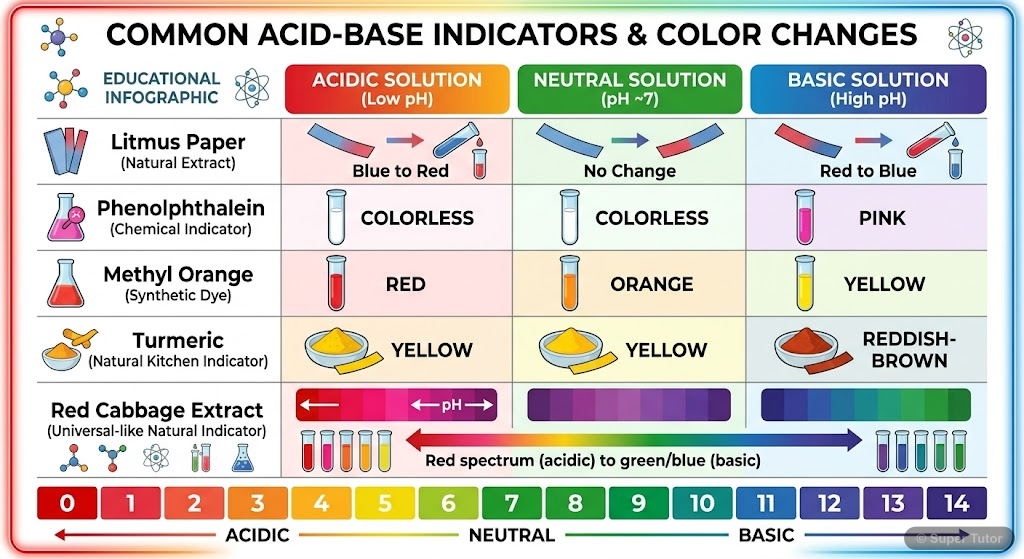
One of 14 illustrations for Acids, Bases and Salts in Super Tutor — alongside flashcards, concept maps and practice questions.
Overview
Acids, bases, and salts are fundamental substances that we encounter daily in our food, medicines, and household products. Acids taste sour and turn blue litmus paper red, while bases taste bitter and turn red litmus paper blue. Salts are neutral compounds formed when acids and bases react together.
Key Concepts
Indicators are dyes or mixtures
Indicators are dyes or mixtures of dyes that change colour to show whether a substance is acidic or basic. Natural indicators include litmus (purple d
When acids react with metals
When acids react with metals, they produce hydrogen gas and a salt. The general equation is: Acid + Metal → Salt + Hydrogen gas. For example, zinc rea
Metal carbonates and metal hydrogencarbonates react
Metal carbonates and metal hydrogencarbonates react with acids to produce carbon dioxide gas, salt, and water. The general equation is: Metal carbonat
Neutralisation is the reaction between
Neutralisation is the reaction between an acid and a base to form salt and water. The general equation is: Acid + Base → Salt + Water. At the ionic le
All acids produce hydrogen ions (H⁺)
All acids produce hydrogen ions (H⁺) in aqueous solutions. These hydrogen ions combine with water molecules to form hydronium ions: H⁺ + H₂O → H₃O⁺. A
Learning Objectives
- Understand the chemical properties of acids and bases through laboratory activities
- Identify how acids and bases react with metals, carbonates, and each other
- Learn that all acids produce H+ ions and all bases produce OH- ions in aqueous solutions
- Understand the pH scale and how to measure the strength of acids and bases
- Explore the importance of pH in everyday life including digestion, tooth decay, and soil quality
Frequently Asked Questions
What are the important topics in Acids, Bases and Salts for Gujarat Board Class 10 Science?
How should I revise Acids, Bases and Salts for the Gujarat Board Class 10 board exam?
Sources & Official References
Content is aligned to the official syllabus. Refer to the board website for the latest curriculum.
More resources for Acids, Bases and Salts
For serious students
Get the full Acids, Bases and Salts chapter — start free.
Quizzes, flashcards, an AI doubt solver and a study plan for Gujarat Board Class 10 Science. Free to start, no card needed.