Acids, Bases and Salts — Revision Notes
Gujarat Board · Class 10 · Science
Acids, Bases and Salts revision notes for Gujarat Board Class 10 Science: 4 topics in quick points. Part of the Gujarat Board Class 10 Science syllabus.
Interactive on Super Tutor
Studying Acids, Bases and Salts? Get the full interactive chapter.
Quizzes, flashcards, AI doubt-solver and a step-by-step study plan — built for revision notes and more.
Free trial, no card needed.
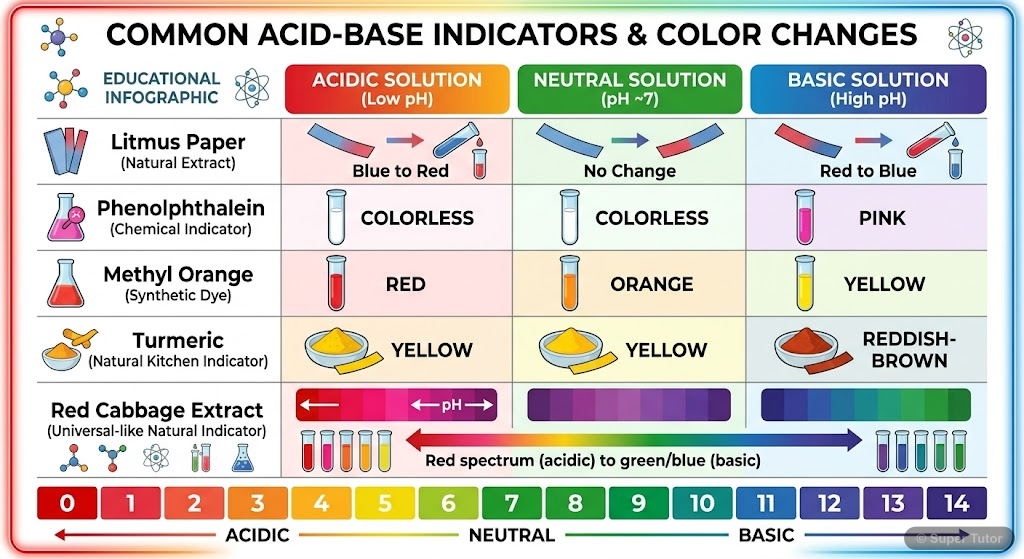
One of 14 illustrations for Acids, Bases and Salts in Super Tutor — alongside flashcards, concept maps and practice questions.
Key Topics to Revise
Indicators — Testing Acids and Bases
- An indicator is a substance that shows different colours in acidic and basic solutions.
- Litmus is a natural indicator extracted from lichen (a plant of division Thallophyta). It is purple when neutral, turns red in acids, and turns blue in bases.
- Phenolphthalein is colourless in acidic solutions and pink/magenta in basic solutions.
Chemical Properties of Acids and Bases
- Acid + Metal → Salt + Hydrogen gas (H₂). Example: H₂SO₄ + Zn → ZnSO₄ + H₂↑
- The hydrogen gas produced burns with a 'pop' sound when a burning candle is brought near it — this is the test for hydrogen gas.
- Not all metals react with bases, but zinc reacts with NaOH: 2NaOH + Zn → Na₂ZnO₂ (sodium zincate) + H₂↑
Acids and Bases in Water — Ions and Conductivity
- All acids produce H⁺ ions (or H₃O⁺ ions / hydronium ions) when dissolved in water. This is responsible for their acidic properties.
- All bases produce OH⁻ ions when dissolved in water. This is responsible for their basic properties.
- Bases which are soluble in water are called alkalis. Example: NaOH, KOH, Ca(OH)₂.
pH Scale — Measuring Acid and Base Strength
- pH stands for 'potenz' (German word for power). It is a scale used to measure the concentration of hydrogen ions in a solution.
- pH scale ranges from 0 to 14.
- pH = 7 → Neutral solution (pure water at 25°C).
Get complete notes with diagrams and examples
Full NotesKey Concepts
Frequently Asked Questions
What are the important topics in Acids, Bases and Salts for Gujarat Board Class 10 Science?
How should I revise Acids, Bases and Salts for the Gujarat Board Class 10 board exam?
Sources & Official References
Content is aligned to the official syllabus. Refer to the board website for the latest curriculum.
More resources for Acids, Bases and Salts
For serious students
Get the full Acids, Bases and Salts chapter — start free.
Quizzes, flashcards, an AI doubt solver and a study plan for Gujarat Board Class 10 Science. Free to start, no card needed.