Metals and Non-metals — Chapter Summary
Gujarat Board · Class 10 · Science
Summary of Metals and Non-metals for Gujarat Board Class 10 Science. Key concepts: Metals possess distinct, Non and The reactivity series is.
Interactive on Super Tutor
Studying Metals and Non-metals? Get the full interactive chapter.
Quizzes, flashcards, AI doubt-solver and a step-by-step study plan — built for chapter summary and more.
Free trial, no card needed.
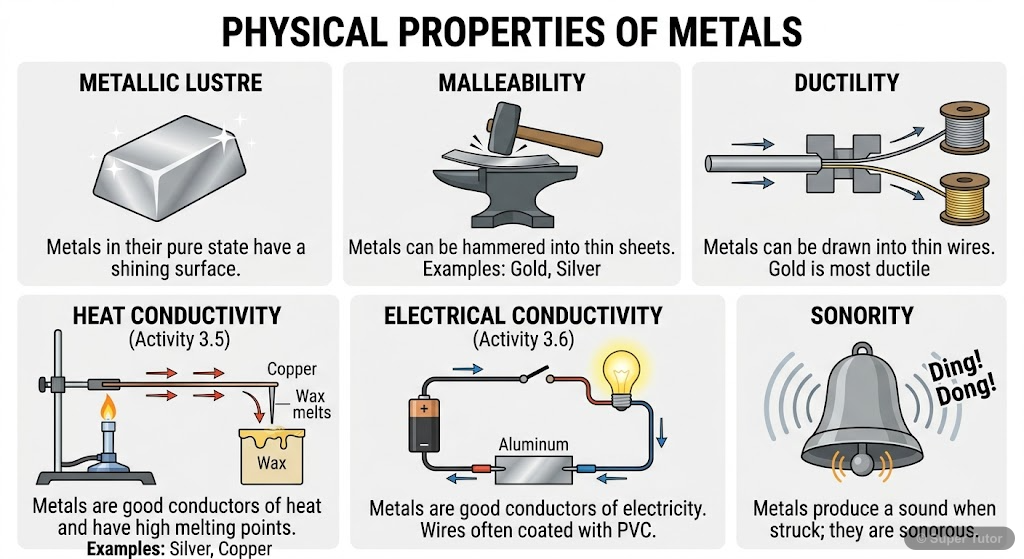
One of 16 illustrations for Metals and Non-metals in Super Tutor — alongside flashcards, concept maps and practice questions.
Overview
Metals and non-metals are two major categories of elements that differ fundamentally in their physical and chemical properties. Understanding the distinction between these elements is crucial for comprehending how materials around us function and react. Metals form the backbone of modern civilizatio
Key Concepts
Metals possess distinct physical characteristics
Metals possess distinct physical characteristics that make them recognizable and useful. Metallic lustre refers to the shining surface of pure metals
Non
Non-metals display contrasting properties to metals. They are generally non-lustrous (except iodine and diamond which are exceptions), brittle, and ca
The reactivity series is a list
The reactivity series is a list of metals arranged in decreasing order of their chemical activity: K > Na > Ca > Mg > Al > Zn > Fe > Pb > Cu > Ag > Au
When metals burn in oxygen
When metals burn in oxygen, they form metal oxides (Metal + O₂ → Metal oxide). Different metals react with oxygen at different rates. Highly reactive
Metals react with water to produce
Metals react with water to produce metal oxides (or hydroxides if soluble) and hydrogen gas. Reactivity decreases from K and Na (violent reaction with
Learning Objectives
- Classify elements as metals and non-metals based on physical and chemical properties
- Explain the physical properties of metals including lustre, malleability, ductility, and conductivity
- Understand the reactivity series and its applications in predicting chemical reactions
- Describe how metals react with oxygen, water, acids, and metal salt solutions
- Learn the process of metal extraction from ores using various reduction methods
Frequently Asked Questions
What are the important topics in Metals and Non-metals for Gujarat Board Class 10 Science?
How should I revise Metals and Non-metals for the Gujarat Board Class 10 board exam?
Sources & Official References
Content is aligned to the official syllabus. Refer to the board website for the latest curriculum.
More resources for Metals and Non-metals
For serious students
Get the full Metals and Non-metals chapter — start free.
Quizzes, flashcards, an AI doubt solver and a study plan for Gujarat Board Class 10 Science. Free to start, no card needed.