In search of Peace: Buddha and Mahavir — Practice Quiz
Gujarat Board · Class 6 · Social Science
Try a 4-question quiz on In search of Peace: Buddha and Mahavir for Gujarat Board Class 6 Social Science: tap an answer to check it and see why.
Interactive on Super Tutor
Studying In search of Peace: Buddha and Mahavir? Get the full interactive chapter.
Quizzes, flashcards, AI doubt-solver and a step-by-step study plan — built for practice quiz and more.
Free trial, no card needed.
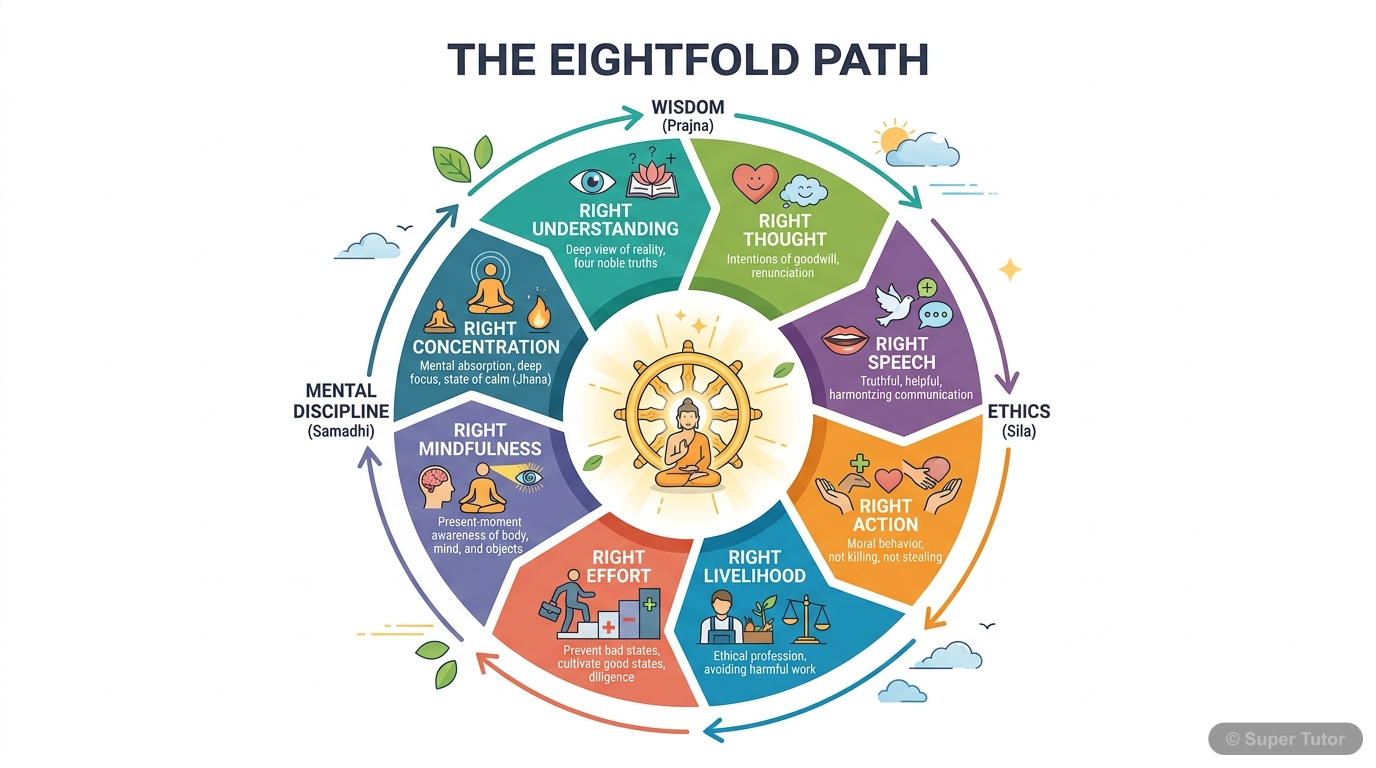
Learn better with visuals Super Tutor pairs illustrations like this with notes and quizzes for In search of Peace: Buddha and Mahavir.
Quick Quiz: In search of Peace: Buddha and Mahavir
0/4Tap an answer to check it instantly. No sign-up needed for these 4.
What was the childhood name of Gautam Buddha?
In which city did Gautam Buddha give his first sermon (preaching)?
Under which tree did Gautam Buddha attain enlightenment?
Where did Gautam Buddha attain Nirvana (death)?
Sample Questions
According to Buddha, how many 'Arya Truths' (noble truths) are there?
Show answer
Four
Step 1: The question asks about the number of noble truths in Buddha's teachings. Step 2: Buddha gave a simple sermon to rid the world of miseries. Step 3: He explained Four Arya Truths (Four Noble Truths): (1) The world is full of miseries, (2) The cause of suffering is greed or strong desire, (3) Destruction of suffering is renunciation of desire, (4) Adoption of the Ashtang Marg (Eightfold Path) eliminates desire. Step 4: Eight is the number of steps in the Ashtang Marg (Eightfold Path), not the number of noble truths. Step 5: Three refers to Triratna of Jainism, and Five refers to the five
What was the childhood name of Mahavir Swami?
Show answer
Vardhaman
Step 1: The question asks about the childhood name of Mahavir Swami. Step 2: Mahavir Swami was born in the Gnatrak Kshatriya dynasty of Kundgram republic. Step 3: His childhood name was Vardhaman. Step 4: He was later called 'Mahavir' because he conquered his mind and senses (Jin means one who has conquered). Step 5: Siddhartha was the childhood name of Gautam Buddha. Nandivardhan was Mahavir's elder brother, and Rahul was Buddha's son.
Where was Mahavir Swami born?
Show answer
Kundgram
Step 1: The question asks the birthplace of Mahavir Swami. Step 2: Mahavir Swami was born in the Gnatrak Kshatriya dynasty. Step 3: His birthplace was Kundgram, which was part of the Vajji Union republic. Step 4: Kapilvastu was the kingdom where Gautam Buddha was born. Bodhgaya is where Buddha attained enlightenment. Step 5: Pawapuri is where Mahavir Swami died and attained Nirvana, not where he was born.
What is the name given to the highest knowledge attained by Mahavir Swami?
Show answer
Kevalgyan
Step 1: The question asks for the name of the highest knowledge Mahavir Swami attained. Step 2: Mahavir Swami left home at the age of 30 and lived as a beggar (Bhikshuk). Step 3: He did harsh penance for twelve years on the bank of river Rijupalika. Step 4: After this penance, he attained the highest knowledge called 'Kevalgyan'. Step 5: Nirvana refers to death/liberation, Samadhi is deep meditation, and Triratna is the doctrine (Ratnatrayi) of samyak vision, samyak knowledge, and samyak behaviour.
+39 more questions on In search of Peace: Buddha and Mahavir (Gujarat Board Class 6 Social Science)
Practise AllFrequently Asked Questions
What are the important topics in In search of Peace: Buddha and Mahavir for Gujarat Board Class 6 Social Science?
How many practice questions are there for In search of Peace: Buddha and Mahavir?
Sources & Official References
Content is aligned to the official syllabus. Refer to the board website for the latest curriculum.
More resources for In search of Peace: Buddha and Mahavir
For serious students
Get the full In search of Peace: Buddha and Mahavir chapter — start free.
Quizzes, flashcards, an AI doubt solver and a study plan for Gujarat Board Class 6 Social Science. Free to start, no card needed.