The Fundamental Unit of Life — Flashcards
Gujarat Board · Class 9 · Science
28 flashcards for The Fundamental Unit of Life (Gujarat Board Class 9 Science) to test yourself on key terms and facts.
Interactive on Super Tutor
Studying The Fundamental Unit of Life? Get the full interactive chapter.
Quizzes, flashcards, AI doubt-solver and a step-by-step study plan — built for flashcards and more.
Free trial, no card needed.
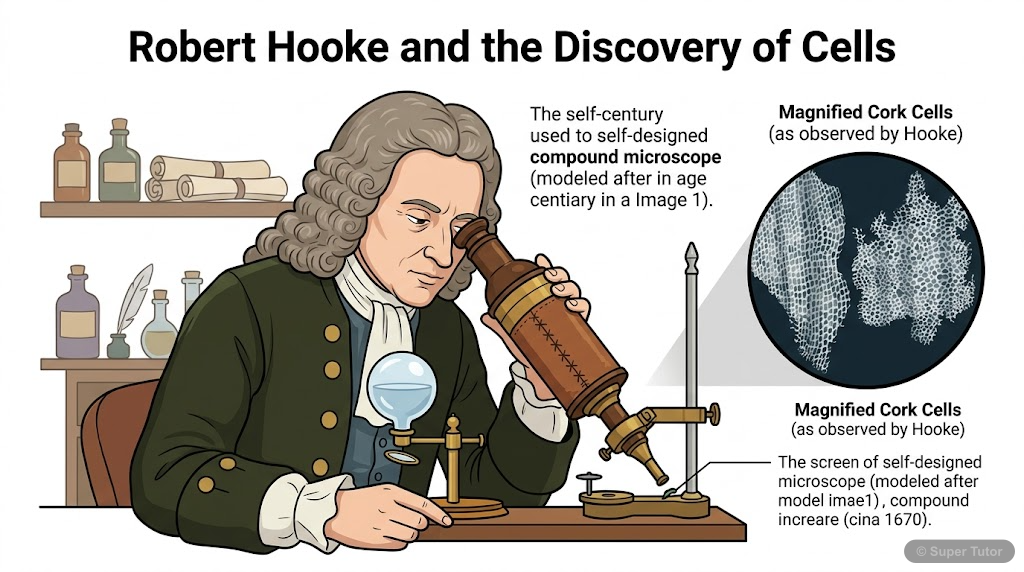
Learn better with visuals Super Tutor pairs illustrations like this with notes and quizzes for The Fundamental Unit of Life.
What did Robert Hooke observe in 1665 that led to the discovery of cells?
Answer
Robert Hooke observed a thin slice of cork under his self-designed microscope and noticed it resembled a honeycomb structure with many small compartments. He called these compartments 'cells' (from th…
Why is the cell called the 'fundamental unit of life'?
Answer
The cell is the fundamental unit of life because: (1) All living organisms are made of cells, (2) Cells are the smallest units of life that can perform all life functions independently, (3) All cells …
How would you prepare a temporary mount of onion peel to observe cells under a microscope?
Answer
Step-by-step process: (1) Peel off the thin epidermis from the inner layer of an onion bulb using forceps, (2) Place the peel in a watch-glass containing water to prevent it from drying or folding, (3…
What is the difference between unicellular and multicellular organisms? Give examples.
Answer
Unicellular organisms (uni = single) are made of a single cell that can perform all life functions independently. Examples: Amoeba, Chlamydomonas, Paramecium, bacteria. Multicellular organisms (multi …
Why do cells of different parts of the body have different shapes and sizes?
Answer
The shape and size of cells are directly related to the specific functions they perform. For example, nerve cells have a typical elongated shape that allows them to transmit electrical signals efficie…
What is the plasma membrane and why is it called a 'selectively permeable membrane'?
Answer
The plasma membrane is the outermost covering of the cell that separates the cell contents from the external environment. It is called a selectively permeable (or semi-permeable) membrane because it a…
Explain the process of diffusion and how it helps in gas exchange in cells.
Answer
Diffusion is the spontaneous movement of substances from a region of high concentration to a region of low concentration, without requiring energy. In cells, when CO₂ (a waste product) accumulates in …
What is osmosis and how does it differ from simple diffusion?
Answer
Osmosis is the movement of water molecules through a selectively permeable membrane from a region of higher water concentration (lower solute concentration) to a region of lower water concentration (h…
+20 more flashcards
Practise AllFrequently Asked Questions
What are the important topics in The Fundamental Unit of Life for Gujarat Board Class 9 Science?
How many flashcards are available for The Fundamental Unit of Life?
How should I revise The Fundamental Unit of Life for Class 9 exams?
Sources & Official References
Content is aligned to the official syllabus. Refer to the board website for the latest curriculum.
More resources for The Fundamental Unit of Life
For serious students
Get the full The Fundamental Unit of Life chapter — start free.
Quizzes, flashcards, an AI doubt solver and a study plan for Gujarat Board Class 9 Science. Free to start, no card needed.