Is Matter Around us Pure? — Flashcards
Gujarat Board · Class 9 · Science
32 flashcards for Is Matter Around us Pure? (Gujarat Board Class 9 Science) to test yourself on key terms and facts.
Interactive on Super Tutor
Studying Is Matter Around us Pure?? Get the full interactive chapter.
Quizzes, flashcards, AI doubt-solver and a step-by-step study plan — built for flashcards and more.
Free trial, no card needed.
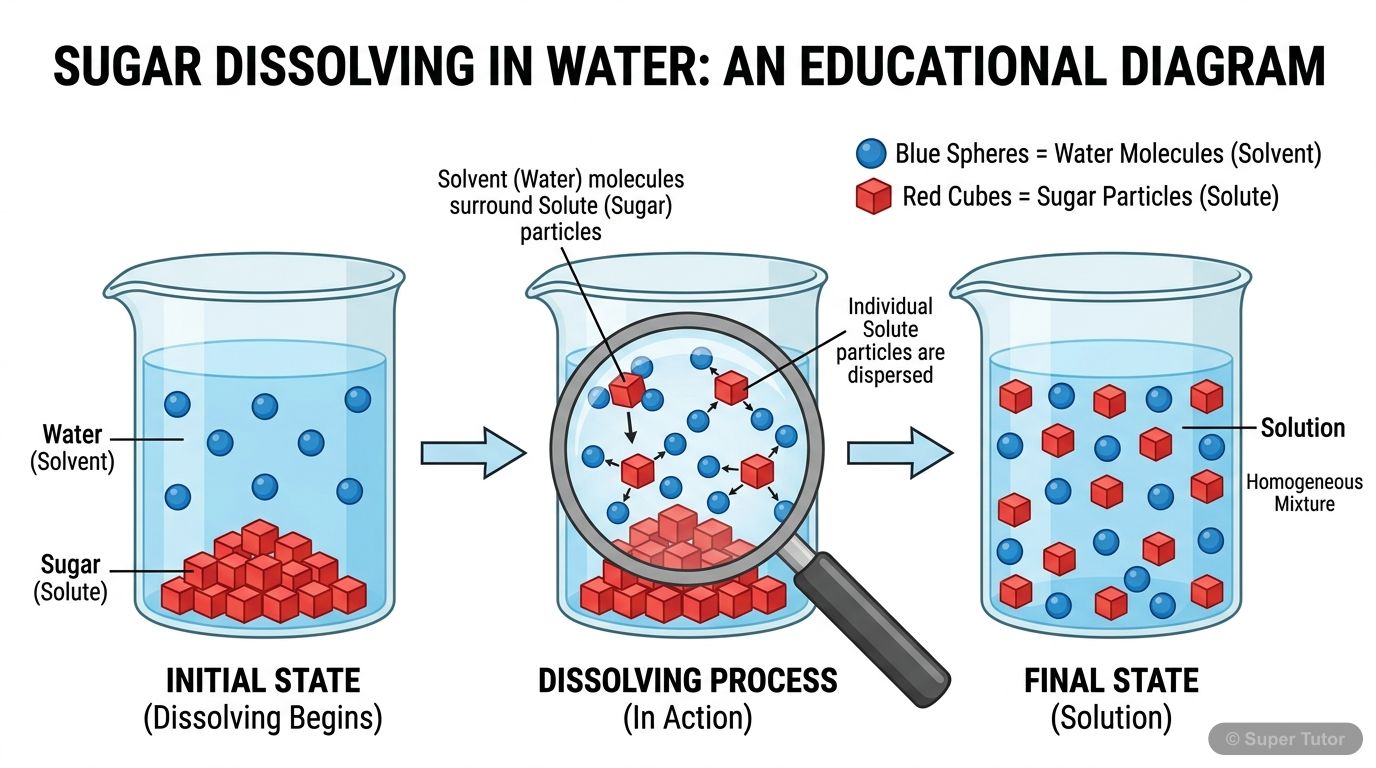
One of 2 illustrations for Is Matter Around us Pure? in Super Tutor — alongside flashcards, concept maps and practice questions.
What is the scientific definition of a pure substance?
Answer
A pure substance is a form of matter in which all constituent particles are the same in their chemical nature. It consists of a single type of particle with uniform composition and properties througho…
Define a mixture and give three examples from everyday life.
Answer
A mixture is matter composed of two or more pure substances (elements or compounds) that are physically combined without forming new chemical compounds. Examples: (1) Milk - mixture of water, fat, pro…
What is the difference between homogeneous and heterogeneous mixtures?
Answer
Homogeneous mixtures have uniform composition throughout with no visible separate components. Example: Sugar dissolved in water appears the same everywhere. Heterogeneous mixtures show visible distinc…
You add copper sulphate powder to water and observe a blue solution forms. In Activity 2.1, why did Group A and Group B form solutions with different shades of blue?
Answer
Both groups formed homogeneous solutions, but the intensity of blue color differs because the concentration (amount of solute per unit solvent) is different. Group A used 1 spatula of copper sulphate …
What is a solution in chemistry?
Answer
A solution is a homogeneous mixture of two or more substances where one substance (solute) is dissolved in another (solvent). The solvent is usually present in larger amount and does the dissolving. E…
What happens when you heat a saturated solution of potassium nitrate and then cool it slowly?
Answer
When heated, more solute dissolves because solubility of potassium nitrate increases with temperature. When cooled slowly, the excess solute crystallizes out of the solution because less solute can re…
What is a saturated solution?
Answer
A saturated solution is one in which the maximum amount of solute has been dissolved at a given temperature and no more solute can be dissolved. At this point, the amount of solute dissolving equals t…
To make a saturated solution of potassium nitrate at 313K, how much potassium nitrate is needed to saturate 50g of water? (Use data: at 313K, solubility = 62g per 100g water)
Answer
Using proportion: If 62g dissolves in 100g water, then x grams dissolve in 50g water. (62/100) = (x/50). Solving: x = (62 × 50)/100 = 31g. Therefore, 31g of potassium nitrate is needed to saturate 50g…
+24 more flashcards
Practise AllFrequently Asked Questions
What are the important topics in Is Matter Around us Pure? for Gujarat Board Class 9 Science?
How many flashcards are available for Is Matter Around us Pure??
How should I revise Is Matter Around us Pure? for Class 9 exams?
Sources & Official References
Content is aligned to the official syllabus. Refer to the board website for the latest curriculum.
More resources for Is Matter Around us Pure?
For serious students
Get the full Is Matter Around us Pure? chapter — start free.
Quizzes, flashcards, an AI doubt solver and a study plan for Gujarat Board Class 9 Science. Free to start, no card needed.