Chapter 5 of 12
Revision Notes
The Fundamental Unit of Life — Revision Notes
Gujarat Board · Class 9 · Science
The Fundamental Unit of Life revision notes for Gujarat Board Class 9 Science: 4 topics in quick points. Includes History of Cell Discovery and Cell.
45 questions28 flashcards5 concepts
Interactive on Super Tutor
Studying The Fundamental Unit of Life? Get the full interactive chapter.
Quizzes, flashcards, AI doubt-solver and a step-by-step study plan — built for revision notes and more.
Free trial, no card needed.
Super Tutor
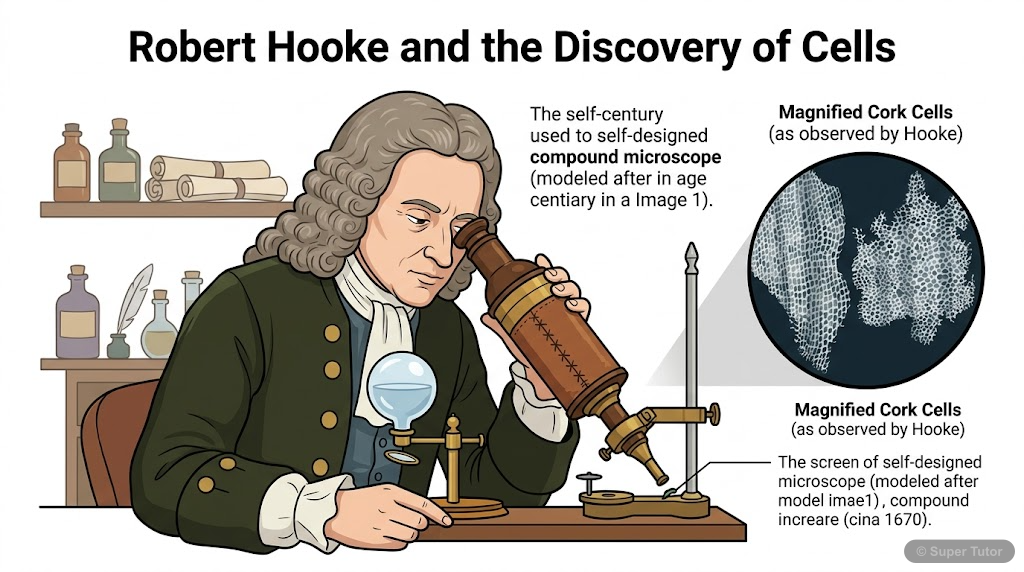
Learn better with visuals Super Tutor pairs illustrations like this with notes and quizzes for The Fundamental Unit of Life.
Key Topics to Revise
1
History of Cell Discovery and Cell Theory
- Robert Hooke (1665) — first observed cells in cork using a primitive microscope; coined the term 'cell'.
- Leeuwenhoek (1674) — discovered free-living cells (microorganisms) in pond water using an improved microscope.
- Robert Brown (1831) — discovered the nucleus inside the cell.
2
Plasma Membrane (Cell Membrane)
- The plasma membrane is the outermost covering of animal cells and the innermost covering of plant cells.
- It is a selectively permeable membrane — allows some substances to pass and blocks others.
- Composed of organic molecules: lipids and proteins.
3
Cell Wall
- Present in plant cells, fungi, and bacteria — ABSENT in animal cells.
- Located OUTSIDE the plasma membrane.
- Composed mainly of cellulose (a complex carbohydrate) in plant cells.
4
Nucleus
- The nucleus is a dense, spherical or oval structure found near the centre of most cells.
- It is surrounded by a double-layered nuclear membrane (nuclear envelope) with pores.
- Nuclear pores allow transfer of materials between the nucleus and the cytoplasm.
Get complete notes with diagrams and examples
Full NotesKey Concepts
A cell is the fundamental unitThe plasma membrane is the outermostFound in plant cellsThe nucleus is a membraneThe cytoplasm is the gel
Frequently Asked Questions
What are the important topics in The Fundamental Unit of Life for Gujarat Board Class 9 Science?
Key topics in The Fundamental Unit of Life include History of Cell Discovery and Cell Theory, Plasma Membrane (Cell Membrane), Cell Wall, Nucleus. Study these first, then practise questions on each for Class 9 exams.
How should I revise The Fundamental Unit of Life for Class 9 exams?
Learn the core ideas first, then work through the 45 practice questions on The Fundamental Unit of Life. Revise definitions regularly and use flashcards for quick recall before the exam.
Sources & Official References
Content is aligned to the official syllabus. Refer to the board website for the latest curriculum.
More resources for The Fundamental Unit of Life
For serious students
Get the full The Fundamental Unit of Life chapter — start free.
Quizzes, flashcards, an AI doubt solver and a study plan for Gujarat Board Class 9 Science. Free to start, no card needed.