Is Matter Around us Pure? — Revision Notes
Gujarat Board · Class 9 · Science
Is Matter Around us Pure? revision notes for Gujarat Board Class 9 Science: 4 topics in quick points. Part of the Gujarat Board Class 9 Science syllabus.
Interactive on Super Tutor
Studying Is Matter Around us Pure?? Get the full interactive chapter.
Quizzes, flashcards, AI doubt-solver and a step-by-step study plan — built for revision notes and more.
Free trial, no card needed.
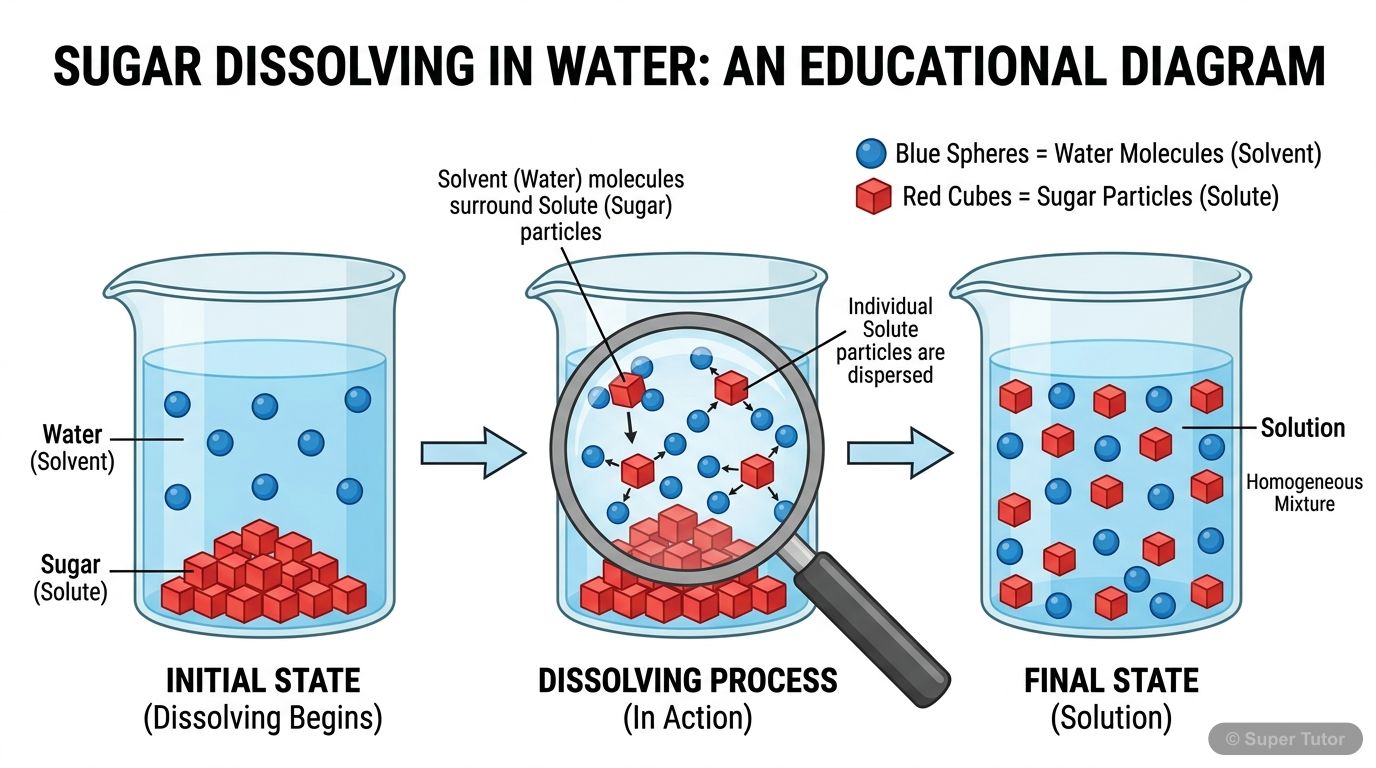
One of 2 illustrations for Is Matter Around us Pure? in Super Tutor — alongside flashcards, concept maps and practice questions.
Key Topics to Revise
Pure Substances vs Mixtures
- A pure substance consists of a single type of particle with the same chemical nature throughout.
- A mixture contains more than one pure substance mixed together in any proportion.
- For a scientist, milk, ghee, salt water, juice etc. are all mixtures — not pure substances.
Types of Mixtures — Homogeneous and Heterogeneous
- Homogeneous mixtures have uniform composition throughout — the same throughout every part.
- Examples of homogeneous mixtures: salt dissolved in water, sugar dissolved in water, copper sulphate solution.
- A homogeneous mixture can have variable composition (e.g., less or more salt in water — both are homogeneous).
Solutions — Properties and Concentration
- A solution is a homogeneous mixture of two or more substances.
- The solvent is the component present in larger amount that does the dissolving.
- The solute is the component present in smaller amount that gets dissolved.
Suspensions and Colloids — Properties and Tyndall Effect
- A suspension is a heterogeneous mixture where solute particles do NOT dissolve — they remain suspended.
- Suspension particle size is greater than 1000 nm — visible to naked eyes.
- Suspension is UNSTABLE — particles settle down on standing.
Get complete notes with diagrams and examples
Full NotesKey Concepts
Frequently Asked Questions
What are the important topics in Is Matter Around us Pure? for Gujarat Board Class 9 Science?
How should I revise Is Matter Around us Pure? for Class 9 exams?
Sources & Official References
Content is aligned to the official syllabus. Refer to the board website for the latest curriculum.
More resources for Is Matter Around us Pure?
For serious students
Get the full Is Matter Around us Pure? chapter — start free.
Quizzes, flashcards, an AI doubt solver and a study plan for Gujarat Board Class 9 Science. Free to start, no card needed.