Absorption of Water and Minerals by Roots — Practice Quiz
ICSE · Class 10 · Biology
Try a 4-question quiz on Absorption of Water and Minerals by Roots for ICSE Class 10 Biology: tap an answer to check it and see why.
Interactive on Super Tutor
Studying Absorption of Water and Minerals by Roots? Get the full interactive chapter.
Quizzes, flashcards, AI doubt-solver and a step-by-step study plan — built for practice quiz and more.
Free trial, no card needed.
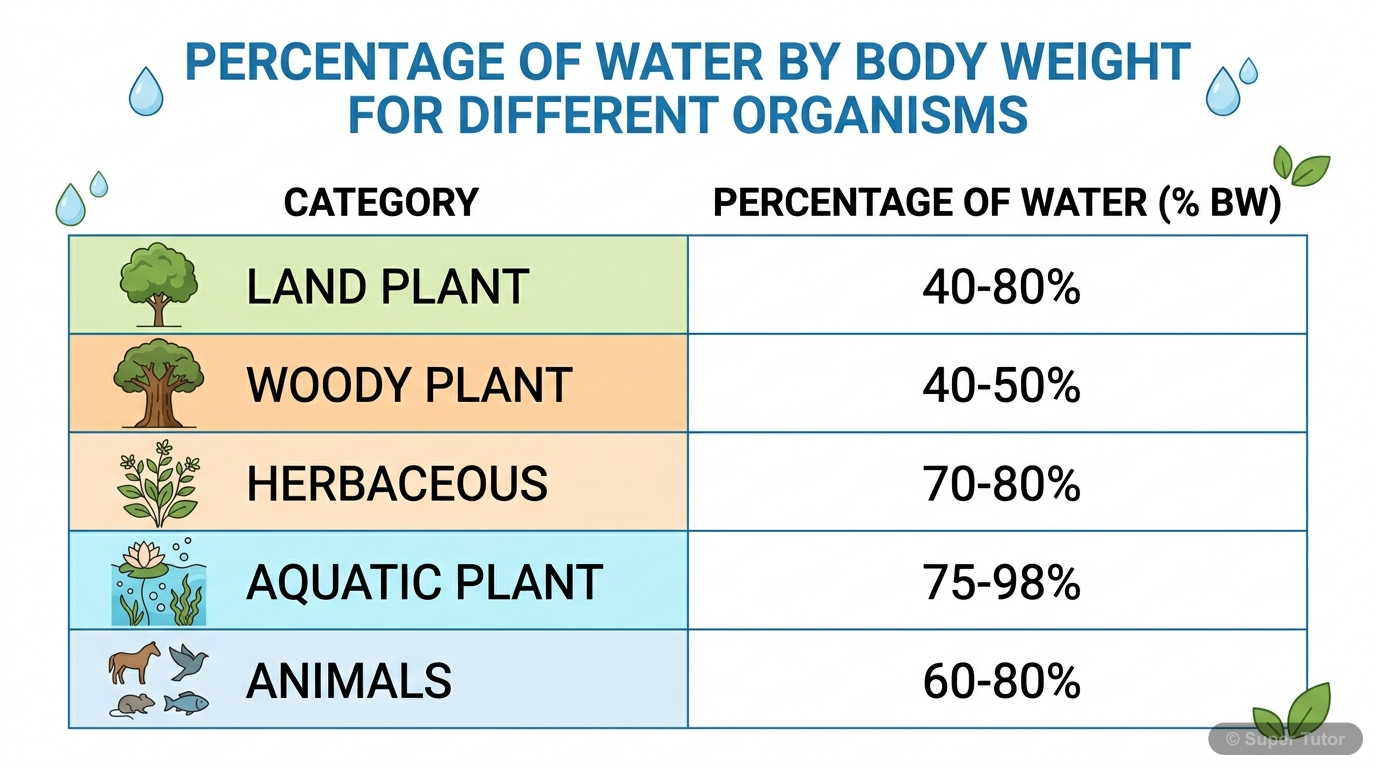
One of 21 illustrations for Absorption of Water and Minerals by Roots in Super Tutor — alongside flashcards, concept maps and practice questions.
See them allQuick Quiz: Absorption of Water and Minerals by Roots
0/4Tap an answer to check it instantly. No sign-up needed for these 4.
What percentage of water is typically found in herbaceous plants?
What is the movement of molecules from higher concentration to lower concentration called?
Which type of membrane allows only water molecules to pass through?
In which solution does a cell become turgid?
Sample Questions
Which of the following are essential elements required for plant growth?
Show answer
Nitrogen (N), Phosphorus (P), Potassium (K)
NPK (Nitrogen, Phosphorus, and Potassium) are the three most important essential elements for normal growth and development of plants. Sodium is not an essential element.
Imbibition is the process of adsorption of water molecules by dry hydrophilic colloids.
Show answer
True
Imbibition is indeed the process of adsorption of water molecules by dry hydrophilic colloids due to surface attraction. Examples include swelling of seeds and wooden doors.
What happens when a cell is placed in a hypertonic solution?
Show answer
Cell becomes flaccid
In a hypertonic solution (higher solute concentration), water leaves the cell by exosmosis, making it flaccid and shrunken.
Which of the following are functions of water in plants?
Show answer
Serves as a solvent, Raw material for photosynthesis, Helps in transpiration, Facilitates gas exchange
Water serves multiple functions: solvent for substances, raw material for photosynthesis, helps in transpiration, and facilitates gas exchange by dissolving gases. Structural support is provided by turgidity, not water directly.
+39 more questions on Absorption of Water and Minerals by Roots (ICSE Class 10 Biology)
Practise AllFrequently Asked Questions
What are the important topics in Absorption of Water and Minerals by Roots for ICSE Class 10 Biology?
How many practice questions are there for Absorption of Water and Minerals by Roots?
Sources & Official References
Content is aligned to the official syllabus. Refer to the board website for the latest curriculum.
More resources for Absorption of Water and Minerals by Roots
Important Questions
Exam-style questions with answers
Revision Notes
Key points for last-minute revision
Chapter Summary
Understand the chapter at a glance
Concept Maps
See how topics connect
Study Plan
Step-by-step plan for this chapter
Flashcards
Quick-fire cards for active recall
Syllabus
What topics to cover
For serious students
Get the full Absorption of Water and Minerals by Roots chapter — start free.
Quizzes, flashcards, an AI doubt solver and a study plan for ICSE Class 10 Biology. Free to start, no card needed.