Evolution — Practice Quiz
ICSE · Class 10 · Biology
Try a 4-question quiz on Evolution for ICSE Class 10 Biology: tap an answer to check it and see why. 41 questions in the full chapter test.
Interactive on Super Tutor
Studying Evolution? Get the full interactive chapter.
Quizzes, flashcards, AI doubt-solver and a step-by-step study plan — built for practice quiz and more.
Free trial, no card needed.
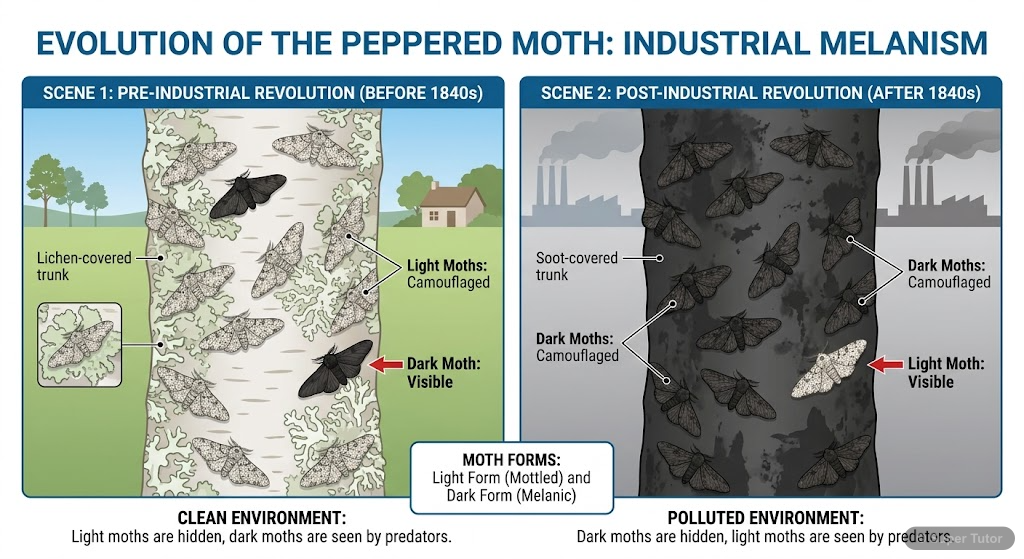
Learn better with visuals Super Tutor pairs illustrations like this with notes and quizzes for Evolution.
Get startedQuick Quiz: Evolution
0/4Tap an answer to check it instantly. No sign-up needed for these 4.
Who proposed the theory of 'Inheritance of Acquired Characters'?
The vermiform appendix in humans is an example of:
According to Lamarck, the long neck of giraffe evolved due to:
Industrial melanism in peppered moths demonstrates:
Sample Questions
Which of the following are postulates of Darwin's theory of Natural Selection?
Show answer
Overproduction of offspring, Struggle for existence, Natural selection, Survival of the fittest
Darwin's theory includes overproduction of offspring, struggle for existence, natural selection, and survival of the fittest. Inheritance of acquired characters is Lamarck's theory, not Darwin's.
The cranial capacity of modern man (Homo sapiens sapiens) is approximately:
Show answer
1450 cc
Modern man (Homo sapiens sapiens) has a cranial capacity of about 1450 cc. This is much larger than earlier ancestors like Australopithecus (450-600 cc) or Homo habilis (750 cc).
Which of the following are vestigial organs in humans?
Show answer
Vermiform appendix, Wisdom teeth, Coccyx, Muscles of ear pinna
All these are vestigial organs - non-functional remains of organs that were functional in ancestors. Heart is a fully functional organ, not vestigial.
Who discovered the fossil 'Lucy'?
Show answer
Donald Johanson
Donald Johanson discovered the fossil 'Lucy' (Australopithecus) in 1974 from Ethiopia. It represents one of our early human ancestors from about 3.2 million years ago.
+37 more questions on Evolution (ICSE Class 10 Biology)
Practise AllFrequently Asked Questions
What are the important topics in Evolution for ICSE Class 10 Biology?
How many practice questions are there for Evolution?
Sources & Official References
Content is aligned to the official syllabus. Refer to the board website for the latest curriculum.
More resources for Evolution
Important Questions
Exam-style questions with answers
Revision Notes
Key points for last-minute revision
Chapter Summary
Understand the chapter at a glance
Concept Maps
See how topics connect
Study Plan
Step-by-step plan for this chapter
Flashcards
Quick-fire cards for active recall
Syllabus
What topics to cover
For serious students
Get the full Evolution chapter — start free.
Quizzes, flashcards, an AI doubt solver and a study plan for ICSE Class 10 Biology. Free to start, no card needed.