Excretory System — Practice Quiz
ICSE · Class 10 · Biology
Try a 4-question quiz on Excretory System for ICSE Class 10 Biology: tap an answer to check it and see why. 40 questions in the full chapter test.
Interactive on Super Tutor
Studying Excretory System? Get the full interactive chapter.
Quizzes, flashcards, AI doubt-solver and a step-by-step study plan — built for practice quiz and more.
Free trial, no card needed.
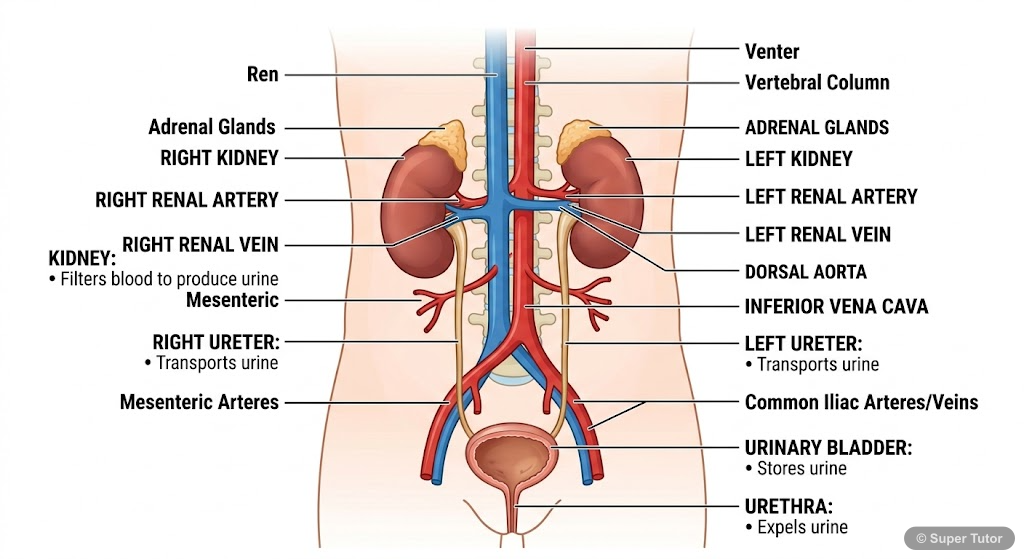
Learn better with visuals Super Tutor pairs illustrations like this with notes and quizzes for Excretory System.
Get startedQuick Quiz: Excretory System
0/4Tap an answer to check it instantly. No sign-up needed for these 4.
What is the structural and functional unit of the kidney?
Which part of the kidney has a dotted appearance?
What is the normal pH range of urine?
The process of emptying the urinary bladder is called:
Sample Questions
Which of the following are the main organs of the excretory system in humans?
Show answer
Kidneys, Ureters, Urinary bladder, Urethra
The human excretory system is made up of two kidneys, two ureters, one urinary bladder and one urethra, as these are the organs that produce, carry, store and expel urine. The heart is part of the circulatory system, not the excretory system, so it is excluded.
The first step in urine formation is ultrafiltration.
Show answer
True
Urine formation begins with ultrafiltration, in which blood plasma is filtered through the glomerular capillaries into the Bowman's capsule due to high hydrostatic pressure. Only after this filtrate is formed do selective reabsorption and tubular secretion take place, confirming that ultrafiltration is indeed the first step.
Which of the following substances are normally reabsorbed by the proximal convoluted tubule?
Show answer
Glucose, Water, Sodium, Amino acids
The proximal convoluted tubule (PCT) reabsorbs glucose, water, sodium, potassium, bicarbonates, phosphate and amino acids back into the blood, restoring their normal concentration. Creatinine, in contrast, is a substance actively secreted into the tubule rather than reabsorbed, so it is not included.
Besides kidneys, which organs also help in excretion?
Show answer
Skin, Lungs, Liver, Large intestine
Besides kidneys, the skin, lungs, liver and large intestine also help in excretion by removing sweat, carbon dioxide/water vapour, urea/bile pigments, and undigested food/bile pigments respectively. The stomach is mainly involved in digestion, not excretion, so it is not included.
+36 more questions on Excretory System (ICSE Class 10 Biology)
Practise AllFrequently Asked Questions
What are the important topics in Excretory System for ICSE Class 10 Biology?
How many practice questions are there for Excretory System?
Sources & Official References
Content is aligned to the official syllabus. Refer to the board website for the latest curriculum.
More resources for Excretory System
Important Questions
Exam-style questions with answers
Revision Notes
Key points for last-minute revision
Chapter Summary
Understand the chapter at a glance
Concept Maps
See how topics connect
Study Plan
Step-by-step plan for this chapter
Flashcards
Quick-fire cards for active recall
Syllabus
What topics to cover
For serious students
Get the full Excretory System chapter — start free.
Quizzes, flashcards, an AI doubt solver and a study plan for ICSE Class 10 Biology. Free to start, no card needed.