Absorption of Water and Minerals by Roots — Flashcards
ICSE · Class 10 · Biology
38 flashcards for Absorption of Water and Minerals by Roots (ICSE Class 10 Biology) to test yourself on key terms and facts.
Interactive on Super Tutor
Studying Absorption of Water and Minerals by Roots? Get the full interactive chapter.
Quizzes, flashcards, AI doubt-solver and a step-by-step study plan — built for flashcards and more.
Free trial, no card needed.
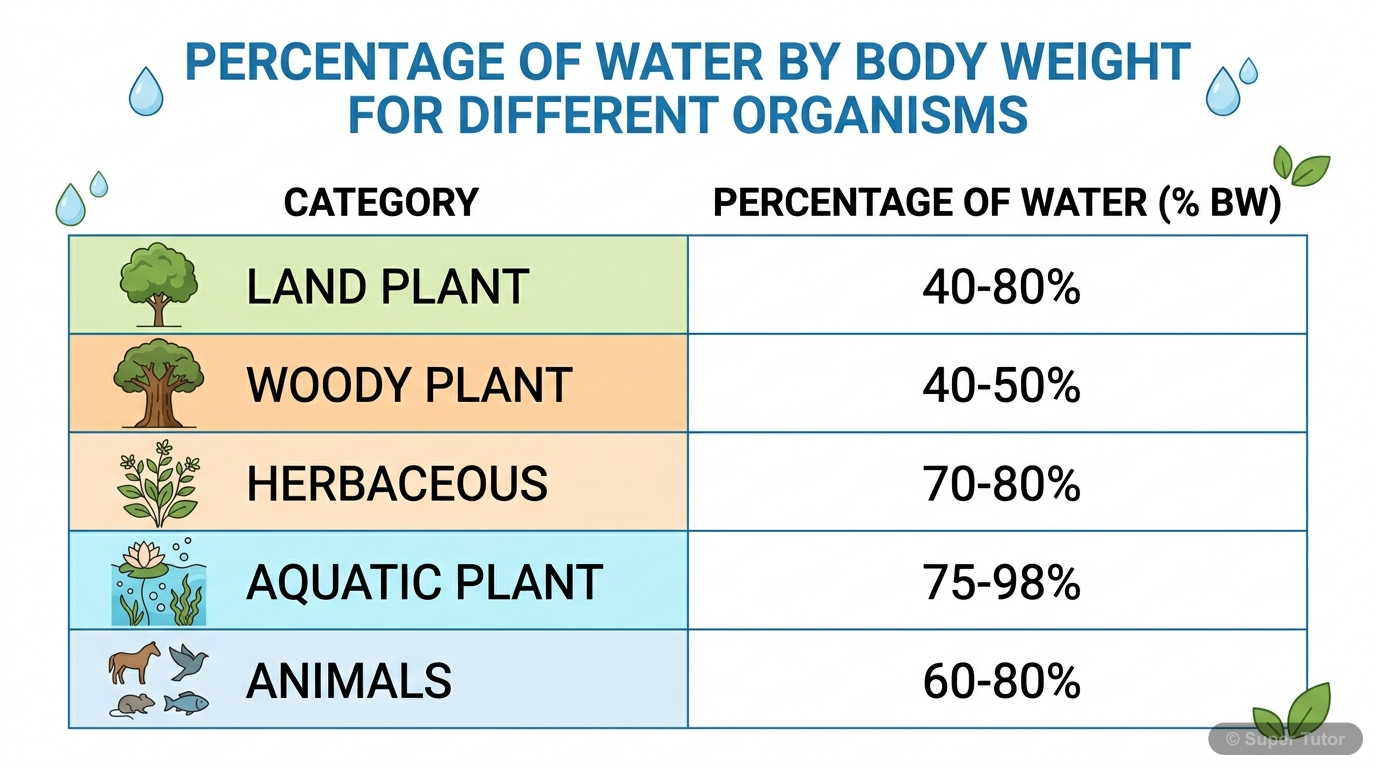
One of 21 illustrations for Absorption of Water and Minerals by Roots in Super Tutor — alongside flashcards, concept maps and practice questions.
See them allWhy is water important for plants?
Answer
Water is essential because a large part of the protoplasm is made of water, plants generally contain more water than animals, and water helps in opening and closing of stomata, photosynthesis, transpo…
What is imbibition?
Answer
Imbibition is the process of adsorption of water molecules by dry hydrophilic colloids due to surface attraction. It happens along the diffusion gradient. A common example is the swelling of dry seeds…
What are three examples of imbibition?
Answer
Three examples are swelling of dry seeds during germination, absorption of water by wooden doors and windows during the rainy season, and kneading of flour.
What is diffusion?
Answer
Diffusion is the movement of molecules of a substance, solid, liquid, or gas, from an area of higher concentration to an area of lower concentration when they are in direct contact. It does not requir…
How can diffusion be demonstrated in a simple school experiment?
Answer
A crystal of potassium permanganate is dropped into water in a beaker. The purple colour spreads gradually through the water until it becomes evenly distributed. This shows movement from higher concen…
What factors mainly affect the rate of diffusion?
Answer
The rate of diffusion mainly depends on the size, temperature, and concentration of molecules. A larger concentration difference causes faster diffusion.
What is osmosis?
Answer
Osmosis is a special kind of diffusion in which water molecules move through a semipermeable membrane from a region of higher concentration to a region of lower concentration. It involves only liquid …
How is osmosis demonstrated using a thistle funnel?
Answer
Distilled water is kept in a beaker and 20% sugar solution is placed in a thistle funnel whose mouth is covered with a semipermeable membrane such as cellophane or goat bladder. After about 15 minutes…
+30 more flashcards
Practise AllFrequently Asked Questions
What are the important topics in Absorption of Water and Minerals by Roots for ICSE Class 10 Biology?
How many flashcards are available for Absorption of Water and Minerals by Roots?
How should I revise Absorption of Water and Minerals by Roots for the ICSE Class 10 board exam?
Sources & Official References
Content is aligned to the official syllabus. Refer to the board website for the latest curriculum.
More resources for Absorption of Water and Minerals by Roots
Practice Quiz
Test yourself with a quick quiz
Important Questions
Exam-style questions with answers
Revision Notes
Key points for last-minute revision
Chapter Summary
Understand the chapter at a glance
Concept Maps
See how topics connect
Study Plan
Step-by-step plan for this chapter
Syllabus
What topics to cover
For serious students
Get the full Absorption of Water and Minerals by Roots chapter — start free.
Quizzes, flashcards, an AI doubt solver and a study plan for ICSE Class 10 Biology. Free to start, no card needed.