Excretory System — Flashcards
ICSE · Class 10 · Biology
35 flashcards for Excretory System (ICSE Class 10 Biology) to test yourself on key terms and facts. Sample: "What is excretion?"
Interactive on Super Tutor
Studying Excretory System? Get the full interactive chapter.
Quizzes, flashcards, AI doubt-solver and a step-by-step study plan — built for flashcards and more.
Free trial, no card needed.
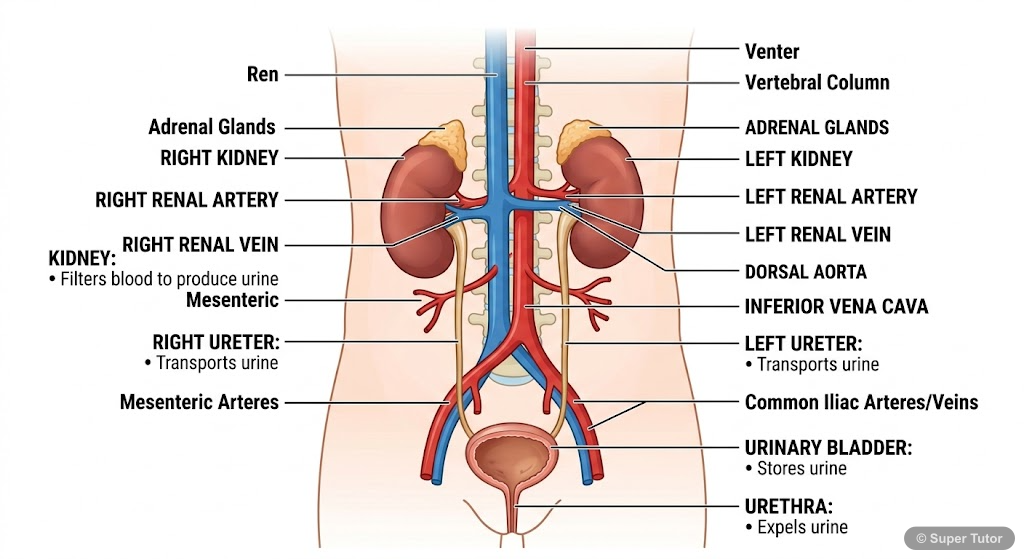
Learn better with visuals Super Tutor pairs illustrations like this with notes and quizzes for Excretory System.
Get startedWhat is excretion?
Answer
Excretion is the removal of metabolic wastes from the cells or the body of an organism. It helps the body get rid of unwanted products formed during life processes and keeps the internal environment s…
Why are kidneys called chief excretory organs?
Answer
Kidneys are the chief excretory organs of man and other vertebrates because they remove nitrogenous wastes, especially urea and uric acid, along with excess water and salts from the blood.
Name the organs of the human excretory system.
Answer
The human excretory system consists of two kidneys, two ureters, one urinary bladder and one urethra.
What is the shape and position of the kidneys?
Answer
Each kidney is bean-shaped with a concavity called hilum on its inner border. Kidneys are present in the abdominal cavity below the diaphragm, one on either side of the vertebral column. The right kid…
What is the hilum of the kidney?
Answer
The hilum is the concavity on the inner border of the kidney, almost in the middle. Blood vessels and lymphatics enter and leave the kidney at the hilum, and the ureter also emerges from this region.
Describe the two main regions seen in a longitudinal section of the kidney.
Answer
A longitudinal section of the kidney shows an outer dark coloured cortex and an inner light coloured medulla. The cortex has a dotted appearance because of Malpighian capsules, proximal convoluted tub…
What is a nephron?
Answer
A nephron, also called a uriniferous tubule, is the structural and functional unit of the kidney. Each human kidney contains about 1.2 million nephrons. A nephron has two main parts: the Malpighian ca…
What is the Malpighian capsule?
Answer
The Malpighian capsule, also called the renal capsule, is made of a double-layered Bowman's capsule and a bunch of capillaries called the glomerulus. It is the part of the nephron where filtration sta…
+27 more flashcards
Practise AllFrequently Asked Questions
What are the important topics in Excretory System for ICSE Class 10 Biology?
How many flashcards are available for Excretory System?
How should I revise Excretory System for the ICSE Class 10 board exam?
Sources & Official References
Content is aligned to the official syllabus. Refer to the board website for the latest curriculum.
More resources for Excretory System
Practice Quiz
Test yourself with a quick quiz
Important Questions
Exam-style questions with answers
Revision Notes
Key points for last-minute revision
Chapter Summary
Understand the chapter at a glance
Concept Maps
See how topics connect
Study Plan
Step-by-step plan for this chapter
Syllabus
What topics to cover
For serious students
Get the full Excretory System chapter — start free.
Quizzes, flashcards, an AI doubt solver and a study plan for ICSE Class 10 Biology. Free to start, no card needed.