Chemical Coordination in Plants — Study Plan
ICSE · Class 10 · Biology
A step-by-step study plan for Chemical Coordination in Plants, ICSE Class 10 Biology: what to learn first, what to practise and when to revise.
Interactive on Super Tutor
Studying Chemical Coordination in Plants? Get the full interactive chapter.
Quizzes, flashcards, AI doubt-solver and a step-by-step study plan — built for study plan and more.
Free trial, no card needed.
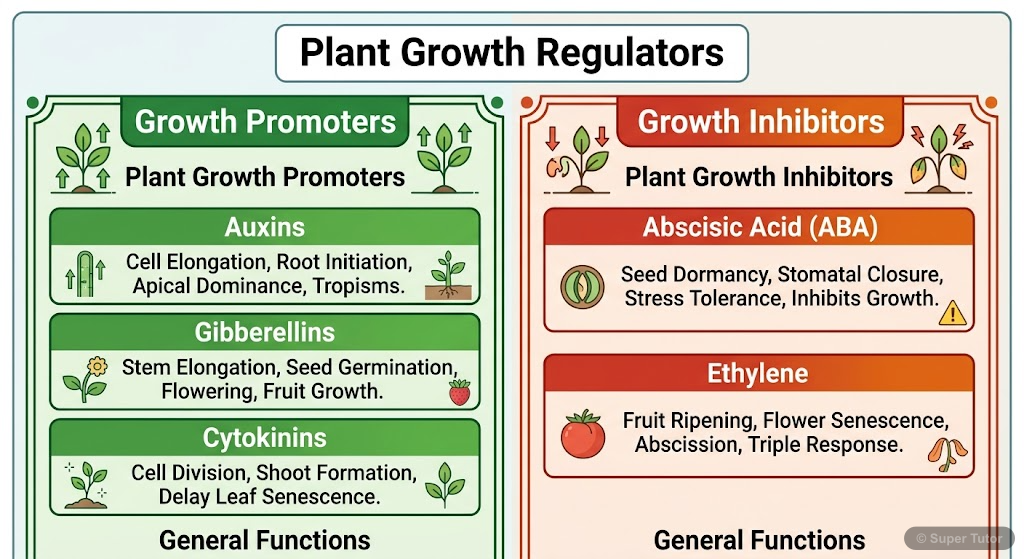
One of 12 illustrations for Chemical Coordination in Plants in Super Tutor — alongside flashcards, concept maps and practice questions.
See them allStudy Plan
Learn the Theory
Read the textbook chapter carefully. Note down definitions, formulas and key ideas. Focus on: Plant Growth Regulators, Auxins, Gibberellins.
Practise
Solve the textbook exercises and extra practice questions. There are 42 questions available for this chapter.
Revise & Test
Revise key points without looking at your notes. Take a practice quiz and mark weak areas for another pass.
Spaced Revision
Come back to Chemical Coordination in Plants after a week. Use flashcards for quick recall and try past exam questions on this chapter.
What to Focus On
- Plant growth regulators are also called plant hormones or phytohormones.
- They are organic substances produced in one part of the plant body and act in another part.
- They are mainly transported through phloem.
- Auxins were the first plant hormones to be discovered.
- Auxins are produced by growing tips of stem and root.
- IAA is the most abundant and powerful naturally occurring auxin.
- Tropic movement is growth in response to a unilateral stimulus.
- Shoot is positively phototropic and root is negatively phototropic.
- Roots are positively geotropic and stems are negatively geotropic.
Common Mistakes to Avoid
Auxin is a growth inhibitor because it controls plant growth.
Indole butyric acid, naphthalene acetic acid, and 2,4-D are natural auxins like IAA.
Apical dominance means lateral buds control the apical bud.
Memory Tips
Plant growth regulators are also called plant hormones or phytohormones
Phytohormones are produced in one part and act in another part; mainly transported through phloem
Growth promoters and growth inhibitors
Auxins are the first plant hormones discovered
Want a personalised study plan?
Super Tutor builds a day-by-day plan for ICSE Class 10 Biology that fits your exam date and pace.
Create My Study PlanFrequently Asked Questions
What are the important topics in Chemical Coordination in Plants for ICSE Class 10 Biology?
How should I revise Chemical Coordination in Plants for the ICSE Class 10 board exam?
Sources & Official References
Content is aligned to the official syllabus. Refer to the board website for the latest curriculum.
More resources for Chemical Coordination in Plants
Practice Quiz
Test yourself with a quick quiz
Important Questions
Exam-style questions with answers
Revision Notes
Key points for last-minute revision
Chapter Summary
Understand the chapter at a glance
Concept Maps
See how topics connect
Flashcards
Quick-fire cards for active recall
Syllabus
What topics to cover
For serious students
Get the full Chemical Coordination in Plants chapter — start free.
Quizzes, flashcards, an AI doubt solver and a study plan for ICSE Class 10 Biology. Free to start, no card needed.