Chemical Coordination in Plants — Chapter Summary
ICSE · Class 10 · Biology
Summary of Chemical Coordination in Plants for ICSE Class 10 Biology. Part of the ICSE Class 10 Biology syllabus.
Interactive on Super Tutor
Studying Chemical Coordination in Plants? Get the full interactive chapter.
Quizzes, flashcards, AI doubt-solver and a step-by-step study plan — built for chapter summary and more.
Free trial, no card needed.
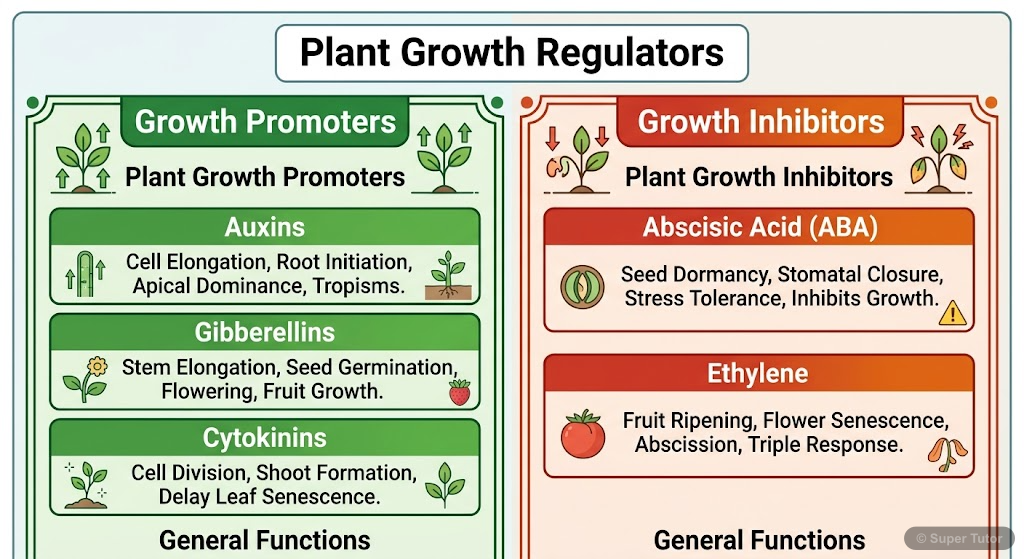
One of 12 illustrations for Chemical Coordination in Plants in Super Tutor — alongside flashcards, concept maps and practice questions.
See them allOverview
Chemical coordination in plants is controlled by plant growth regulators, also called plant hormones or phytohormones. These are organic substances made in one part of the plant and transported to another part, mainly through phloem. They control growth, development, movement, flowering, fruit forma
Key Concepts
Plant growth regulators are organic substances
Plant growth regulators are organic substances produced in one part of the plant body and act in another part. They are mainly transported through phl
Auxins were the first plant hormones
Auxins were the first plant hormones to be discovered. They are produced by growing tips of stem and root. Indole Acetic Acid is the most abundant and
Auxin causes stem elongation
Auxin causes stem elongation, induces cell division, is responsible for apical dominance, prevents abscission, induces parthenocarpy, and promotes fem
Gibberellins are growth promoters
Gibberellins are growth promoters. More than 100 types are known. They are produced in young leaves, plastids of immature seeds, or even roots. They c
Cytokinins are growth promoters produced
Cytokinins are growth promoters produced in meristems. They promote cell division and cell enlargement, delay senescence, oppose apical dominance, pro
Learning Objectives
- Understand the meaning of plant growth regulators and their transport in plants.
- Identify the main growth promoters: auxins, gibberellins, and cytokinins.
- Identify the main growth inhibitors: ethylene and abscisic acid.
- Explain how auxin controls elongation, apical dominance, phototropism, geotropism, abscission, parthenocarpy, and femaleness.
- Describe the functions of gibberellins in elongation, flowering, germination, parthenocarpy, and dwarf plants.
Frequently Asked Questions
What are the important topics in Chemical Coordination in Plants for ICSE Class 10 Biology?
How should I revise Chemical Coordination in Plants for the ICSE Class 10 board exam?
Sources & Official References
Content is aligned to the official syllabus. Refer to the board website for the latest curriculum.
More resources for Chemical Coordination in Plants
For serious students
Get the full Chemical Coordination in Plants chapter — start free.
Quizzes, flashcards, an AI doubt solver and a study plan for ICSE Class 10 Biology. Free to start, no card needed.