Periodic Properties and Variations of Properties - Physical and Chemical — Syllabus
ICSE · Class 10 · Chemistry
What Periodic Properties and Variations of Properties - Physical and Chemical covers in ICSE Class 10 Chemistry: 4 topics, for the 2026-27 session.
Interactive on Super Tutor
Studying Periodic Properties and Variations of Properties - Physical and Chemical? Get the full interactive chapter.
Quizzes, flashcards, AI doubt-solver and a step-by-step study plan — built for syllabus and more.
Free trial, no card needed.
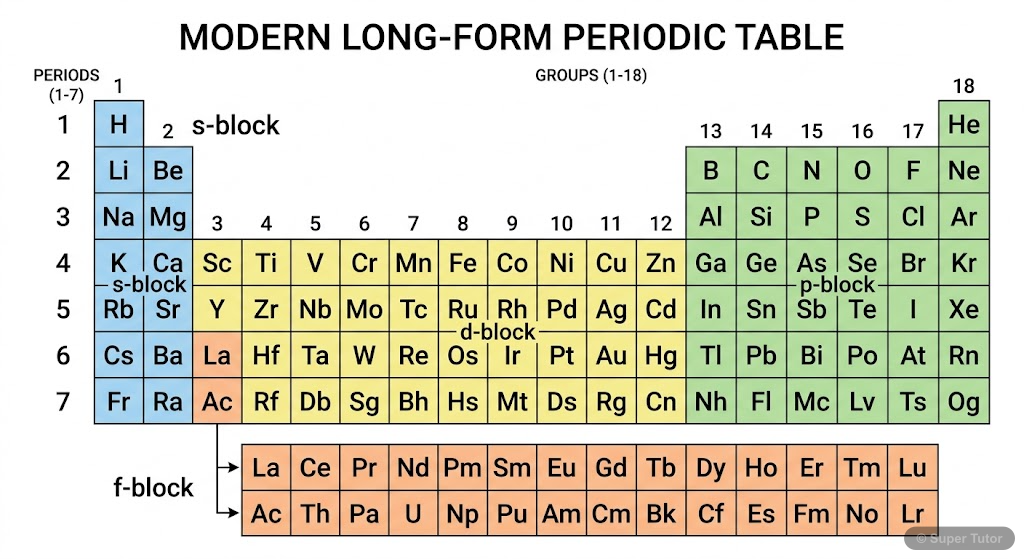
One of 11 illustrations for Periodic Properties and Variations of Properties - Physical and Chemical in Super Tutor — alongside flashcards, concept maps and practice questions.
See them allTopics in Periodic Properties and Variations of Properties - Physical and Chemical
1. Modern Periodic Table and Periodicity
- The modern periodic table arranges elements in increasing order of atomic numbers.
- The modern periodic table has seven periods and eighteen groups.
- Elements with similar properties appear in the same group because their outer electronic configurations are similar.
2. Classification of Elements
- Noble gases are Group 18 elements with completely filled shells: He, Ne, Ar, Kr, Xe and Rn.
- Noble gases are practically unreactive under normal conditions because they have stable electronic configurations.
- Representative elements include groups 1, 2, 13, 14, 15, 16, 17 and 18.
3. Atomic Size or Atomic Radius
- Atomic size or atomic radius is the distance from the centre of the nucleus to the outermost shell of electrons.
- Atomic radius can be expressed in Angstrom unit or in picometres.
- Å = 10^-8 cm = 10^-10 m.
4. Ionisation Energy and Ionisation Potential
- Ionisation energy is the minimum amount of energy required to remove the most loosely bound electron from an isolated gaseous atom to form a cation.
- Ionisation energy is expressed in kJ/mol or eV/atom.
- Ionisation potential is the same quantity as ionisation energy but expressed in eV.
Key Concepts
Central concept: Periodic properties arise because elements show recurring patterns in electronic configuration when arranged by increasing atomic number
Work through every topic in Periodic Properties and Variations of Properties - Physical and Chemical with notes and quizzes
Start This ChapterFrequently Asked Questions
What are the important topics in Periodic Properties and Variations of Properties - Physical and Chemical for ICSE Class 10 Chemistry?
How should I revise Periodic Properties and Variations of Properties - Physical and Chemical for the ICSE Class 10 board exam?
Sources & Official References
Content is aligned to the official syllabus. Refer to the board website for the latest curriculum.
More resources for Periodic Properties and Variations of Properties - Physical and Chemical
Practice Quiz
Test yourself with a quick quiz
Important Questions
Exam-style questions with answers
Revision Notes
Key points for last-minute revision
Formula Sheet
The chapter's formulas in one place
Chapter Summary
Understand the chapter at a glance
Concept Maps
See how topics connect
Study Plan
Step-by-step plan for this chapter
Flashcards
Quick-fire cards for active recall
For serious students
Get the full Periodic Properties and Variations of Properties - Physical and Chemical chapter — start free.
Quizzes, flashcards, an AI doubt solver and a study plan for ICSE Class 10 Chemistry. Free to start, no card needed.