Study of Acids, Bases and Salts — Syllabus
ICSE · Class 10 · Chemistry
What Study of Acids, Bases and Salts covers in ICSE Class 10 Chemistry: 4 topics, for the 2026-27 session. Part of the ICSE Class 10 Chemistry syllabus.
Interactive on Super Tutor
Studying Study of Acids, Bases and Salts? Get the full interactive chapter.
Quizzes, flashcards, AI doubt-solver and a step-by-step study plan — built for syllabus and more.
Free trial, no card needed.
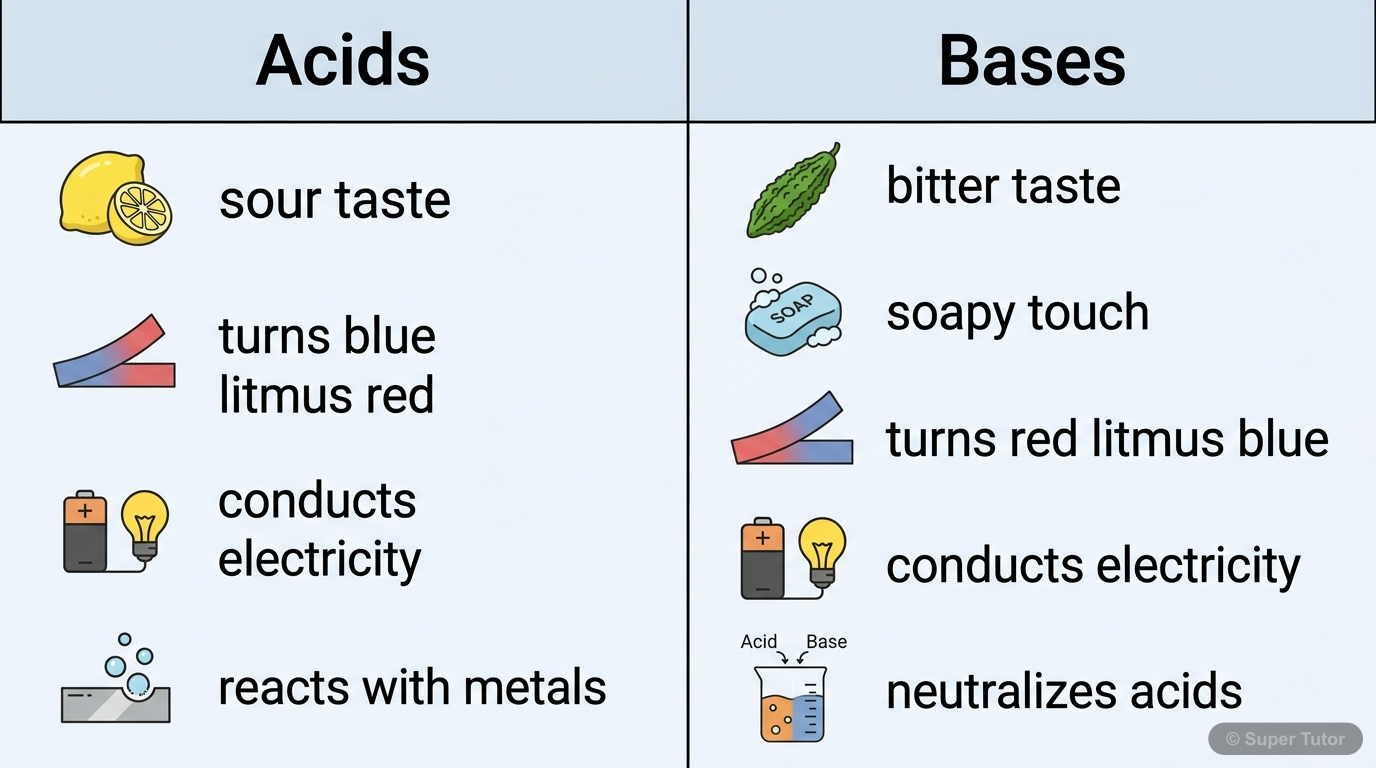
One of 15 illustrations for Study of Acids, Bases and Salts in Super Tutor — alongside flashcards, concept maps and practice questions.
See them allTopics in Study of Acids, Bases and Salts
Acids: Nature, Types and Basicity
- Mineral acids are acids derived from minerals. Common examples are HCl, HNO3 and H2SO4.
- Mineral acids are corrosive, strong and completely ionised in water.
- Organic acids are derived from living organisms and contain carbon. They are weak, less corrosive and only partially ionised in water.
Bases and Alkalis
- A base reacts with hydronium ions furnished by an acid to form salt and water only.
- Bases are usually oxides or hydroxides of metals; ammonium hydroxide also acts as a base.
- Alkalis are a particular class of bases that are soluble in water.
Salts and Their Types
- A salt is an ionic compound formed by the partial or complete replacement of the replaceable hydrogen atoms of an acid by a metallic ion or ammonium ion.
- Normal salts are formed by complete replacement of all replaceable hydrogen atoms.
- Examples of normal salts are NaCl, Na2SO4 and KNO3.
pH, Water and Indicators
- The pH value of a solution is the negative logarithm base 10 of the hydronium ion concentration.
- The pH scale is used to show acidic, neutral and alkaline nature.
- pH 7 is the midpoint representing neutrality.
Key Concepts
Central concept: Acids, bases and salts and their behaviour in water, reactions, classifications, pH, indicators, solubility, hydrolysis, crystallisation and preparation methods
Work through every topic in Study of Acids, Bases and Salts with notes and quizzes
Start This ChapterFrequently Asked Questions
What are the important topics in Study of Acids, Bases and Salts for ICSE Class 10 Chemistry?
How should I revise Study of Acids, Bases and Salts for the ICSE Class 10 board exam?
Sources & Official References
Content is aligned to the official syllabus. Refer to the board website for the latest curriculum.
More resources for Study of Acids, Bases and Salts
Practice Quiz
Test yourself with a quick quiz
Important Questions
Exam-style questions with answers
Revision Notes
Key points for last-minute revision
Formula Sheet
The chapter's formulas in one place
Chapter Summary
Understand the chapter at a glance
Concept Maps
See how topics connect
Study Plan
Step-by-step plan for this chapter
Flashcards
Quick-fire cards for active recall
For serious students
Get the full Study of Acids, Bases and Salts chapter — start free.
Quizzes, flashcards, an AI doubt solver and a study plan for ICSE Class 10 Chemistry. Free to start, no card needed.