Periodic Properties and Variations of Properties - Physical and Chemical — Flashcards
ICSE · Class 10 · Chemistry
46 flashcards for Periodic Properties and Variations of Properties - Physical and Chemical (ICSE Class 10 Chemistry) to test yourself on key terms.
Interactive on Super Tutor
Studying Periodic Properties and Variations of Properties - Physical and Chemical? Get the full interactive chapter.
Quizzes, flashcards, AI doubt-solver and a step-by-step study plan — built for flashcards and more.
Free trial, no card needed.
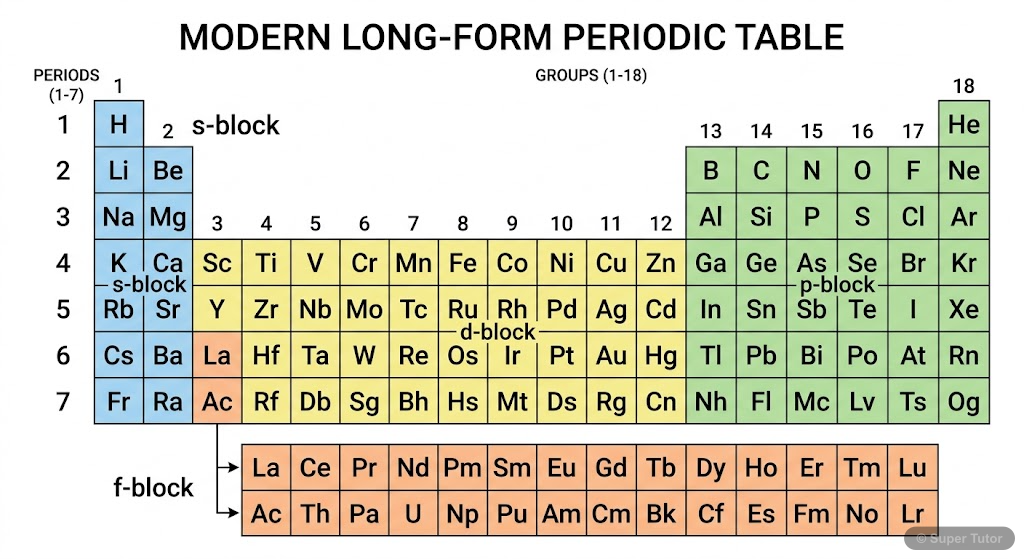
One of 11 illustrations for Periodic Properties and Variations of Properties - Physical and Chemical in Super Tutor — alongside flashcards, concept maps and practice questions.
See them allWhat is periodicity?
Answer
The periodic repetition of elements having similar properties after regular intervals is called periodicity.
State Mendeleev's Periodic Law.
Answer
The physical and chemical properties of the elements are periodic functions of their atomic weight given by Mendeleev.
State Modern Periodic Law.
Answer
The physical and chemical properties of the elements are the periodic functions of their atomic numbers.
How are elements arranged in the modern periodic table?
Answer
The Modern periodic table arranges elements in increasing order of atomic numbers. It has seven periods and eighteen groups.
Which elements are called noble gases?
Answer
He, Ne, Ar, Kr, Xe and Rn are noble gases. They are Group 18 elements with completely filled shells and are practically unreactive under normal conditions.
Which elements are called representative elements?
Answer
Elements of Groups 1, 2, 13, 14, 15, 16, 17 and 18 are called representative elements. They are also called normal elements.
Which elements are s-block elements?
Answer
Elements of Group 1 and Group 2 are s-block elements. Group 1 elements are alkali metals and Group 2 elements are alkaline earth metals.
Which elements are p-block elements?
Answer
Elements of Groups 13 to 18 are p-block elements.
+38 more flashcards
Practise AllFrequently Asked Questions
What are the important topics in Periodic Properties and Variations of Properties - Physical and Chemical for ICSE Class 10 Chemistry?
How many flashcards are available for Periodic Properties and Variations of Properties - Physical and Chemical?
How should I revise Periodic Properties and Variations of Properties - Physical and Chemical for the ICSE Class 10 board exam?
Sources & Official References
Content is aligned to the official syllabus. Refer to the board website for the latest curriculum.
More resources for Periodic Properties and Variations of Properties - Physical and Chemical
Practice Quiz
Test yourself with a quick quiz
Important Questions
Exam-style questions with answers
Revision Notes
Key points for last-minute revision
Formula Sheet
The chapter's formulas in one place
Chapter Summary
Understand the chapter at a glance
Concept Maps
See how topics connect
Study Plan
Step-by-step plan for this chapter
Syllabus
What topics to cover
For serious students
Get the full Periodic Properties and Variations of Properties - Physical and Chemical chapter — start free.
Quizzes, flashcards, an AI doubt solver and a study plan for ICSE Class 10 Chemistry. Free to start, no card needed.