Interchange of Sentences
ICSE · Class 10 · English Language - Archer
Summary of Interchange of Sentences for ICSE Class 10 English Language - Archer. Key concepts, important points, and chapter overview.
Interactive on Super Tutor
Studying Interchange of Sentences? Get the full interactive chapter.
Quizzes, flashcards, AI doubt-solver and a step-by-step study plan — built for chapter summary and more.
1,000+ Class 10 students started this chapter today
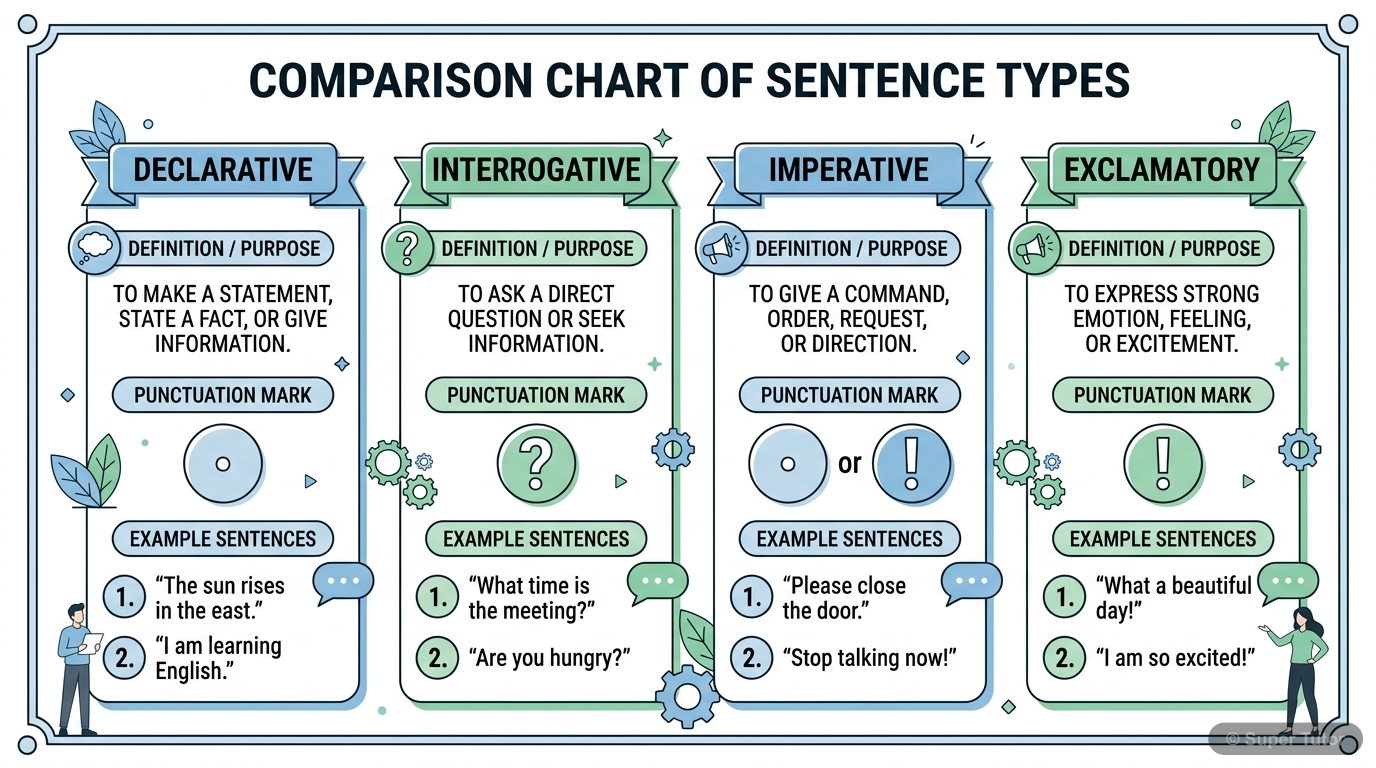
This is just one of 5+ visuals inside Super Tutor's Interchange of Sentences chapter
Explore the full setOverview
Sentence interchange means changing one kind of sentence into another kind without changing the meaning. The chapter focuses on declarative, interrogative, exclamatory, and imperative sentences, along with important grammar patterns such as question tags, too...to, no sooner...than, hardly/scarcely/
Key Concepts
A phrase is a group
A phrase is a group of words that does not have any verb or has only a non-finite verb and gives partial information. A sentence makes complete sense
A declarative sentence states something
A declarative sentence states something. It can be positive or negative.
An interrogative sentence asks a question
An interrogative sentence asks a question. An assertive sentence can be changed into an interrogative sentence by adding a negative if it is affirmati
An exclamatory sentence expresses strong
An exclamatory sentence expresses strong or sudden emotion. An assertive sentence can be changed into an exclamatory one by adding words like indeed,
An imperative sentence is used
An imperative sentence is used to order, command, request, or make a wish.
Learning Objectives
- Identify the four kinds of sentences: declarative, interrogative, exclamatory, and imperative.
- Distinguish between a phrase and a sentence.
- Convert assertive sentences into interrogative and exclamatory forms.
- Change affirmative sentences into negative ones and negative sentences into affirmative ones.
- Form correct question tags with proper punctuation, auxiliary verb, and agreement with subject.
Frequently Asked Questions
What are the important topics in Interchange of Sentences for ICSE Class 10 English Language - Archer?
How to score full marks in Interchange of Sentences — ICSE Class 10 English Language - Archer?
Sources & Official References
Content is aligned to the official syllabus. Refer to the board website for the latest curriculum.
More resources for Interchange of Sentences
Practice Quiz
Test yourself with a quick quiz
Important Questions
Practice with board exam-style questions
Revision Notes
Key points for last-minute revision
Formula Sheet
All formulas in one place
Concept Maps
See how topics connect visually
Study Plan
Step-by-step plan to ace this chapter
Flashcards
Quick-fire cards for active recall
Syllabus
What topics to cover
NCERT Solutions
Every textbook question solved step by step
For serious students
Get the full Interchange of Sentences chapter — for free.
Quizzes, flashcards, AI doubt-solver and a step-by-step study plan for ICSE Class 10 English Language - Archer.