Synthesis of Sentences
ICSE · Class 10 · English Language - Archer
Summary of Synthesis of Sentences for ICSE Class 10 English Language - Archer. Key concepts, important points, and chapter overview.
Interactive on Super Tutor
Studying Synthesis of Sentences? Get the full interactive chapter.
Quizzes, flashcards, AI doubt-solver and a step-by-step study plan — built for chapter summary and more.
1,000+ Class 10 students started this chapter today
Learn better with visuals Super Tutor has hundreds of illustrations like this across every chapter — all free to try.
Get startedOverview
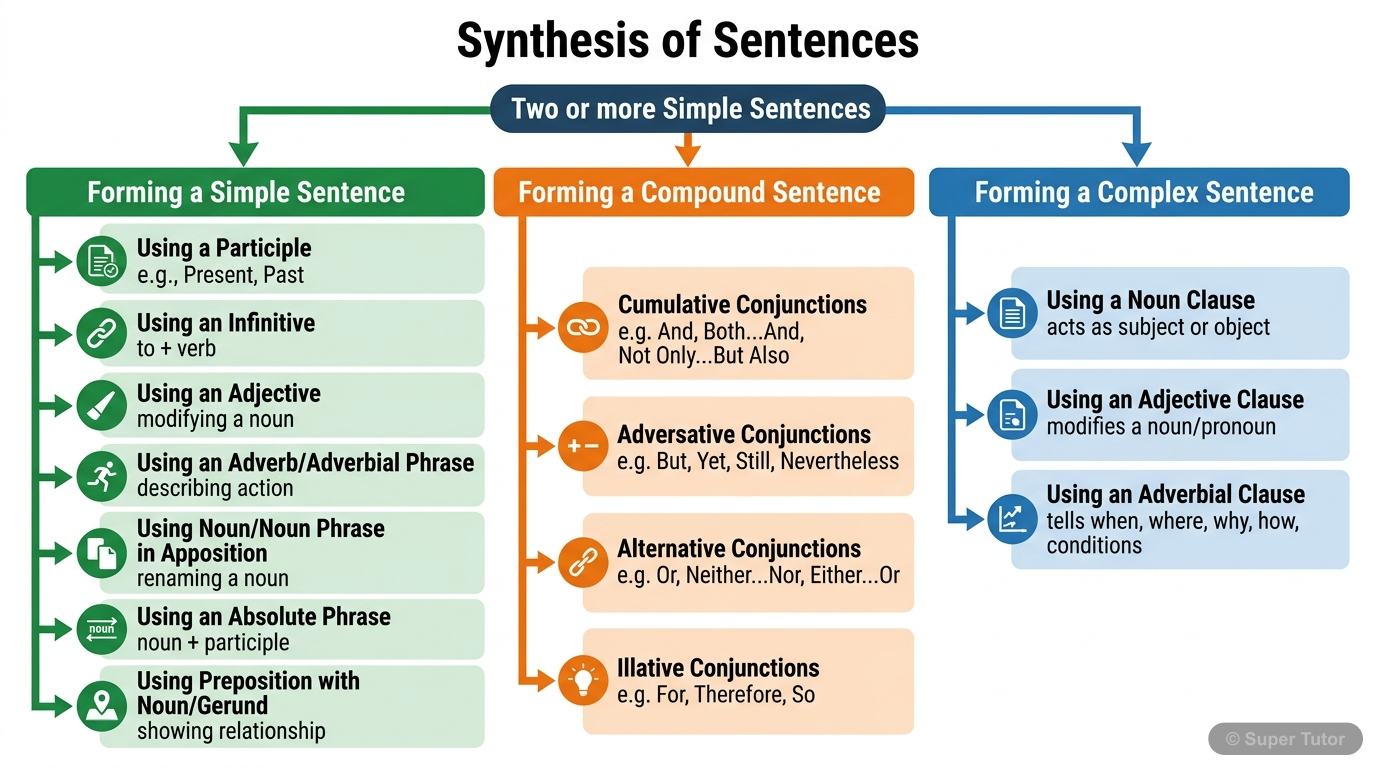
Synthesis of sentences means combining two or more sentences into one new sentence. The new sentence may be simple, compound, or complex. The main idea of the chapter is that sentence combination must preserve correct grammar, especially the use of finite verbs and conjunctions. A simple sentence mu
Key Concepts
It is the process of combining
It is the process of combining two or more sentences into a new sentence.
A simple sentence has one finite
A simple sentence has one finite verb. When several sentences are combined into one simple sentence, the result must still have only one finite verb.
A compound sentence is formed by
A compound sentence is formed by joining two independent clauses using coordinating conjunctions such as for, therefore, so, and, both...and, not only
A complex sentence is formed by
A complex sentence is formed by joining simple sentences using a noun clause, adjective clause, or adverbial clause.
A phrase has no finite verb
A phrase has no finite verb and cannot stand on its own.
Learning Objectives
- Understand the meaning of synthesis of sentences
- Distinguish between phrase, sentence, and clause
- Form simple sentences from two or more sentences using different methods
- Form compound sentences using coordinating conjunctions
- Form complex sentences using noun clauses, adjective clauses, and adverbial clauses
Frequently Asked Questions
What are the important topics in Synthesis of Sentences for ICSE Class 10 English Language - Archer?
How to score full marks in Synthesis of Sentences — ICSE Class 10 English Language - Archer?
Sources & Official References
Content is aligned to the official syllabus. Refer to the board website for the latest curriculum.
More resources for Synthesis of Sentences
Practice Quiz
Test yourself with a quick quiz
Important Questions
Practice with board exam-style questions
Revision Notes
Key points for last-minute revision
Formula Sheet
All formulas in one place
Concept Maps
See how topics connect visually
Study Plan
Step-by-step plan to ace this chapter
Flashcards
Quick-fire cards for active recall
Syllabus
What topics to cover
NCERT Solutions
Every textbook question solved step by step
For serious students
Get the full Synthesis of Sentences chapter — for free.
Quizzes, flashcards, AI doubt-solver and a step-by-step study plan for ICSE Class 10 English Language - Archer.