Narrative Composition
ICSE · Class 10 · English Language - Archer
Practice quiz for Narrative Composition — ICSE Class 10 English Language - Archer. MCQs and questions with answers to test your preparation.
Interactive on Super Tutor
Studying Narrative Composition? Get the full interactive chapter.
Quizzes, flashcards, AI doubt-solver and a step-by-step study plan — built for practice quiz and more.
1,000+ Class 10 students started this chapter today
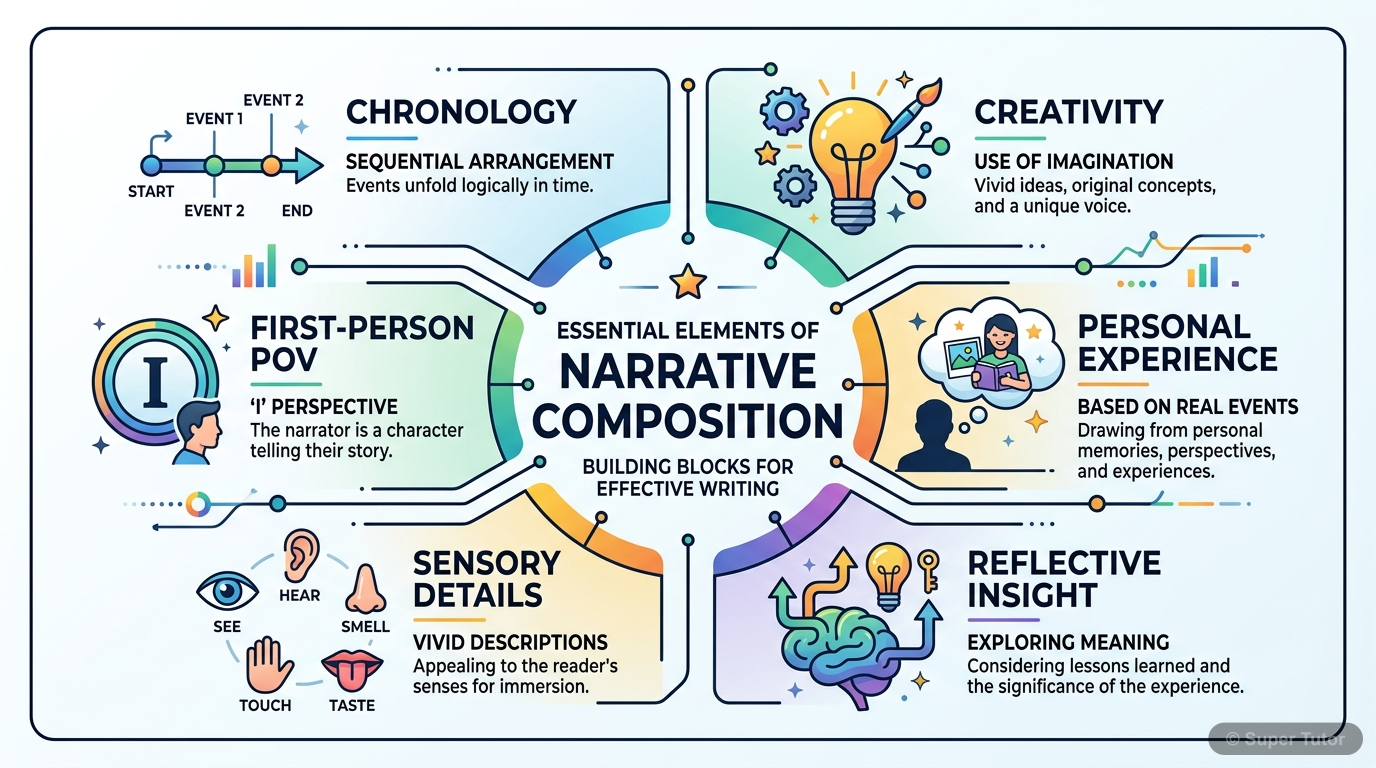
Super Tutor has 5+ illustrations like this for Narrative Composition alone — flashcards, concept maps, and step-by-step visuals.
See them allQuick Quiz: Narrative Composition
0/4Tap an answer to check it instantly. No sign-up needed for these 4.
What is the primary purpose of a hook in narrative composition?
In which part of a narrative does the tension reach its highest point?
Which famous opening line is mentioned in the chapter as an example of grabbing attention?
What should you do first when writing a narrative composition?
Sample Questions
In the zoo story example, what did the narrator initially mistake the black swan's hiss for?
Show answer
A cobra
Step 1: In the zoo story, when the narrator heard a loud hiss, he thought it was a cobra. Step 2: The text specifically states: 'I was sure it was nothing less than a cobra and I would not make it out alive.' Step 3: This shows how fear and panic can make us imagine the worst possible scenario. Step 4: The reality was much different - it was actually a protective black swan defending its cygnets. Step 5: This misunderstanding adds humor and teaches about not jumping to conclusions in dangerous situations.
Which part of the narrative usually moves the fastest according to the chapter?
Show answer
Rising Action
Step 1: The chapter states that 'the introduction moves the slowest and the rising action moves the fastest.' Step 2: Rising action is where events build up quickly toward the climax, creating momentum and excitement. Step 3: The fast pace during rising action helps maintain reader interest and builds tension. Step 4: The introduction moves slowly to establish setting and characters, while the climax is a single intense moment. Step 5: Understanding pace helps writers plan their narrative structure effectively.
What technique can be used to create excitement and build tension in a narrative?
Show answer
Flashbacks and flash-forwards
Step 1: The chapter mentions that 'you may use the technique of flashbacks and flash-forwards to create excitement and build up tension.' Step 2: Flashbacks reveal important past events that explain current situations. Step 3: Flash-forwards give hints about future events, creating suspense and anticipation. Step 4: These techniques add complexity and keep readers engaged by revealing information strategically. Step 5: The other options would actually make the narrative less engaging rather than more exciting.
According to the speech example, what was the topic the Junior Head Girl spoke about?
Show answer
Social media usage and mental health
Step 1: The sample narrative clearly states that the Junior Head Girl 'had been asked to speak about social media usage and mental health.' Step 2: This topic was chosen because it's relevant to students and affects their daily lives. Step 3: The narrator wanted to highlight how social media affects relationships in our lives. Step 4: This shows how narrative compositions can address contemporary and meaningful subjects. Step 5: The other options are not mentioned in this particular example story.
+41 more questions available
Practice AllFrequently Asked Questions
What are the important topics in Narrative Composition for ICSE Class 10 English Language - Archer?
How to score full marks in Narrative Composition — ICSE Class 10 English Language - Archer?
Sources & Official References
Content is aligned to the official syllabus. Refer to the board website for the latest curriculum.
More resources for Narrative Composition
Important Questions
Practice with board exam-style questions
Revision Notes
Key points for last-minute revision
Formula Sheet
All formulas in one place
Chapter Summary
Understand the chapter at a glance
Concept Maps
See how topics connect visually
Study Plan
Step-by-step plan to ace this chapter
Flashcards
Quick-fire cards for active recall
Syllabus
What topics to cover
NCERT Solutions
Every textbook question solved step by step
For serious students
Get the full Narrative Composition chapter — for free.
Quizzes, flashcards, AI doubt-solver and a step-by-step study plan for ICSE Class 10 English Language - Archer.