Argumentative Composition
ICSE · Class 10 · English Language - Archer
Practice quiz for Argumentative Composition — ICSE Class 10 English Language - Archer. MCQs and questions with answers to test your preparation.
Interactive on Super Tutor
Studying Argumentative Composition? Get the full interactive chapter.
Quizzes, flashcards, AI doubt-solver and a step-by-step study plan — built for practice quiz and more.
1,000+ Class 10 students started this chapter today
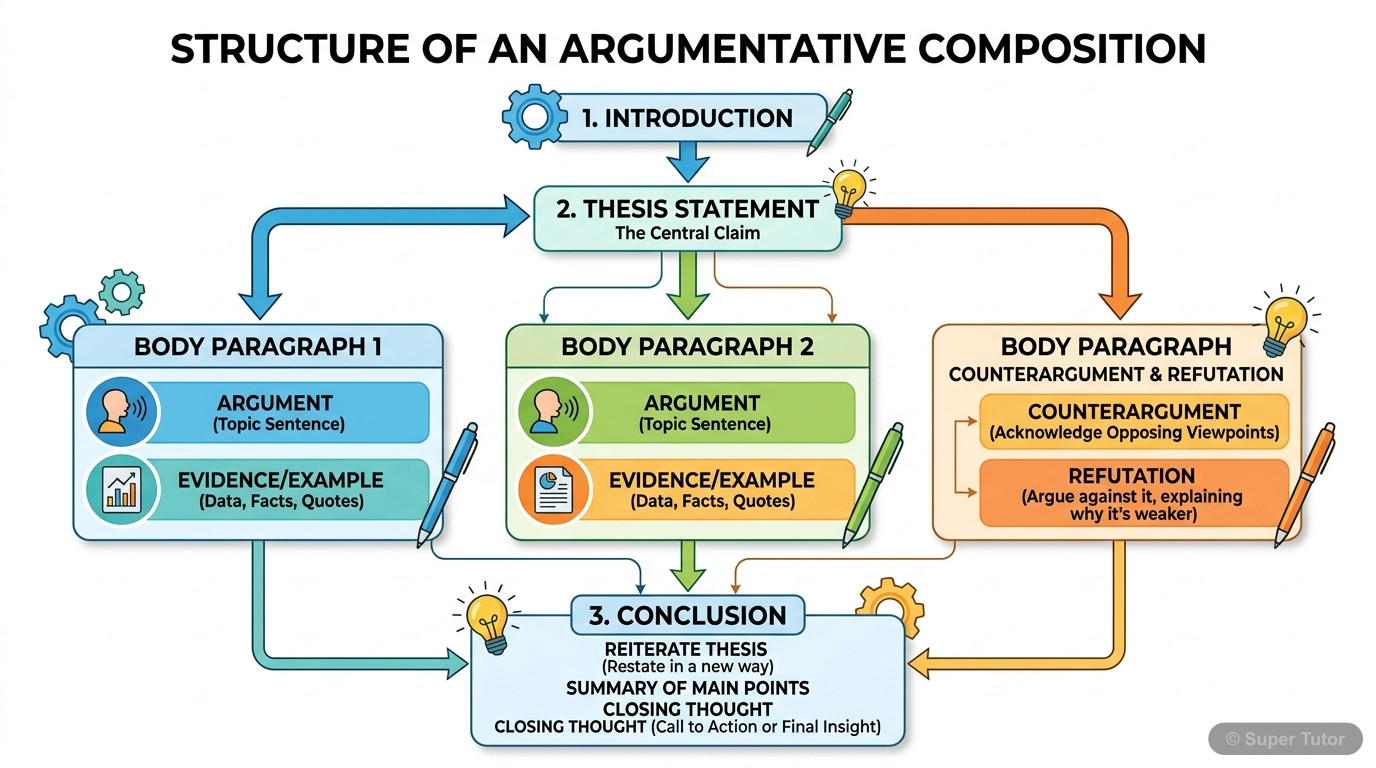
Super Tutor has 5+ illustrations like this for Argumentative Composition alone — flashcards, concept maps, and step-by-step visuals.
See them allQuick Quiz: Argumentative Composition
0/4Tap an answer to check it instantly. No sign-up needed for these 4.
What is the first step you should take before writing an argumentative composition?
According to the Five Es structure, what does 'Evocation' refer to?
Which linking word would be most appropriate to introduce your second argument?
What should you NOT do in the conclusion of an argumentative composition?
Sample Questions
Which of the following is an example of a refutation in argumentative writing?
Show answer
Some argue that stray dogs protect neighborhoods, but they bark all night and chase vehicles
A refutation acknowledges the opposing viewpoint and then counters it with your own argument. The correct option first presents the counterargument ('Some argue that stray dogs protect neighborhoods') and then refutes it ('but they bark all night and chase vehicles'). This shows you understand the opposing view but can argue against it. The other options are either simple statements of position or facts, not refutations of opposing arguments.
In the Five Es structure, what comes after 'Explanation'?
Show answer
Exposition
In the Five Es structure, the sequence is: Evocation (state your side), Explanation (define key terms), Exposition (give reasons for your stance), Example (provide supporting examples), and End (conclude). After explaining key terms in the 'Explanation' stage, you move to 'Exposition' where you present the reasons that support your argument. This logical flow ensures your argument builds systematically from position to definition to reasoning.
Which linking phrase would be most suitable for introducing an example?
Show answer
For instance
When introducing examples to support your arguments, phrases like 'For instance', 'Such as', 'An example of this', or 'Particularly' are most appropriate. 'For instance' clearly signals to the reader that you are about to provide a specific example that illustrates your point. 'In conclusion' is for endings, 'However' shows contrast, and 'Moreover' adds additional points rather than introducing examples.
What is the main purpose of using linking words in argumentative composition?
Show answer
To enable readers to follow the argument easily
Linking words serve as bridges between ideas, helping readers understand the logical flow of your argument. They signal relationships between sentences and paragraphs, whether you're adding information, showing contrast, providing examples, or concluding. Without proper linking words, arguments appear disjointed and confusing. Their primary function is clarity and coherence, not length, impression, or space-filling. Good linking words make your argument more persuasive by making it easier to follow.
+33 more questions available
Practice AllFrequently Asked Questions
What are the important topics in Argumentative Composition for ICSE Class 10 English Language - Archer?
How to score full marks in Argumentative Composition — ICSE Class 10 English Language - Archer?
Sources & Official References
Content is aligned to the official syllabus. Refer to the board website for the latest curriculum.
More resources for Argumentative Composition
Important Questions
Practice with board exam-style questions
Revision Notes
Key points for last-minute revision
Formula Sheet
All formulas in one place
Chapter Summary
Understand the chapter at a glance
Concept Maps
See how topics connect visually
Study Plan
Step-by-step plan to ace this chapter
Flashcards
Quick-fire cards for active recall
Syllabus
What topics to cover
NCERT Solutions
Every textbook question solved step by step
For serious students
Get the full Argumentative Composition chapter — for free.
Quizzes, flashcards, AI doubt-solver and a step-by-step study plan for ICSE Class 10 English Language - Archer.