Synthesis of Sentences
ICSE · Class 10 · English Language - Archer
Practice quiz for Synthesis of Sentences — ICSE Class 10 English Language - Archer. MCQs and questions with answers to test your preparation.
Interactive on Super Tutor
Studying Synthesis of Sentences? Get the full interactive chapter.
Quizzes, flashcards, AI doubt-solver and a step-by-step study plan — built for practice quiz and more.
1,000+ Class 10 students started this chapter today
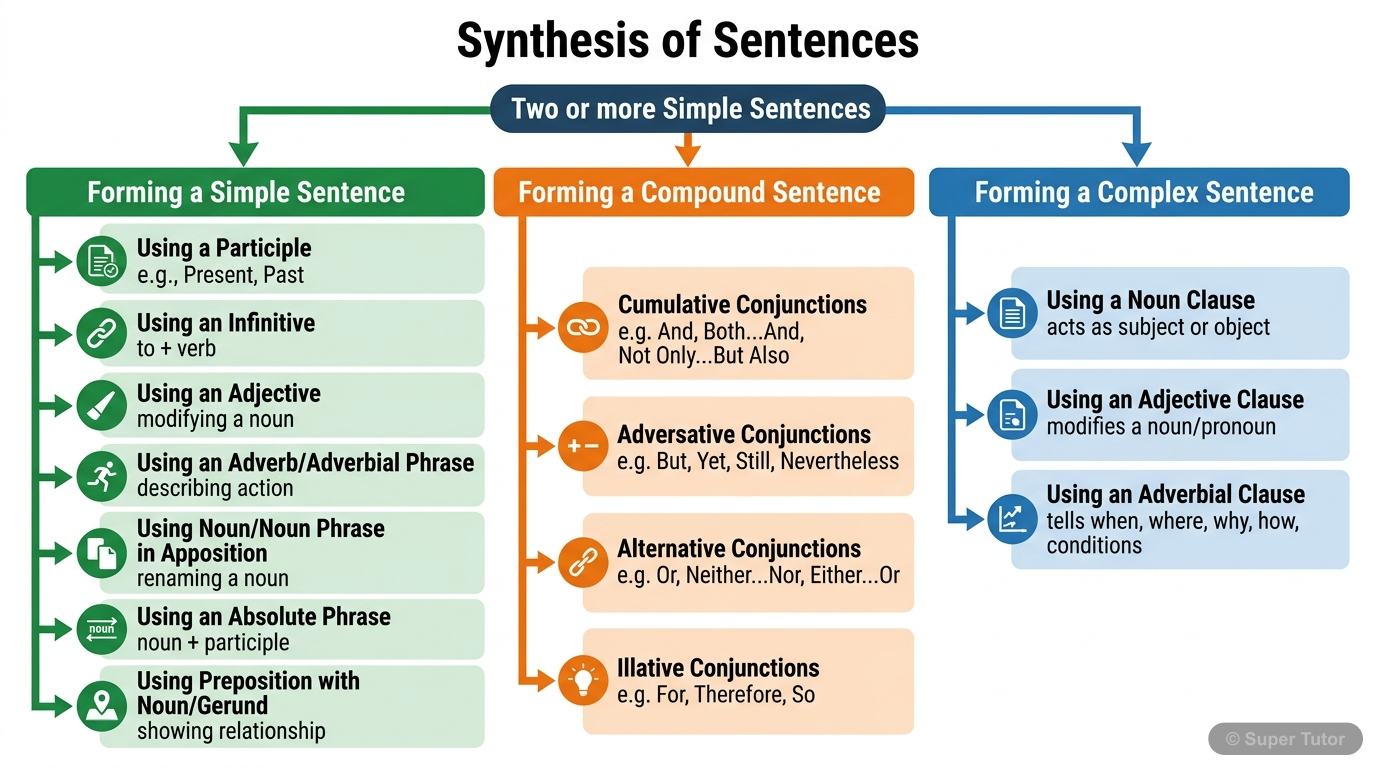
Learn better with visuals Super Tutor has hundreds of illustrations like this across every chapter — all free to try.
Get startedQuick Quiz: Synthesis of Sentences
0/4Tap an answer to check it instantly. No sign-up needed for these 4.
What is synthesis of sentences?
Combine these sentences using a participle: 'Raj opened the door. Raj saw his friend waiting.' Which is correct?
Which coordinating conjunction shows cause and effect relationship?
Combine using an infinitive: 'She studies hard. She wants to pass the exam.' Which is correct?
Sample Questions
What type of sentence is formed when we combine sentences using coordinating conjunctions?
Show answer
Compound sentence
Coordinating conjunctions (for, and, nor, but, or, yet, so) are used to join two independent clauses to form compound sentences. Each clause can stand alone as a complete sentence. Simple sentences have one clause, complex sentences have one independent and one dependent clause, and compound-complex sentences have multiple independent and at least one dependent clause.
Combine using an adjective: 'The teacher gave us homework. The homework was difficult.' Which is correct?
Show answer
The teacher gave us difficult homework.
When combining sentences using an adjective, we convert the descriptive sentence into an adjective that modifies the noun. 'The homework was difficult' becomes 'difficult homework'. This creates a simple sentence with one finite verb. Option A uses a coordinating conjunction, option C uses a relative pronoun for complex sentences, and option D uses a participle construction incorrectly.
Which subordinating conjunction is used to show contrast in complex sentences?
Show answer
although
The subordinating conjunction 'although' is used to show contrast or concession in complex sentences. It means 'in spite of the fact that'. For example: 'Although it was raining, we went for a walk.' 'Because' shows reason, 'when' shows time, and 'since' can show time or reason - but none of these show contrast like 'although' does.
What is a noun clause?
Show answer
A clause that acts as a noun in a sentence
A noun clause is a dependent clause that functions as a noun in a sentence. It can act as a subject, object, or complement. Noun clauses often begin with words like 'that', 'what', 'who', 'when', 'where', 'why', 'how', 'whether', or 'if'. Option A describes an adjective clause, option C describes an adverbial clause, and option D specifically describes adverbial clauses of time and place.
+40 more questions available
Practice AllFrequently Asked Questions
What are the important topics in Synthesis of Sentences for ICSE Class 10 English Language - Archer?
How to score full marks in Synthesis of Sentences — ICSE Class 10 English Language - Archer?
Sources & Official References
Content is aligned to the official syllabus. Refer to the board website for the latest curriculum.
More resources for Synthesis of Sentences
Important Questions
Practice with board exam-style questions
Revision Notes
Key points for last-minute revision
Formula Sheet
All formulas in one place
Chapter Summary
Understand the chapter at a glance
Concept Maps
See how topics connect visually
Study Plan
Step-by-step plan to ace this chapter
Flashcards
Quick-fire cards for active recall
Syllabus
What topics to cover
NCERT Solutions
Every textbook question solved step by step
For serious students
Get the full Synthesis of Sentences chapter — for free.
Quizzes, flashcards, AI doubt-solver and a step-by-step study plan for ICSE Class 10 English Language - Archer.