The Boy who Broke the Bank
ICSE · Class 10 · English Literature-Treasure Chest ( Poems and Short Stories)
Summary of The Boy who Broke the Bank for ICSE Class 10 English Literature-Treasure Chest ( Poems and Short Stories). Key concepts, important points, and chapter overview.
Interactive on Super Tutor
Studying The Boy who Broke the Bank? Get the full interactive chapter.
Quizzes, flashcards, AI doubt-solver and a step-by-step study plan — built for chapter summary and more.
1,000+ Class 10 students started this chapter today
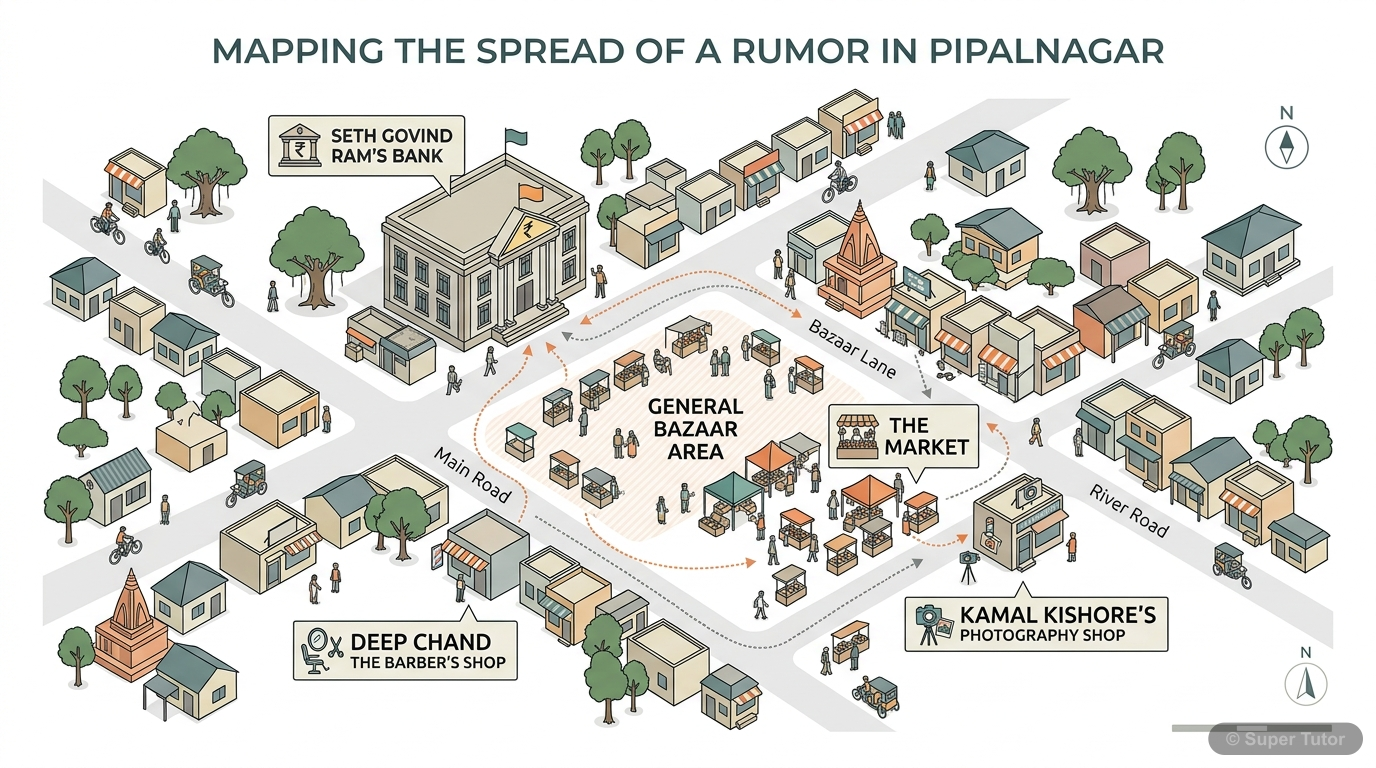
Super Tutor has 7+ illustrations like this for The Boy who Broke the Bank alone — flashcards, concept maps, and step-by-step visuals.
See them allOverview
The story is a humorous satire about how a small, innocent complaint grows into a full-scale bank panic. Nathu, a sweeper-boy at Seth Govind Ram's bank in Pipalnagar, is upset because his salary has not been paid by the 20th of the month. His words are overheard, repeated carelessly, and distorted a
Key Concepts
The story starts with Nathu's fair
The story starts with Nathu's fair complaint about his unpaid salary. He is not spreading a false story; he is simply grumbling about a real problem.
The complaint moves from Nathu
The complaint moves from Nathu to Sitaram, then to Mrs. Srivastava, Mrs. Bhushan, Mr. Bhushan, Kamal Kishore, Deep Chand, the injured customer, and fi
Each person adds fear
Each person adds fear, assumption, or exaggeration. The message changes from unpaid salary to bankruptcy and then to complete collapse.
Once the injured customer cries out
Once the injured customer cries out that 'The bird has flown!', people rush to protect their money. Fear spreads faster than facts.
The person who started the whole
The person who started the whole incident does not know it. Nathu keeps sweeping the bank without realising that his complaint caused the panic.
Learning Objectives
- To understand how a rumour grows when passed from person to person
- To identify the role of each character in the rumour chain
- To explain the theme of the destructive power of rumours
- To notice the story's humour, irony, and satire
- To recall how fear spreads in a small town and creates mass panic
Frequently Asked Questions
What are the important topics in The Boy who Broke the Bank for ICSE Class 10 English Literature-Treasure Chest ( Poems and Short Stories)?
How to score full marks in The Boy who Broke the Bank — ICSE Class 10 English Literature-Treasure Chest ( Poems and Short Stories)?
Sources & Official References
Content is aligned to the official syllabus. Refer to the board website for the latest curriculum.
More resources for The Boy who Broke the Bank
Practice Quiz
Test yourself with a quick quiz
Important Questions
Practice with board exam-style questions
Revision Notes
Key points for last-minute revision
Formula Sheet
All formulas in one place
Concept Maps
See how topics connect visually
Study Plan
Step-by-step plan to ace this chapter
Flashcards
Quick-fire cards for active recall
Syllabus
What topics to cover
NCERT Solutions
Every textbook question solved step by step
For serious students
Get the full The Boy who Broke the Bank chapter — for free.
Quizzes, flashcards, AI doubt-solver and a step-by-step study plan for ICSE Class 10 English Literature-Treasure Chest ( Poems and Short Stories).