Force — Chapter Summary
ICSE · Class 10 · Physics
Summary of Force for ICSE Class 10 Physics. Key concepts: Force is a push or pull, These forces act only when and These forces act without.
Interactive on Super Tutor
Studying Force? Get the full interactive chapter.
Quizzes, flashcards, AI doubt-solver and a step-by-step study plan — built for chapter summary and more.
Free trial, no card needed.
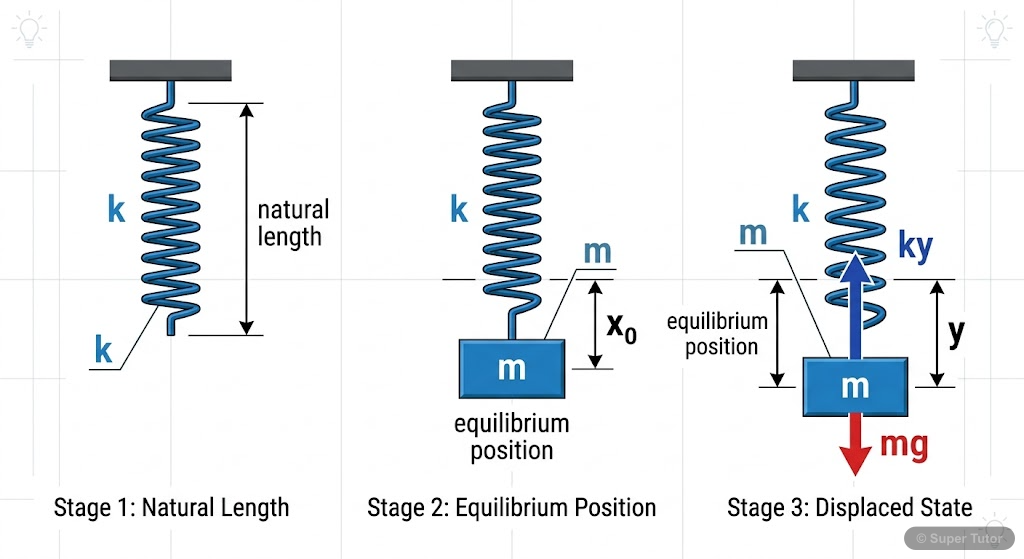
One of 22 illustrations for Force in Super Tutor — alongside flashcards, concept maps and practice questions.
See them allOverview
Force is a push or pull applied on a body by another body to change its state, size, or shape. It can change motion, stop motion, start motion, or deform an object. Force is measured in newton in the SI system and dyne in the CGS system. Force is the basic idea behind motion, turning effect, equilib
Key Concepts
Force is a push or pull
Force is a push or pull that can change the state, size, or shape of a body. It may change dimensions by stretching, compressing, or deforming an obje
These forces act only when objects
These forces act only when objects are in physical contact. Examples include frictional force, normal reaction force, tension in a string, force in a
These forces act without physical contact
These forces act without physical contact between bodies. Gravitational, electrostatic, and magnetic forces are non-contact forces. They follow invers
The CGS unit of force
The CGS unit of force is dyne and the SI unit is newton. One dyne gives an acceleration of 1 cm/s^2 to 1 g mass. One newton gives an acceleration of 1
A body remains in its present
A body remains in its present state until an external force acts on it. This is also called the law of inertia.
Learning Objectives
- Understand the meaning of force and its effects on bodies
- Differentiate between contact and non-contact forces
- Learn the SI, CGS, and gravitational units of force
- Understand Newton's three laws of motion and the equations of motion
- Study moment of force, couple, and equilibrium
Frequently Asked Questions
What are the important topics in Force for ICSE Class 10 Physics?
How should I revise Force for the ICSE Class 10 board exam?
Sources & Official References
Content is aligned to the official syllabus. Refer to the board website for the latest curriculum.
More resources for Force
Practice Quiz
Test yourself with a quick quiz
Important Questions
Exam-style questions with answers
Revision Notes
Key points for last-minute revision
Formula Sheet
The chapter's formulas in one place
Concept Maps
See how topics connect
Study Plan
Step-by-step plan for this chapter
Flashcards
Quick-fire cards for active recall
Syllabus
What topics to cover
For serious students
Get the full Force chapter — start free.
Quizzes, flashcards, an AI doubt solver and a study plan for ICSE Class 10 Physics. Free to start, no card needed.