Calorimetry — Chapter Summary
ICSE · Class 10 · Physics
Summary of Calorimetry for ICSE Class 10 Physics. Key concepts: Heat is the energy due, Temperature is the degree and One calorie is the heat.
Interactive on Super Tutor
Studying Calorimetry? Get the full interactive chapter.
Quizzes, flashcards, AI doubt-solver and a step-by-step study plan — built for chapter summary and more.
Free trial, no card needed.
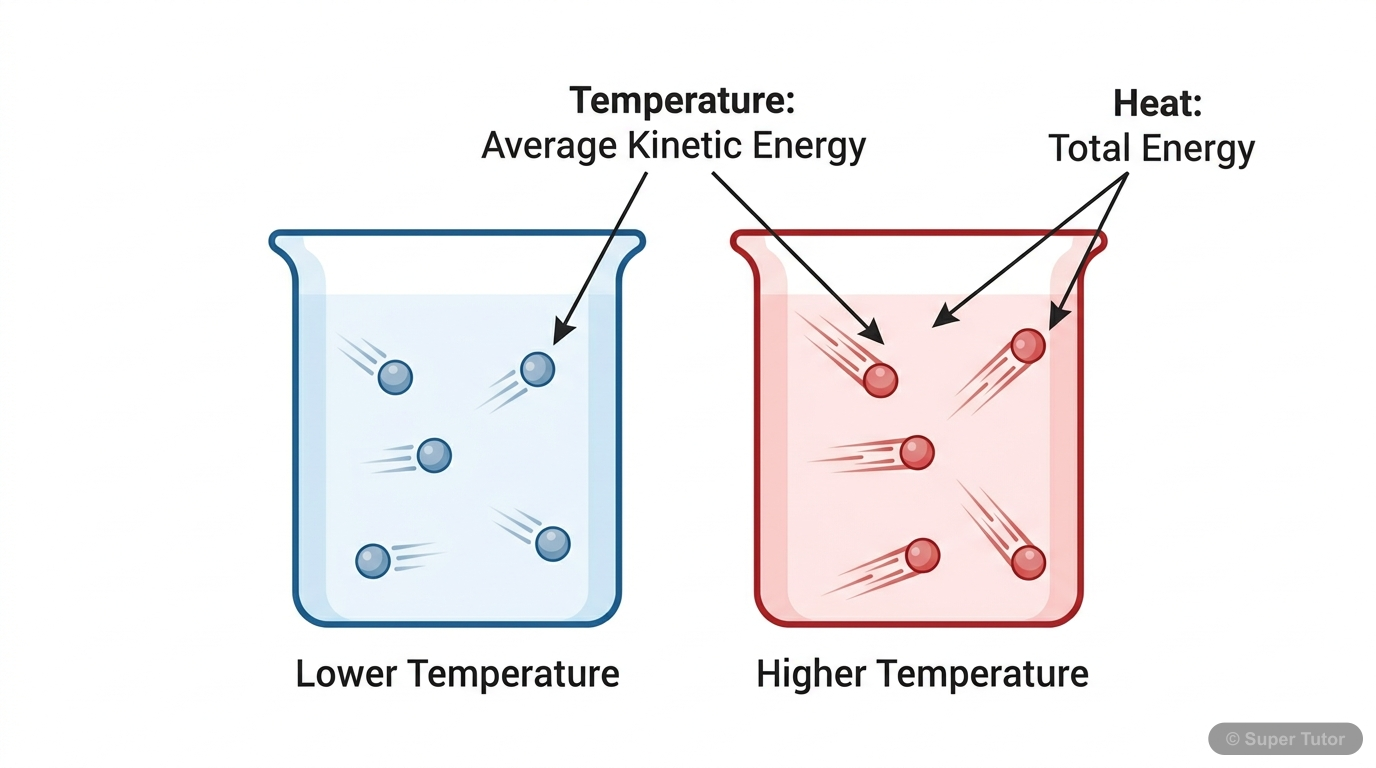
One of 13 illustrations for Calorimetry in Super Tutor — alongside flashcards, concept maps and practice questions.
See them allOverview
Calorimetry is the branch of physics that deals with the measurement of heat energy. Heat is energy in transit due to temperature difference, and it flows from a body at higher temperature to a body at lower temperature. Temperature measures the average internal kinetic energy of molecules, so it de
Key Concepts
Heat is the energy due
Heat is the energy due to the kinetic state of matter. It is energy in transit caused by a temperature difference and flows naturally from a hotter bo
Temperature is the degree of hotness
Temperature is the degree of hotness or coldness of a body. It measures the average internal kinetic energy of molecules and decides the direction of
One calorie is the heat required
One calorie is the heat required to raise the temperature of 1 g of water from 14.5°C to 15.5°C. One kilocalorie is the heat required to raise the tem
Heat capacity is the heat required
Heat capacity is the heat required to raise the temperature of the whole mass of a body by 1°C or 1 K. It depends on mass and material. Its formula is
Specific heat capacity is the heat
Specific heat capacity is the heat required to raise the temperature of unit mass of a body by 1°C or 1 K. It depends only on the material. Its formul
Learning Objectives
- Understand heat, temperature, and calorimetry as basic thermal ideas
- Distinguish between heat capacity and specific heat capacity
- Use Q = mcΔt for heat calculations
- Apply the principle of calorimetry to mixtures
- Understand the construction and use of a calorimeter
Frequently Asked Questions
What are the important topics in Calorimetry for ICSE Class 10 Physics?
How should I revise Calorimetry for the ICSE Class 10 board exam?
Sources & Official References
Content is aligned to the official syllabus. Refer to the board website for the latest curriculum.
More resources for Calorimetry
Practice Quiz
Test yourself with a quick quiz
Important Questions
Exam-style questions with answers
Revision Notes
Key points for last-minute revision
Formula Sheet
The chapter's formulas in one place
Concept Maps
See how topics connect
Study Plan
Step-by-step plan for this chapter
Flashcards
Quick-fire cards for active recall
Syllabus
What topics to cover
For serious students
Get the full Calorimetry chapter — start free.
Quizzes, flashcards, an AI doubt solver and a study plan for ICSE Class 10 Physics. Free to start, no card needed.