Refraction through a lens — Chapter Summary
ICSE · Class 10 · Physics
Summary of Refraction through a lens for ICSE Class 10 Physics. Key concepts: A lens is a transparent, The optical centre is and For a convex lens.
Interactive on Super Tutor
Studying Refraction through a lens? Get the full interactive chapter.
Quizzes, flashcards, AI doubt-solver and a step-by-step study plan — built for chapter summary and more.
Free trial, no card needed.
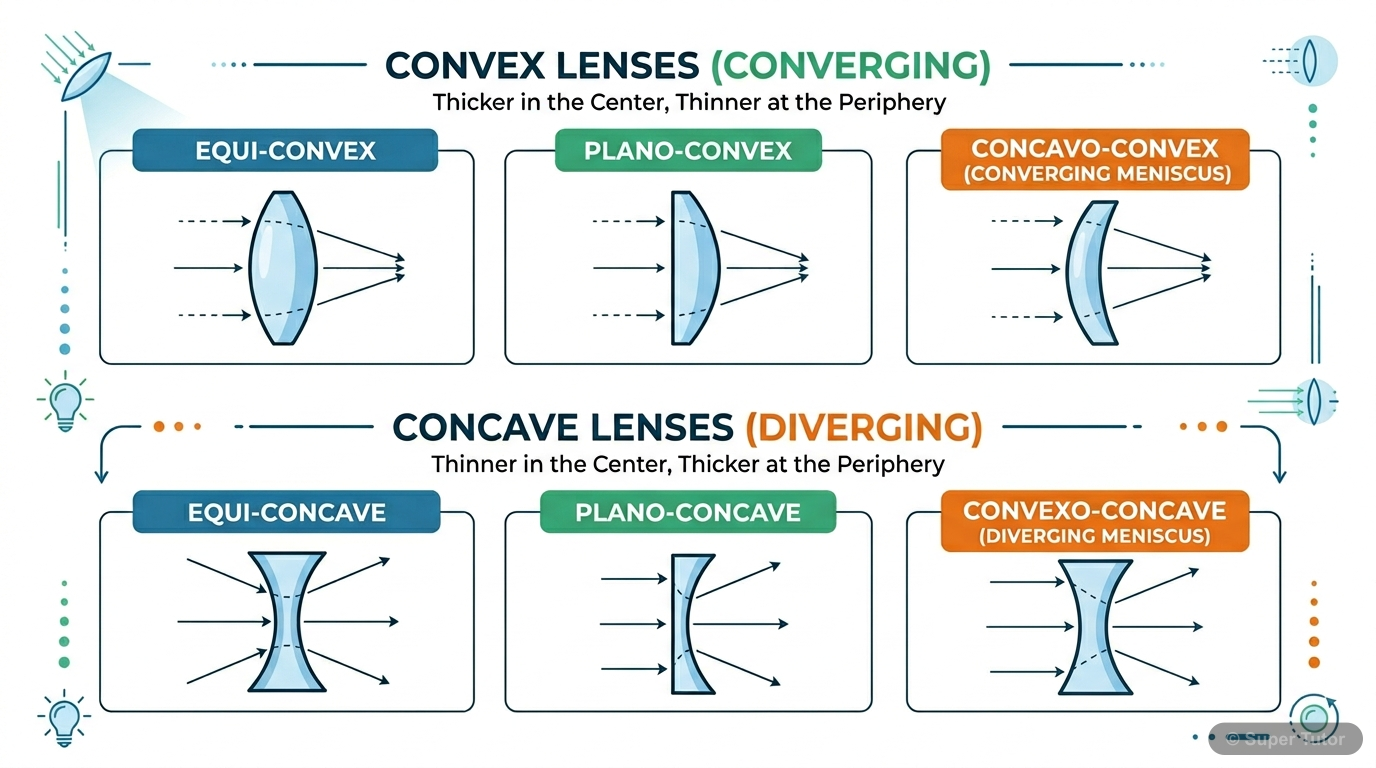
One of 22 illustrations for Refraction through a lens in Super Tutor — alongside flashcards, concept maps and practice questions.
See them allOverview
A lens is a transparent homogeneous refracting medium bounded by either two curved surfaces or one plane surface and one curved surface. A convex lens is thicker in the middle and thinner at the periphery, so it converges light and has a real focus. A concave lens is thinner in the middle and thicke
Key Concepts
A lens is a transparent homogeneous
A lens is a transparent homogeneous refracting medium bounded by either two curved surfaces or one plane surface and one curved surface. Convex lenses
The optical centre is the point
The optical centre is the point through which a ray passes without deviation in a thin lens. The principal axis is the line passing through the optica
For a convex lens
For a convex lens, the first focal point is the point from where a divergent beam becomes parallel after refraction, and the second focal point is whe
Focal length is the distance between
Focal length is the distance between the optical centre and the main focus. Usually, when focus is mentioned, the second focal point is meant. Convex
A convex lens can form real
A convex lens can form real and virtual images. For an object at infinity, the image is real, inverted, and diminished at focus. For an object at 2F1,
Learning Objectives
- Identify convex and concave lenses and their types
- Understand optical centre, principal axis, focal points, and focal length
- Explain image formation by convex and concave lenses using ray behaviour
- Apply sign convention correctly for object distance, image distance, and focal length
- Use the lens formula to solve numerical problems
Frequently Asked Questions
What are the important topics in Refraction through a lens for ICSE Class 10 Physics?
How should I revise Refraction through a lens for the ICSE Class 10 board exam?
Sources & Official References
Content is aligned to the official syllabus. Refer to the board website for the latest curriculum.
More resources for Refraction through a lens
For serious students
Get the full Refraction through a lens chapter — start free.
Quizzes, flashcards, an AI doubt solver and a study plan for ICSE Class 10 Physics. Free to start, no card needed.